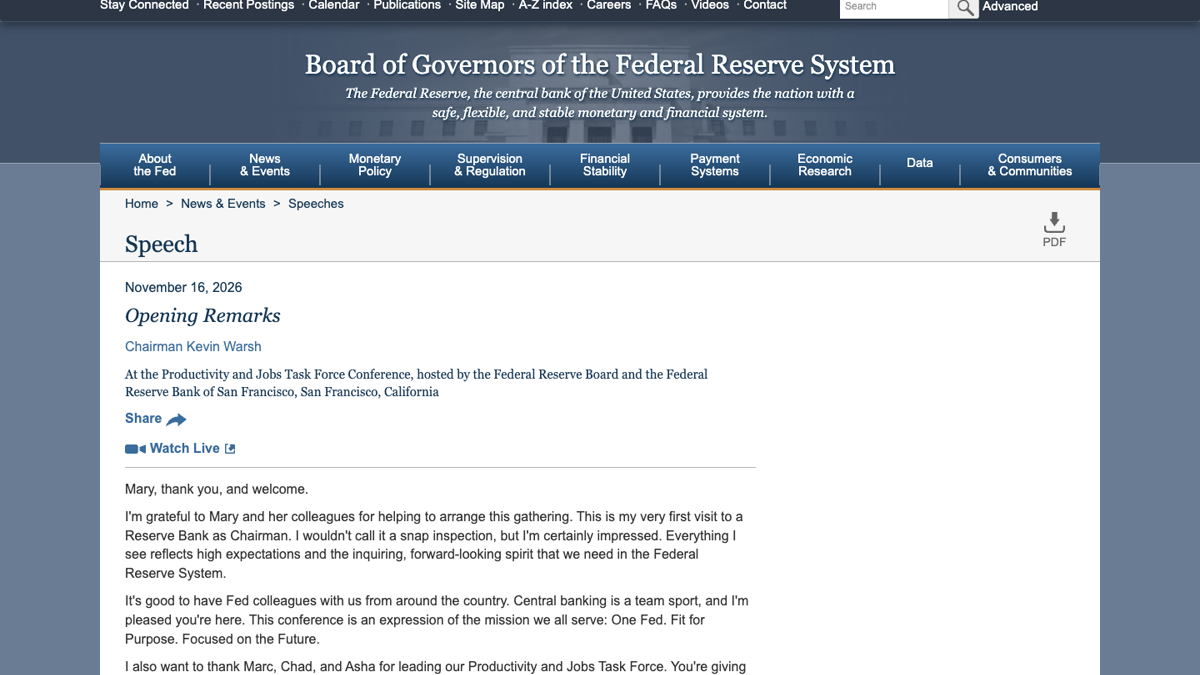


On November 16, Federal Reserve Chairman Kevin Warsh proposed in San Francisco that Fed staff have begun using models to simulate several possible outcomes for the economy under "super intelligence." Among the three scenarios, one starts with a weakening of expected returns and a decline in stock valuations.
These remarks were made in the opening speech of a meeting on productivity and employment, co-organized by the Federal Reserve Board of Governors and the San Francisco Federal Reserve. Walsh stated that this was his first visit to a regional federal reserve since taking on the role of chairman, and that this working group is one of five groups he has convened.
The three paths in the employee model
Wash emphasized that these are merely illustrative scenarios used for discussion, generated by the council staff using a stylized model framework, and that the most accurate results are likely not to be among them. In the first scenario, the benefits brought about by increased productivity are widely shared between workers and capital owners, with actual GDP growth rates consistently exceeding the long-term average, and the United States maintains near-full employment.
In the second scenario, the growth rate of GDP is also higher than the long-term average. However, some jobs will be replaced by technology rather than supplemented. The combination of automation and labor market frictions could push the unemployment rate to levels that do not correspond to full employment. Here, growth and employment diverge.
The third scenario is disheartening due to superintelligence. After a large amount of capital investment and a rise in the stock market, expected returns weaken, stock valuations fall, the economy slows down, and there is a more noticeable increase in unemployment rates. The economy will eventually recover, but the productivity gains that were initially anticipated will not be achieved.
A List of Questions for Policy Makers
Wash did not draw any policy conclusions. Instead, he listed the following questions: Whether total factor productivity will increase, whether the widespread adoption of specialized knowledge can significantly improve living standards, when the wave of change will begin and when it will subside, whether the United States will experience these changes earlier and more rapidly than other countries, and whether competitors might take preemptive actions to harm the U.S. economy.
He first described the changes that are taking place: A few years ago, it was like a fantasy to be able to find an almost all-knowing expert at any time in one's pocket, but now the marginal cost of satisfying curiosity is rapidly declining, even approaching zero. He then used economic literature to explain the underlying reasons. According to the estimates he cited, since the 1930s, research investment has increased by more than 20 times, yet research productivity has decreased even more; the United States has seen relatively strong productivity growth in recent quarters, but there has not yet been a decisive structural breakthrough. Only if super intelligence can accelerate the creation of new ideas is it possible for growth to be maintained at significantly higher levels in the long term.
The reason he gave is that once an idea is discovered, using it hardly incurs any cost, and one person’s use does not prevent others from using it as well. Internal combustion engines and electricity have led to decades of subsequent innovation, yet they have not automated the act of “generating ideas” itself; superintelligence may be able to change the methods and speed of innovation. He also mentioned that the slowdown in population growth once caused many economists to worry about a “long-term stagnation,” and this technology could rewrite that assessment.
He said that the Federal Reserve officials attending the meeting are not futurists, nor do they intend to predict the next steps of technology; their task is to make emergency plans. The faster the world changes, the more important this becomes. The section on risks is brief but specific: superintelligence can also empower bad actors, and the Federal Reserve is particularly concerned about the potential vulnerabilities in critical infrastructure. He also mentioned that machines can accumulate and even surpass human knowledge, but humans must remain the ultimate decision-makers.
There are also clear expressions of stance in the speech. Walsh mentioned economist Mundell's theory about the United States rising to become a superpower in the 20th century, and then asked rhetorically: Can one be a superpower without super intelligence? He said that he does not make predictions, but he is “not entirely neutral” regarding America's leading position during that period.
The reminder for positions stays at the situational level.
The speech only mentioned one thing regarding monetary policy: the large-scale adoption of this technology will have a significant impact on the economy and will have important implications for monetary policy in the future. The role of the Federal Reserve is neither to advocate nor to oppose it, and the speech did not mention the interest rate path.
For readers who hold a large position in concept stocks of AI and regard the narrative around AI as a source of risk appetite in the crypto market, it is worth remembering the trigger chain for the third scenario: first, there is capital investment and an increase in stock prices; then, expected returns weaken, leading to a decline in valuations; this in turn affects employment. This downward path has been publicly described by the Federal Reserve Chairman, who did not provide any probabilities, but central banks have already listed a decline in AI valuations as a situation that needs to be prepared for in advance.
Wash said that over time, he expects to see more clarity. Following this meeting, the possibility of AI leading to a decline in valuations is already one of the scenarios being assessed by the Federal Reserve staff.