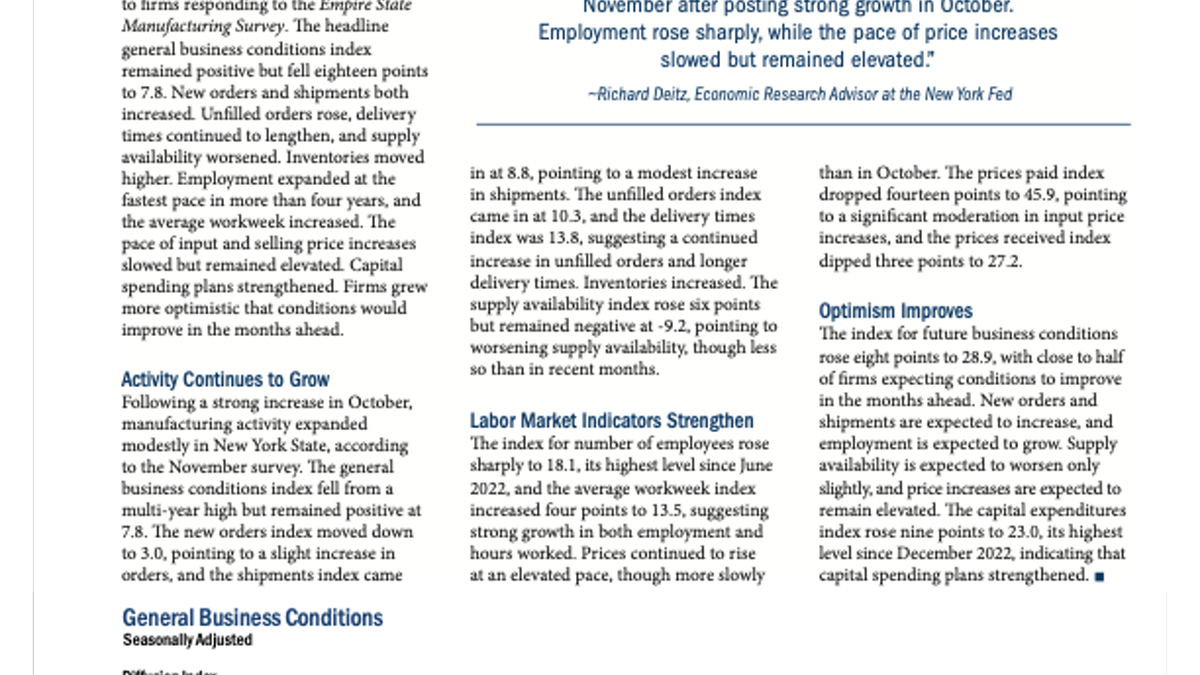


The manufacturing survey released by the Federal Reserve of New York on November 16 showed that the overall business conditions index fell from 25.5 in October to 7.8, a decline of nearly 18 points. In the same survey, the employee count index rose to 18.1, the highest reading since June 2022.
The responses for this Empire State Manufacturing Survey were collected from November 2nd to 9th, targeting manufacturing enterprises in New York State. A positive index indicates that more companies reported improvement than those that reported deterioration. The index score of 25.5 in October was a multi-year high, so the decline in November represents a return from that high level. In November, 31.0% of companies said their operating conditions had improved, while 23.2% said they had worsened; in October, these proportions were 44.4% and 18.9%, respectively.
Orders are cooling down, but the number of staff is increasing.
The most significant decline was seen in orders. The new order index dropped from 23.2 to 3.0, a decrease of 20.2 points, nearly coming to a standstill; the shipment index fell from 13.1 to 8.8. The outstanding orders index remained at 10.3, and the delivery time index at 13.8, indicating that the backlog of orders is still increasing, and deliveries are still slowing down, although the pace is slower than in October.
The direction of employment is the opposite. The employee count index rose from 10.3 to 18.1, with 21.5% of companies reporting increases in staff, while only 3.4% reported layoffs; the average working week index increased by 4 points to 13.5. Even as order growth has almost come to a halt, companies are still hiring and forcing their employees to work overtime, possibly to process backlogged orders from before. The survey itself did not ask companies for reasons for this.
The supply side has not yet recovered. The supply availability index has risen by 6 points, but it remains negative at -9.2, indicating that more companies are facing tighter supplies, although to a lesser extent than in the past few months. The inventory index is 9.2, and inventories continue to increase.
The survey page also indicates that the data has just undergone an annual benchmark revision, and some historical data has been adjusted according to the new seasonal factors. When comparing the figures for October from previous reports with this time, the revised values published in this period should be used as the reference. The October figures cited in this article all come from the November report.
Fewer companies are raising prices, and there are none that are lowering prices.
Prices are the most sensitive set of figures to interest rates in this report. The Payment Price Index fell from 59.5 to 45.9, a decrease of 13.6 points; in October, 60.5% of companies reported an increase in input costs, which dropped to 45.9% in November. The Charging Price Index decreased from 30.6 to 27.2, with 27.2% of companies raising their selling prices.
Another detail is that the proportion of companies reporting a “price decrease” in both price indicators is 0.0%. There are fewer companies raising prices, and no companies are lowering prices. Richard Deitz, an economic research advisor at the Federal Reserve Bank of New York, commented that the pace of price increases has slowed down, but they are still at a high level.
Enterprise forecasts for future prices further indicate that pressures remain. In expectations for six months from now, the payment price index is 66.7, slightly lower than 70.9 in October, and 70% of enterprises anticipate that costs will continue to rise; the expected collection price has dropped from 48.0 to 41.2, with fewer companies planning to raise prices. Costs are still rising while selling prices are increasing more slowly, which may put pressure on profit margins. The survey did not directly ask about profits.
Enterprises are more optimistic about the next few months.
Forward-looking indicators are improving. The Future Business Conditions Index has risen by 8 points to 28.9, with nearly half of the companies expecting conditions to improve in the coming months; the Capital Expenditure Index has increased by 9 points to 23.0, the highest level since December 2022. Companies expect orders and shipments to increase, employment to continue growing, and price increases to remain relatively high.
There are also signs of cooling in the forward-looking sub-indicators. The expected index for future delivery times has dropped from 14.0 to 2.3, the expected future inventory has decreased from 9.3 to 4.6, and the expected future employment has fallen from 19.5 to 16.8. The expected index for new orders in the future is 24.5, slightly higher than October's 22.4. Businesses are more optimistic about the overall outlook, and their expectations for further lengthening of the supply chain and large-scale inventory replenishment are weakening.
This survey only covers manufacturing in New York State, and the sample size is limited; it may not always be in sync with national industrial output data. For readers interested in the Federal Reserve's next moves, they can use the Payment Price Index as a benchmark: 59.5 in October, 45.9 in November. If it continues to decline next month, then there will be a sustained alleviation of input cost pressures.
Changes that can be confirmed as of November are: the growth rate of orders has significantly slowed down, yet companies' willingness to hire is at its strongest in over four years. The number of companies raising prices has decreased by nearly 15 percentage points compared to last month.