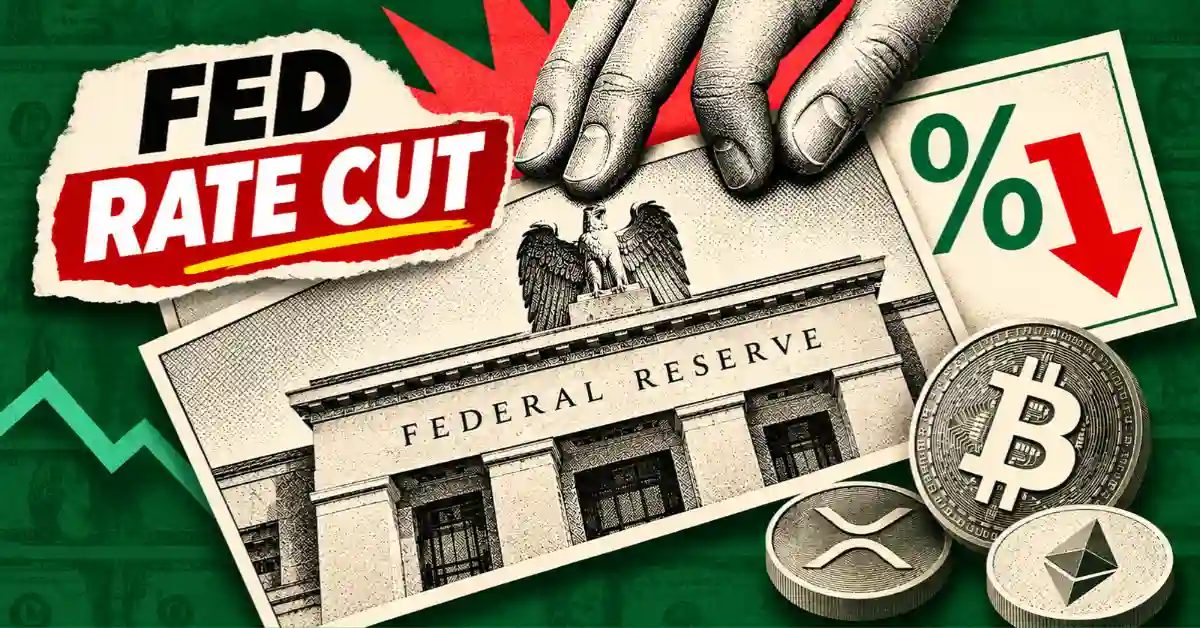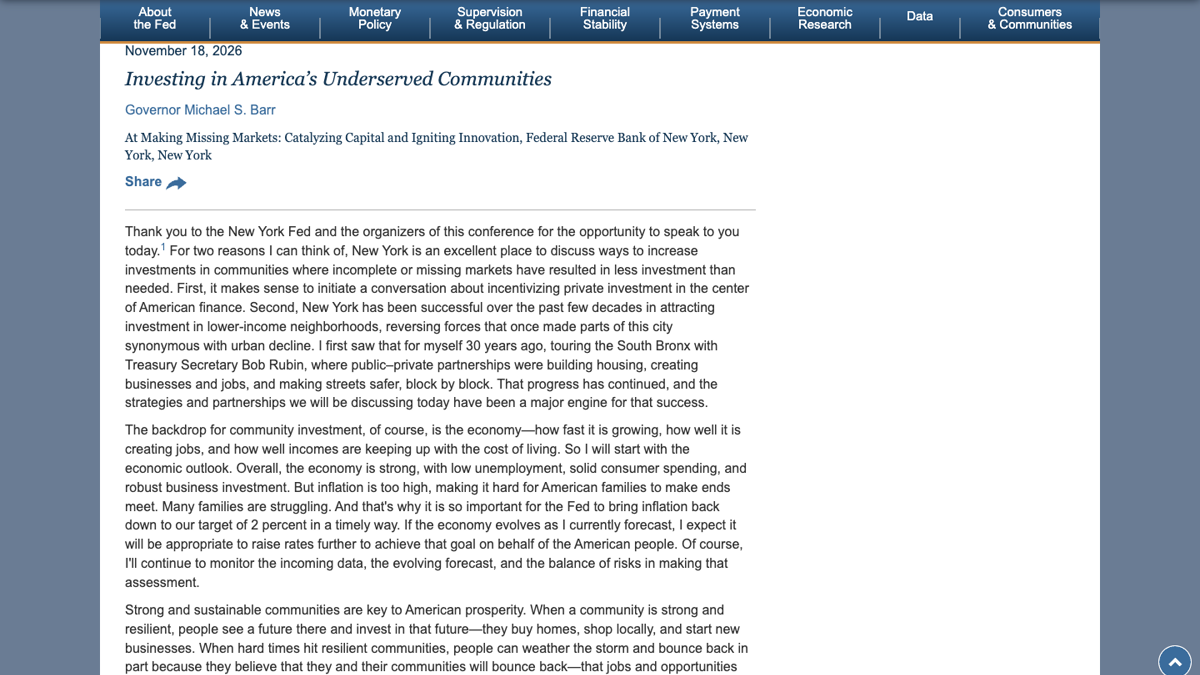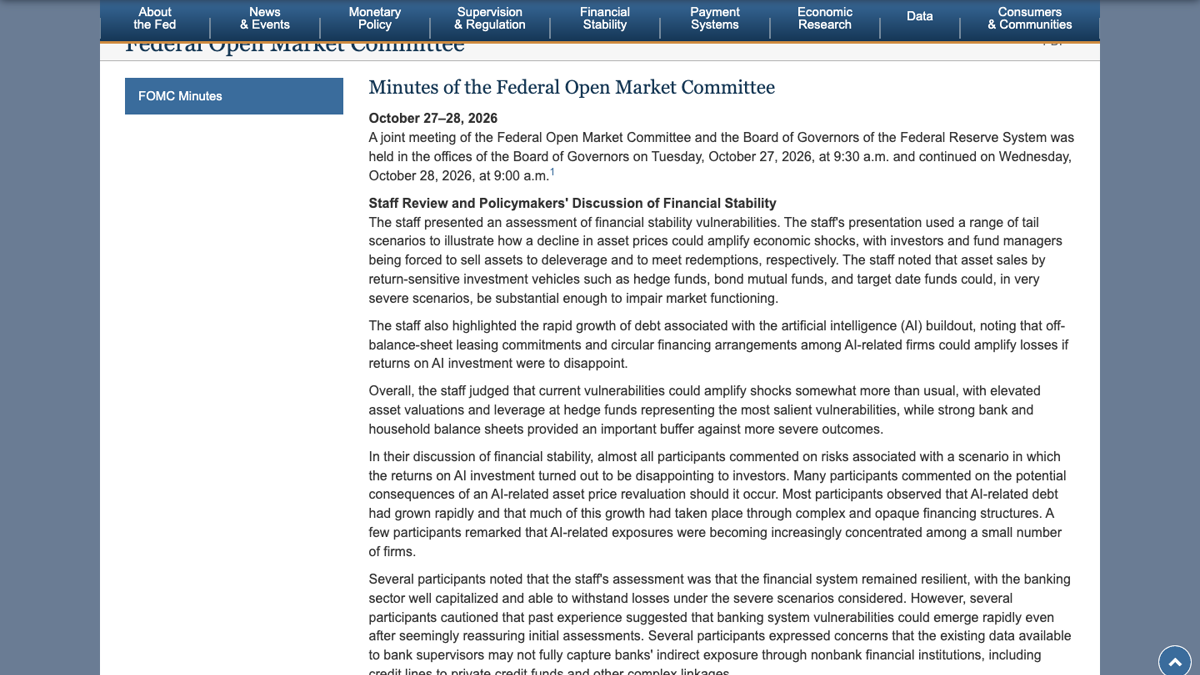


The Federal Reserve released the minutes of its meeting on October 27-28 on November 18: The committee maintained the federal funds rate target range of 3.75% to 4% by a vote of 10 to 2, but nearly all participants believed that further rate hikes might be appropriate under their respective baseline projections.
This is the public record of the discussions at the October meeting, and it should not be confused with the new interest rate decision made on November 18th. Two members who opposed maintaining the current interest rate wanted to raise it by 25 basis points on the spot, while among those who supported no change, some also felt that the chosen option was quite close. The main reason for the pause was to accumulate information and observe how the existing tightening measures would be transmitted.
Waiting for more data; the tightening direction has not been reversed.
Most participants supported maintaining the current range, with considerations including whether the investment needs of AI can continue, the evolution of financing conditions, the transmission of interest rate hikes in September to the economy, and geopolitical situations. Some believed that a gradual tightening could give businesses and households time to adapt to higher interest rates; several participants emphasized that the overall interest rate trajectory over a period of time should be taken into account.
Many people have requested a clear message: this time's decision not to raise interest rates does not weaken the commitment to bring inflation back down to 2% in a timely manner. A minority advocate for immediate tightening, arguing that inflation is still too high and there are insufficient signs of moderation. Further delays could lead to inflation becoming entrenched or may force more substantial and disruptive measures to be taken in the future.
For the coming months, almost all participants supported further raising the target range under the baseline outlook. Two of them believed that if new inflation data is unfavorable, a hike of more than 25 basis points could be considered at the next meeting. This condition cannot be omitted; it has not turned into a decision where the committee has already agreed on a certain magnitude.
The date for the next meeting is from December 8th to 9th. For those holding positions in U.S. stocks and crypto assets, a useful benchmark for assessing interest rate risks is as follows: if the pause in October coincides with subsequent potential tightening measures, then the actions in December will still depend on data, outlooks, and risk-benefit considerations. It cannot be inferred from the word "maintain" that a rate cut is imminent.
AI Construction not only drives demand but also raises certain costs.
Participants believe that the economy is still expanding at a strong pace, household spending is resilient, and corporate fixed investment is solid, but growth is not uniform. AI Investment, manufacturing, and data center construction are relatively strong, while housing and other industries sensitive to interest rates are weaker. The increase in the cost of necessities puts pressure on the budgets of middle- and low-income families.
Most people believe that inflationary pressures are widespread. Many have mentioned how the demand related to AI construction is squeezing supply, driving up prices of technology-related consumer goods; several have noted that these pressures are beginning to extend beyond the direct industries involved in data center construction. Most also observe that high costs may be transmitted more broadly and more persistently to consumer and corporate prices.
At the same time, some participants believed that as production capacity and productivity increase, price pressures might ease. Others pointed out that a more stringent scrutiny of returns and financing could slow down AI spending, thereby alleviating demand pressures. The minutes reflected these different perspectives and did not label AI investment as purely inflationary.
Based on the price information of CPI and producers at that time, staff estimated that the overall PCE in September would be 3.6% year-on-year, with the core figure being 3.1%. This was an estimate by the staff at the time of the meeting. The core figure excludes changes in consumer energy and many food prices, and should not be taken as the officially announced PCE for November.
The labor market is viewed by most participants as stable, with nearly full employment. In September, the unemployment rate rose slightly to 4.2%, but it is still 0.2 percentage points lower than the average in the second half of 2025; over the three months ending in September, non-agricultural employment increased by about 50,000 people per month on average. Participants also discussed the relatively slow pace of recruitment, job departures, and job hunting, indicating that mobility within this stability remains weak.
Funding has become more expensive, and it has not yet led to a complete cessation of credit supply.
The summary states that overall financial conditions still support growth, but most participants noted a tightening since the September meeting, including higher mortgage rates, an widening credit spread for some high-risk borrowers related to AI, and a decrease in issuances by companies with lower ratings. This is a different assessment from the situation where no company is able to obtain financing.
Many people believe that borrowing costs and more selective lending practices have affected residential investment, commercial real estate, small businesses, and other sectors that are sensitive to interest rates. Stricter market constraints on high-leverage AI projects may also cool down investment demand. The summary does not quantify how much growth these factors will ultimately reduce.
During the financial stability discussions, nearly all participants mentioned the risk that the returns on AI investments did not meet expectations. Many focused on the growth of debt within complex and opaque structures. Staff also concluded that the balance sheets of banks and households provided an important buffer, suggesting that potential shocks might be magnified to some extent compared to usual, rather than asserting that a crisis had already occurred.
At the implementation level, the committee also maintains a policy of ample reserves. Reserve management purchases are kept at zero for the current period, and the trading desk determines the reserve requirements on a monthly basis; there is no preset path for the pace of these purchases. Maintaining reserve supply and purchasing assets to ease monetary policy should not be simply considered as the same thing.
Public records ultimately boil down to a wait with boundaries: The target range remains unchanged, and further interest rate hikes are still the direction indicated by most benchmarks. The next formal decision will be made at the December meeting.