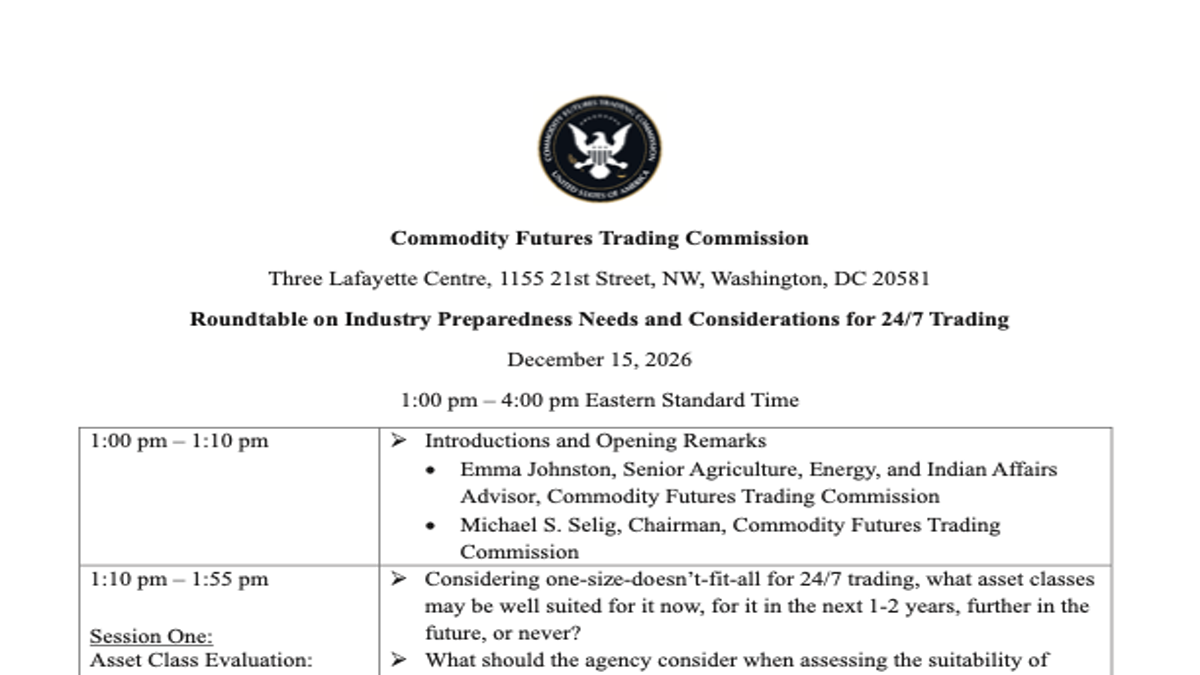


CFTC announced the agenda for the 24/7 trading roundtable on December 15th on November 17th, listing stablecoins, tokenization, and blockchain as tools to discuss clearing obstacles. The meeting will take place from 1 PM to 4 PM Eastern Standard Time, and no new regulations for 24/7 trading have been established yet.
For users who are already accustomed to trading encrypted assets on weekends, the key difference proposed in this agenda is whether trading and settlement can operate simultaneously. The ability to execute orders on weekends does not automatically guarantee that collateral, margin, and staffing arrangements can also respond continuously. What needs to be discussed is CFTC what conditions are required for different assets and different business models.
First, let's ask which assets are suitable to be made available.
The agenda reserves the time from 1:10 PM to 1:55 PM for the assessment of asset categories. The issues to be discussed include which assets are suitable for 24/7 trading now, which may need to wait for one to two years or longer, and which may never be suitable for trading. The discussion will also take into account physical delivery, regional differences, and business needs.
This design does not place all derivatives on the same clock. The consideration of physical delivery, regional factors, and commercial needs indicates that CFTC is still collecting data on the differences among various markets. The announcement did not list a list of products that have been approved for 24/7 trading, nor did it declare that all exchanges must change their trading hours.
In a press release, Chairman Michael Selig stated that it is necessary to hear from industry stakeholders about how round-the-clock trading affects their respective business models, in order for regulatory frameworks to be appropriately adapted to market participants. This is the stance behind convening this discussion and should not be construed as granting compliance approval to any particular platform.
The emergence of stablecoins is related to settlement issues.
The second session will take place from 2:05 PM to 2:55 PM, with the theme being risk management for round-the-clock settlement. The agenda will first cover capital and settlement connectivity, collateral, and margin requirements, followed by a discussion on whether new technologies such as tokenization, the adoption of stablecoins, and blockchain can address existing obstacles.
What is handled here in liquidation are the funds, collateral, and risk arrangements after transactions. Whether moving payment assets onto the blockchain can also solve these issues is still something that will be discussed at the meeting. The authorities have not stated that stablecoins will replace bank funds, nor have they designated any particular stablecoin as the standard settlement asset.
The agenda also separately discussed the model of having sufficient funds in advance, as well as the potential risks associated with treating weekend transactions as a separate session. For users, this indicates that the so-called weekend trading capability on the platform needs to be examined more closely: whether funds must be deposited in advance and how weekend sessions are integrated with weekday ones can both affect actual usability. The specific answers will depend on the official terms of each platform.
This is also what distinguishes this incident from the usual promotion of "24-hour trading" products. The discussion puts settlement, capital, and margin on the same page; for those involved in crypto derivatives, the criteria for judgment should include the ability to replenish margin and handle collateral, rather than just whether the place order button is lit up. The roundtable itself does not promise any level of service from the platform.
Weekend liquidity will still be tested by market structure.
The third session lasted from 3:05 pm to 3:55 pm. The agenda covered weekend price discovery, liquidity, and manipulation risks, as well as position limits and circuit breakers for volatility control. These are still on the agenda, and CFTC has not yet determined any specific limits or circuit breaker thresholds.
If 24/7 trading is expanded, the maintenance windows will also need to be rearranged. CFTC calls for the industry to discuss network security, system updates, monitoring, and maintenance: how much time is required to ensure continuous operation and updates, and what are the costs? The press release does not provide a cost estimate for the industry, nor does it announce that traditional maintenance times can be canceled directly.
Personnel allocation is also within the scope of the same discussion. Users may see consecutive quotes on weekends, but whether risk management, customer service, technical support, and settlement support are available during the same time period requires specific arrangements. As can be seen from the agenda, regulatory discussions have included operational preparedness in the feasibility assessment; one cannot answer all questions solely based on the time the blockchain is operational.
Two breaks were scheduled within the originally planned three hours, with Selig delivering the closing speech in the last five minutes. The agenda provided only questions and a timeline; there were no answers from the participants released, let alone any concluded cost-benefit analyses. Pre-writing the questions as policy conclusions would advance the status of this event by one step.
The meeting was held at the Washington CFTC headquarters, was open to the public, and was planned to be broadcast live via the official website. The press release made it clear that the views, opinions, and information expressed by the participants represented only themselves, and did not necessarily represent those of the committee, staff, or the U.S. government. Subsequently, when individual guests make claims, this attribution should also be maintained.
The next node that can be verified at present is the roundtable on December 15th. The discussion surrounding stablecoins has extended from whether transfers are possible to clearing access, margin requirements, and weekend risk control. However, whether these measures apply to different asset classes is still in the stage of openly seeking industry opinions.