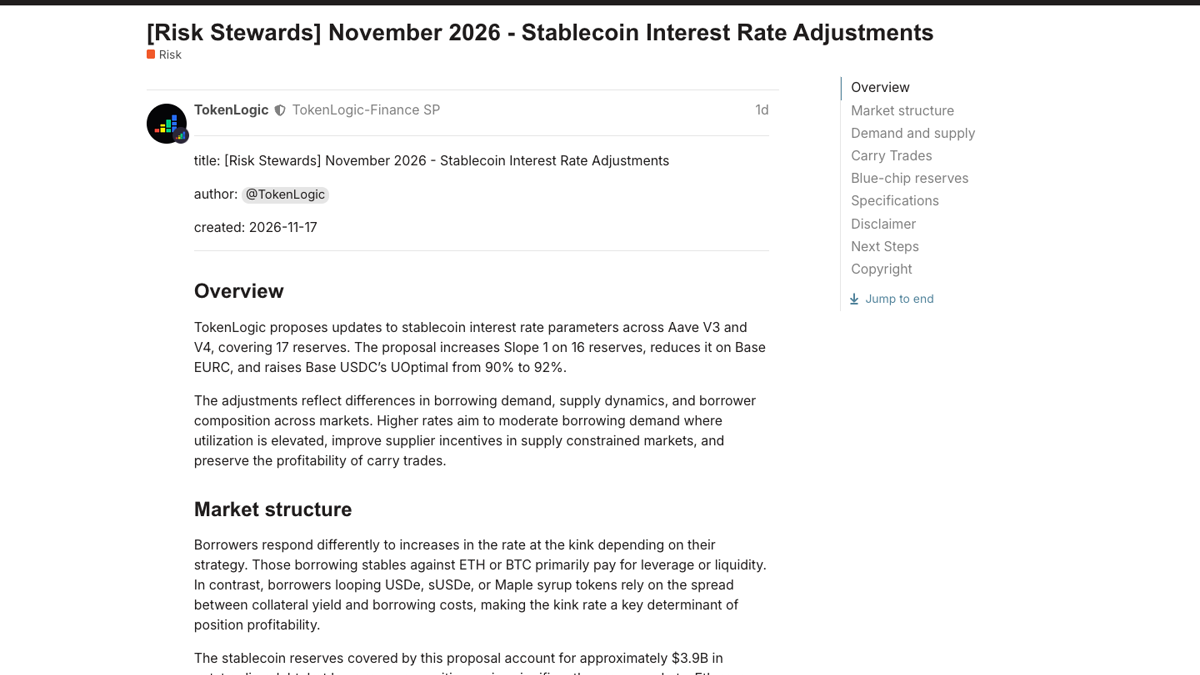


On November 17th at the Aave governance forum, TokenLogic proposed to adjust the interest rate parameters for 17 stablecoins: 16 of them are planned to have their rates increased by Slope, while the rate of Base is planned to be decreased. At the same time, Base USDC's optimal utilization rate is to be raised from 90% to 92%.
These are the parameter suggestions submitted by the Aave service provider, which will subsequently be implemented by the risk administrators. The full text covers multiple markets including V3 and V4; it cannot be generalized as a uniform interest rate increase for all stablecoins. For borrowers, the factors that determine cost changes are the specific blockchain they are on, their reserve levels, utilization rates, and interest rate curves, rather than whether the coin's name is the same as USDC.
There are two opposite origins for high utilization rates.
The reserves covered by these materials amount to approximately $3.9 billion in outstanding debt. Of this, about 53% is supported by blue-chip collateral such as ETH and BTC, 39% comes from interest-bearing stablecoin positions, and the remainder consists of other or mixed collateral. The stablecoin positions are maintained by lending out stablecoins and reinvesting them in interest-bearing assets, with earnings depending on the difference between the returns from the collateral and the borrowing costs.
In the past 60 days, Avalanche USDC has exceeded the 90% optimal utilization threshold for 54 days, with an average utilization rate of 92.1%; Base USDC and Optimism USDC have each exceeded this threshold for 43 days and 41 days, respectively. Ethereum Core USDC has an average utilization rate of 93.8%, close to the 94% threshold, with 33 days within this high range.
A high utilization rate does not necessarily indicate an increasing demand for loans. Avalanche USDt is a counterexample: although supply decreased by about 13%, debt remained unchanged, yet the utilization rate rose from 79% to 91%. In this scenario, even if the providers of funds withdraw, it is still possible to increase the utilization rate. Therefore, the proposal emphasizes attracting and retaining suppliers by improving returns.
In other markets, both sides reduced their volumes together. The debt and supply of Monad USDC decreased by approximately 33% and 31% respectively, while in Plasma USDT0, they both decreased by about 16%. The utilization rate remains near the turning point. TokenLogic believes that this is consistent with simultaneous exits from both ends of the cyclic positions and does not interpret it as a new wave of lending activity.
On the contrary: during the observation period, the average utilization rate was around 50%, and there was not a single day when it reached 90%. The proposal aims to reduce Slope from 7.5% to 7% in order to improve the attractiveness of borrowing and make use of more idle liquidity. This is the only reserve that will be adjusted downward in this round.
The percentages in the parameter table do not equal the actual interest rates of everyone.
Slope 1 represents the interest rate curve parameter, and the proposal discusses its role based on the borrowing interest rate at the inflection point; UOptimal refers to the optimal utilization rate inflection point on the curve. They should not be directly regarded as the actual annualized borrowing rate displayed on the wallet interface at any given moment; the utilization rate and changes in parameters need to be considered together.
In the parameter table, Ethereum’s Core V3 USDC is proposed to be increased from 4.5% to 4.7%, Base USDC from 4.75% to 5%, and Optimism USDC from 4% to 4.2%. For Ethereum’s V4, Core, and frxUSD, it is proposed to increase from 4% to 4.5%, which represents a change of 50 basis points, different from the 20 basis points seen in many markets.
V4 Ethereum's Plus and USDT as well as USDC are all scheduled to increase from 4.7% to 4.8%. Base USDC There is also a change in the optimal utilization rate from 90% to 92%. Users should check both the version of their reserves and the network at the same time, and not mix the configurations of Core V3, Core V4, and Plus V4 into one pool.
For comparison, the material states that Ethereum’s average interest rate over the past 30 days is 4.98%, while V4 Core USDT is at 5.34%, both of which are higher than the approximate 4.5% level of the other platforms listed. Core V3 USDT has seen a recent return of supply, and its utilization rate has returned below the 94% turning point; therefore, in this round, its Slope remains unchanged at 1; V4 Core USDT’s debt is still growing and is still within the adjustment range.
Cyclic earnings also depend on the reward budget.
The proposal states that many decentralized finance (DeFi) markets use USDe as the main collateral, while sUSDe, Maple, and syrup tokens also hold an important position. The earnings of USDe are mainly affected by the Ethena's Merkl reward programs, and the target returns include the supply earnings from Aave. The actual outcome depends on whether the reward budget can cover the scale of supply.
The targets listed in the material are V3 market at 5.25%, V4 Ethereum at 5.75%; over the past two weeks, syrupUSDC and syrupUSDT had average returns of about 5% and 4.8% respectively. These figures correspond to the reward targets and recent observations, and should not be taken as future locked-in returns.
According to TokenLogic calculations, the equity returns generated by using maximum leverage in most markets are still likely to reach double digits even after the proposed adjustments; however, returns in most markets are expected to decrease by about 0.9 to 1.8 percentage points. These calculations take into account positions, collateral, and incentive conditions, but they do not constitute a guarantee of profit for any individual user, nor can they ignore the significant differences between markets.
Concentration imposes another layer of constraint. Ethena accounts for 61.6% of the supply from wallet Plasma USDT0, and Mantle USDT0 accounts for 74%; the top ten borrowers each account for 96% and 94.3% of these two sources of debt. The actions of a few wallets could significantly change the utilization rate, and the current interest rate differential alone cannot explain how the fund pool will operate.
The distribution of Base USDC's holdings is more dispersed: the largest supplier holds 3.6%, and the top ten together account for 16.3%, while the largest borrower only holds 4.8% of the debt. This is the basis on which the proposal argues that it would be more suitable to improve optimal utilization rates. However, this remains an analysis by service providers and does not constitute a risk-free proof.
The operational boundaries available to borrowers are to first check whether the relevant reserve parameters have been executed, and then to calculate their own collateral earnings, actual borrowing costs, and reward conditions. The next steps listed in the forum are still to implement and track utilization rates, supply, and arbitrage spreads; the suggestions for the 17 reserves cannot yet replace the current parameters on the chain.