Key Points
- Mastercard and Ripple are exploring the use of RLUSD for card settlement.
- Gemini and WebBank connect this project to the existing payment system.
- XRP provides support for the underlying ledger, but it is not a settlement currency.
Mastercard is delving deeper into the XRP Ledger ecosystem, but its plans are far more than just adding cryptocurrency payments to credit cards.
This payment company is collaborating with Ripple, Gemini, and WebBank to explore the use of RLUSD, a US dollar-pegged stablecoin based on Ripple, for settling traditional card transactions through blockchain infrastructure.
Ripple announced this collaboration in November 2025. Since then, Mastercard has expanded its stablecoin settlement program and participated in the payment experiments of XRP Ledger, which has once again drawn external attention: whether the company will ultimately use XRP directly.
How Mastercard, Ripple, Gemini and WebBank collaborate
The initial protocol revolved around Gemini Credit Card. This credit card was issued by WebBank and operates on the payment network of Mastercard.
Rather than changing the way consumers make purchases, partners are exploring whether it is possible to use RLUSD to settle the obligations between Mastercard and WebBank on XRP Ledger. Customers can still continue to pay in US dollars, while the blockchain infrastructure will handle part of the settlement process.
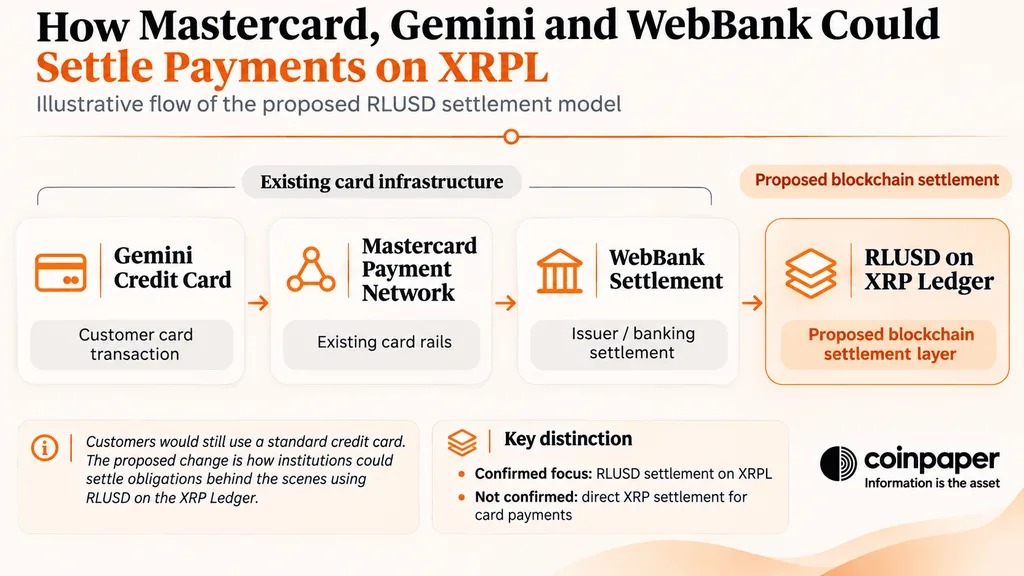
This proposed arrangement is built upon the earlier RLUSD settlement integration by Mastercard, which indicates the company's intention to connect traditional card payments with digital assets.
However, the initial project was subject to regulatory approval and system integration efforts. The initial announcement did not indicate that the arrangement had entered full commercial operation.
Mastercard Expands Stablecoin Payments Beyond Ripple
Subsequently, in June 2026, Mastercard expanded its settlement strategy by announcing support for a variety of regulated stablecoins, including RLUSD, USDC, PYUSD, and SoFiUSD.
The supported networks include XRP Ledger, Ethereum, Solana, and several other blockchains. This means that Ripple is merely one of the participants in the infrastructure of Mastercard's stablecoins, rather than the sole provider.
Competition has already begun to emerge. SoFi has shifted its card settlement business to its own stablecoin, demonstrating that banks can adopt digital settlements without relying on Ripple.
Mastercard Recently, there was also a focus on introducing a XRP Ledger hacker conference where developers used RLUSD to build AI payment applications. Participants created a system that allows AI proxies to make payments to verified merchants while adhering to expenditure limits.
These experiments link the interest in Mastercard in autonomous payments with the growing XRPL payment activities, however, the developer demonstrations do not prove that the related solutions have been commercially implemented.
Mastercard really uses XRP?
The answer depends on what "using XRP" specifically refers to.
XRP is the native asset of XRP Ledger. In RLUSD, it is used to pay transaction fees when transferring through this network. However, in the proposed arrangement of Mastercard, the payment value will be denominated in RLUSD instead of XRP.
Ripple Executives have previously explained the relationship between XRP and RLUSD, emphasizing the role of XRP in network operations, as well as the parallel existence of transactions denominated in US dollars.
At the same time, the RLUSD settlement cooperation recently reached between Ripple and DriveWealth also indicates that such stablecoins can support more financial services without the need for XRP to be the main settlement asset.
Marcus Hale
Marcus Hale is a cryptocurrency and financial markets contributor who reports on topics such as Bitcoin, Ethereum, digital assets, regulation, ETF, and institutional adoption. His work focuses on factors that may impact market developments, investor trends, and the broader forces shaping the crypto economy.