Brief
The weekly usage of OpenRouter in token increased by 44 times in 2026, while the average price of each token decreased by 83%.
From January to November, expenditures increased by 7.6 times, but since the beginning of October, they have remained relatively stable overall.
These data have raised questions from the outside world about the infrastructure investment in AI, although it only covers one platform.
According to a study released by the company on Thursday, OpenRouter users are consuming AI and token more than ever before, but their spending has hardly increased since the beginning of October. OpenRouter provides developers with a channel to access AI models from different suppliers through a single service.
Between January 5th and November 16th, the weekly payment token of OpenRouter increased by 44 times, while expenditures grew by 7.6 times. During the same period, the average price of each token decreased by 83%.
Token is a small unit of information processed and generated by the AI model. Developers usually pay to access the model through API. The decrease in price allows companies to run more AI tasks without necessarily increasing their budget.
Do you know?
You can now take action on the news you've read: use your Decrypt Money account to go long or short on Anthropic, Nvidia, Microsoft, and more targets through perpetual contracts.
Is the Jevons Paradox losing its momentum?
In 1865, the British economist William Stanley Jevons observed that the improvement in the efficiency of steam engines led to an increased consumption of coal in Britain. Making a resource cheaper may generate enough additional demand to offset the initial savings.
In January 2025, when Chinese developer DeepSeek used a low-cost model to shake up the tech stock market, the AI industry accepted this viewpoint. Satya Nadella, CEO of Microsoft, also cited this paradox to explain why greater efficiency might accelerate the adoption of AI.
Which companies are expected to go public before 2027?
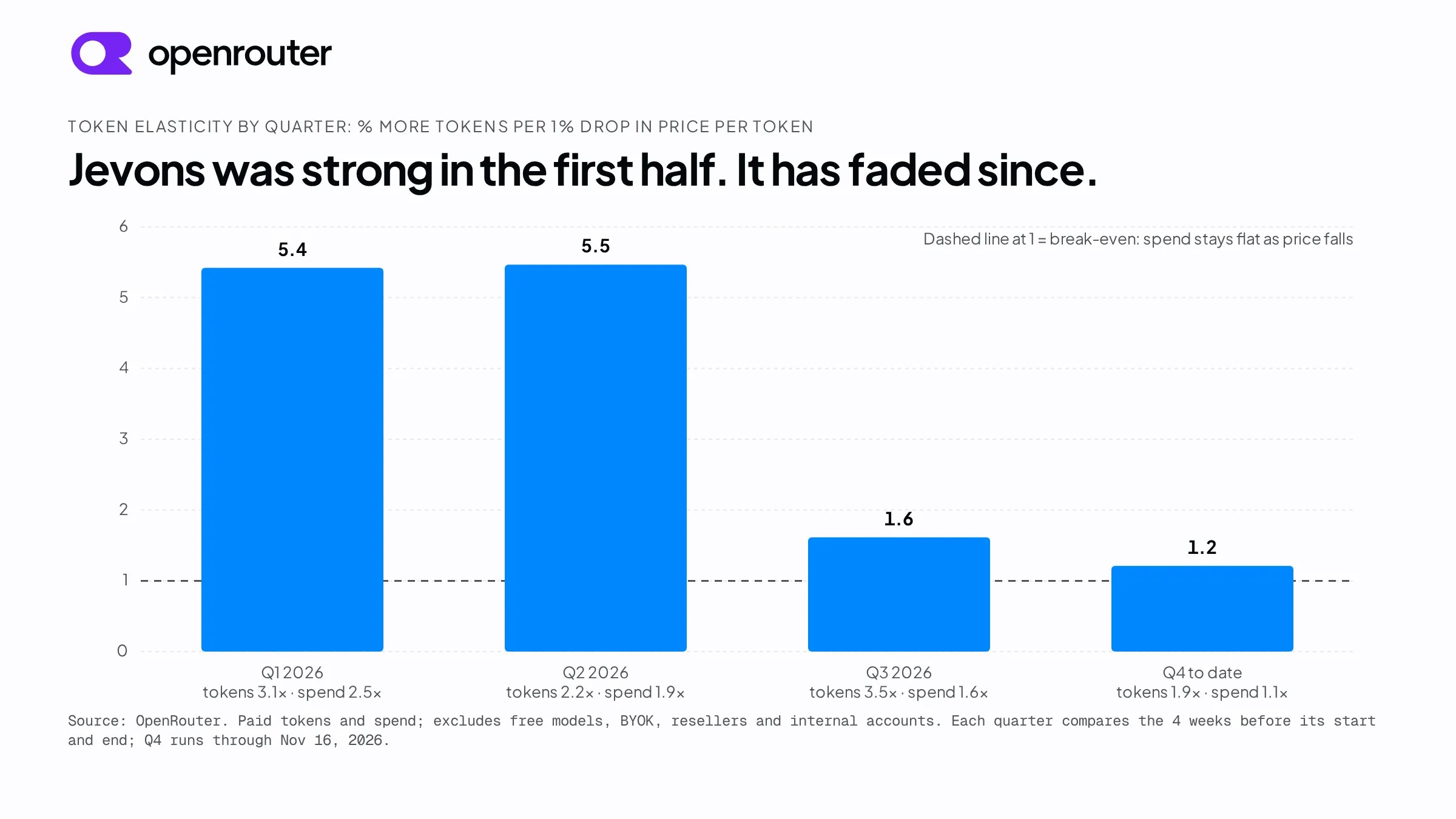
For most of 2026, the data from OpenRouter supported this argument. The company used price elasticity to measure this relationship, which refers to the percentage increase in usage of token for every 1% decrease in the average price of token.
This flexibility reached 5.5 in the second quarter, dropped to 1.6 in the third quarter, and further fell to 1.2 in the fourth quarter as of November 16. When the flexibility is 1, prices fall while expenditures remain unchanged; when it is below this level, expenditures decrease.
The company also found that there are differences among different types of customers. It seems that larger enterprises are more likely to retain the cost savings rather than expand their use, compared to growth-oriented companies whose products are built around AI.
What does this spending boom for AI mean?
JPMorgan Chase estimates that global AI capital expenditures will reach $900 billion alone in 2026, and the cumulative expenditures by 2030 will amount to $5.5 trillion. The bank also pointed out that the dependence on external financing for data center expansion is on the rise.
If the price decline of AI exceeds the growth in demand, then selling more token does not necessarily translate into higher revenue for model providers. For companies financing data centers, revenue growth is related to recouping the costs of building these facilities.
This study does not imply that the broader AI market is stagnating. OpenRouter It excludes free models, internal accounts, resellers, and customers using their own API keys, and its data also does not include subscription revenue or expenditures made directly to AI providers.
Token It is also not possible to directly measure computing power: different models may require different hardware resources when processing or generating the same amount of token. Lower prices may also reflect lower operating costs, which means that equal expenditures do not necessarily mean equal profits.
OpenRouter believes that the surge at the beginning of 2026 is related to the emergence of AI intelligents that are capable of performing coding tasks more autonomously. The company recorded that the elasticity readings in December 2024 and November 2025 were both close to 1, and then there was a rebound after the subsequent model releases.