Crude Oil Prices: USOIL Hits $140 as Trump Threatens to “Blow Everything Up” in Iran
天空漫步者
04-06 03:12
Ai Focus
USOIL traded at $140.35 as Trump’s Iran timeline shifted to Tuesday and Strait of Hormuz closure risks stayed in focus.
Helpful
No.Help

Crude oil prices have stayed near $140 as traders tracked the war in the Middle East and reports around the Strait of Hormuz closure. USOIL traded around $140.35, up 1.12% over the past 24 hours. The move kept oil near its highest daily close since June 2022. It also drew fresh attention to Hyperliquid, where 24/7 commodity-linked perpetual futures have seen rising activity during the latest oil rally.

According to UBlockchain, Hyperliquid HIP-3 recorded about $14.39 billion in cumulative trading volume over the last seven days, while open interest stood near $2.39 billion.

This latest price action came as President Donald Trump mixed threats with calls for a deal with Iran. In today's remarks, he said Iran must agree to terms or face wider U.S. action by Tuesday. However, despite the rising threats, Iranian officials have signaled that the Strait of Hormuz will remain closed, keeping supply fears in focus.

Oil markets have reacted to Trump’s statements in different ways over the past two weeks. Earlier comments about pauses and talks pushed prices lower for short periods. More recent comments had less effect, and prices stayed firm as traders weighed ongoing military risks and supply disruption.

USOIL Stays Elevated as Supply Concerns Continue

The USOIL chart shows a steady rise during the session. Price opened near $138.80 and then pushed above $141.00 before easing back. The session high appeared near $141.2 to $141.3, while the low sat close to $138.8.

Even after the pullback, oil held above the earlier breakout zone. That kept short-term momentum positive. Immediate resistance remained near $141.0 to $141.3, while support appeared near $139.0 and then around $138.8.

Source: CoinMarketCap

Traders remained focused on the Strait of Hormuz because it is one of the world’s main oil shipping routes. Any disruption there can tighten supply and lift prices. That risk remained in place as fighting continued and tanker movements stayed under pressure.

The market also watched energy infrastructure across the Gulf. Strikes on infrastructure and threats of more attacks added to supply concerns. Those factors helped keep crude prices elevated even when diplomacy headlines briefly appeared.

Donald Trump Increases 48-Hour Deadline to 82 Hours

Recent market behavior suggested traders were becoming less responsive to peace signals from Trump. Earlier announcements about pauses in strikes caused sharp moves lower in Brent crude futures. Later comments produced smaller reactions, and prices recovered quickly.

Concurrently, the Brent crude has returned to around the same level seen before Trump’s pause comments two weeks earlier. Oil has recently hit $109 per barrel, up more than 50% since the war began. U.S. gasoline prices also moved higher, with the AAA national average reaching $4.10 a gallon on Saturday from $2.98 before the war.

According to the Kobeissi Letter, Trump’s shifting deadlines and public comments may reflect an effort to contain oil prices. The report said Iran’s leverage remains tied to energy markets. It added that higher prices make the market more sensitive to supply risk and military headlines.

At the same time, markets have been parsing Trump’s latest statements on Iran. The Kobeissi Letter said a previously reported 48-hour deadline had effectively shifted after Trump later posted, “Tuesday, 8:00 P.M. Eastern Time!” That extended the timeline to about 82 hours and added another layer of uncertainty for traders.

Trump also told multiple news outlets he would “blow everything up” in Iran if no deal was reached by Tuesday, according to the same report. Those remarks followed other hardline comments, including references to sending Iran back to the “stone ages.” Together, the statements have kept geopolitical tension at the center of oil trading. Iran, meanwhile, kept its position on the Strait of Hormuz, which traders viewed as a direct risk to global flows.

Tip
$0
Like
1
Save
1
Views 372
HQYC reminds readers to view blockchain rationally, stay aware of risks, and beware of virtual token issuance and speculation. All content on this site represents market information or related viewpoints only and does not constitute any form of investment advice. If you find sensitive content, please click“Report”,and we will handle it promptly。
Submit
Comment 0
Hot
Latest
No comments yet. Be the first!
Related
StoneX Raises Microsoft's target price from $450 to $600, optimistic about AI chips, agents, and Azure progress
StoneX raises Microsoft's target price from $450 to $600, maintaining a "buy" rating. The firm believes that Microsoft is shifting from large-scale construction of AI infrastructure to improving the commercialization efficiency of its own-developed chips, AI models, and agent products. Azure performance will become a key point of observation after the financial report on October 28th.
The Block
·2026-10-18 15:27:22
21
SAND Price Analysis: Can The Sandbox Rise to $0.10 by 2026?
The Sandbox token SAND has recently rebounded along with an increase in trading activity, but it is still uncertain whether the buying momentum can be sustained. The article suggests that if the broader crypto market improves and the project ecosystem attracts more investor interest, SAND could have a chance to reach $0.10 in 2026, but this would still be considered an optimistic scenario rather than a definite goal.
Coinpedia
·2026-10-18 14:47:31
30
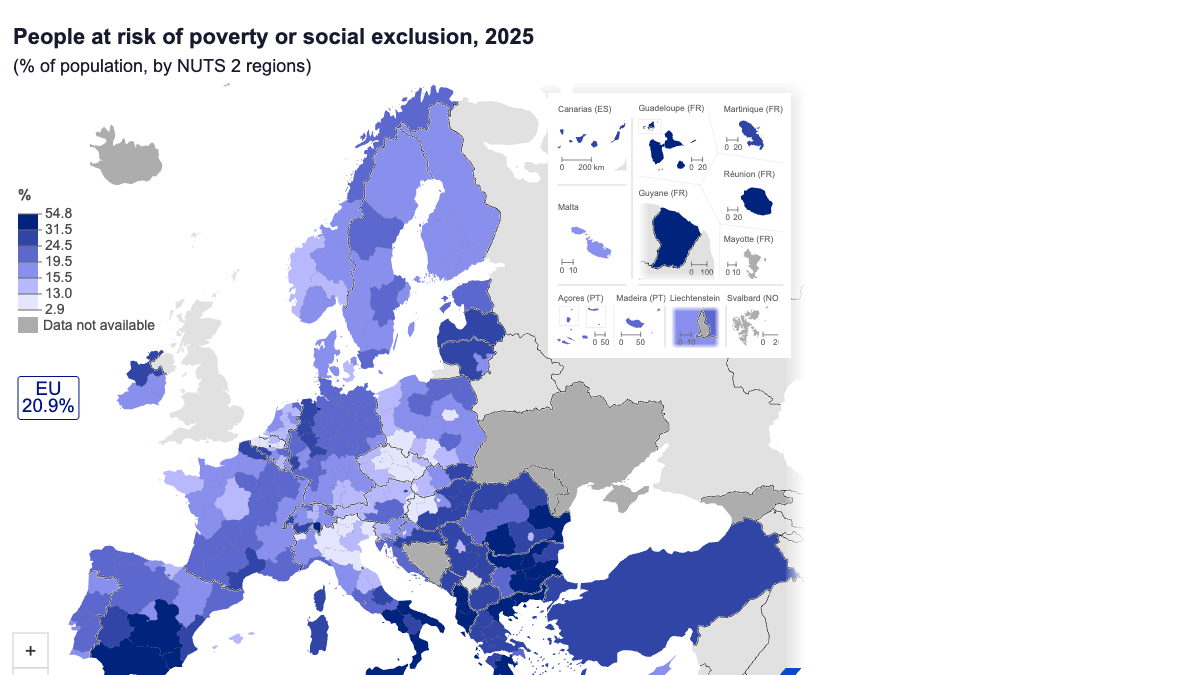
More than 92 million people in the EU at risk of poverty or social exclusion: What regional disparities does the average figure conceal?
Regional data released by the European Statistical Office on October 16 brought to light an issue often obscured by macroeconomic growth rates: By 2025, approximately 92.7 million people in the EU will be at risk of "poverty or social exclusion," accounting for 20.9% of the total population. This indicator does not refer to the number of people who are already in absolute poverty, nor to the unemployment rate. It comprehensively reflects risks such as relative income poverty, severe material and social deprivation, or living in families with very low labor participation rates. Even if the EU's overall economy continues to grow, housing costs, income distribution, and job opportunities in certain regions may still prevent many people from benefiting from this growth.
币百科
·2026-10-18 12:22:38
44
U.S. import prices rose 1.1% in September, export prices rose 2.2%: Where does the cross-border price pressure come from?
The U.S. Bureau of Labor Statistics released the September import and export price indices on October 16, providing another perspective on inflation for the macro market: import prices rose 1.1% month-on-month, up from 0.5% after revision in the previous month; export prices rose 2.2% month-on-month, compared to 1.2% in the previous month. Import prices increased by 8.1% year-on-year, while export prices rose by 11.6% year-on-year. These figures are notable, but they are not the Consumer Price Index, nor can they be directly applied to calculate the increase in the cost of a basket of goods purchased by residents. Price indices measure changes in the prices of goods and services in cross-border transactions, and it takes time for these changes to be reflected in corporate costs, retail prices, and profit margins through contracts, inventory, exchange rates, and competition, among other factors.
币百科
·2026-10-18 12:22:36
46
Anthropic Reveals Internal Employment Research: Are People Getting Busier as Agents Do More Work?
On October 16th, Anthropic released a study on work and employment using itself as a case study. The figure that is most likely to be intercepted and circulated is: as of August, the ratio of the operating time of the company's internal interactive AI agents to the working hours of employees was approximately six to one. However, interpreting this as "one employee being replaced by six agents" is neither in line with the research methodology nor does it accurately represent the findings. The operating time of these agents does not equate to the total human working hours; model generation, waiting times, rework, and acceptance processes are all part of the actual production workflow. What is truly worth noting in the report is that after AI was introduced into the organization, there were changes in job structures, work rhythms, and management costs simultaneously.
CoinMeta
·2026-10-18 12:22:31
46
View More