

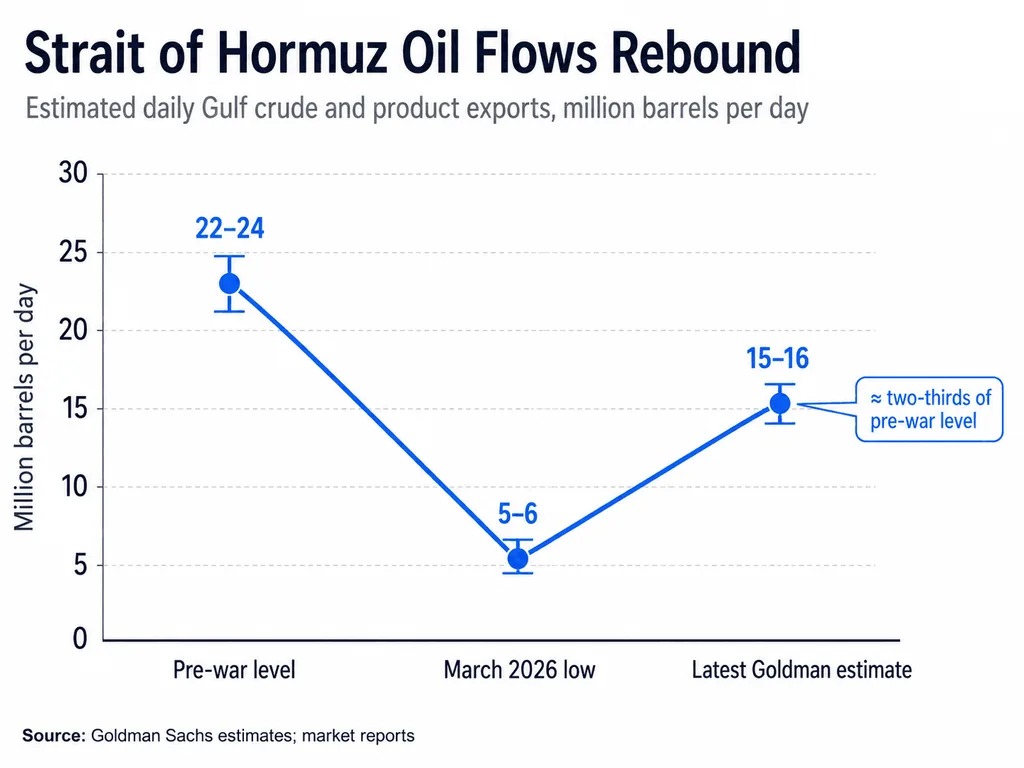
Oil tanker transportation through the Strait of Hormuz is recovering, and the supply pressures on the global energy market have accordingly eased. Goldman Sachs estimates that exports of crude oil and petroleum products from the Gulf region have rebounded to 15 to 16 million barrels per day, which is about two-thirds of the level before the conflict.
The lower point of the exit has been significantly repaired.
In March this year, due to the escalation of military activities and the increased security risks for merchant ships, oil shipments through the Strait of Hormuz dropped to between 5 and 6 million barrels per day. Compared to that time, current exports have significantly improved, but they are still about 7 to 8 million barrels lower than before the US-Iran conflict.
Recent estimates by U.S. officials are even higher, suggesting that the flow through this waterway is about 8 to 10 million barrels per day. However, data from commercial tracking agencies are relatively lower, as some oil tankers do not continuously send identification signals, making it more difficult to accurately quantify the actual volume of transportation.
Oil prices give back some of the geopolitical premium.
After transportation resumed, concerns about supply disruptions in the market eased. Previously, when shipping through the Strait of Hormuz was restricted, the price of Brent crude oil approached $95 per barrel, and the market also speculated that the United States might further tighten sanctions against Iran.
By this Friday, Brent crude oil has fallen back to around $90 per barrel and is expected to see a weekly decline. Traders are re-evaluating the possibility of a long-term supply shortage, causing oil prices to give back some of the risk premium brought on by the war.
Iran's stance still affects subsequent recovery.
However, the market remains highly sensitive to the situation in the Gulf. Before the conflict, about one-fifth of global crude oil and liquefied natural gas shipments passed through the Strait of Hormuz, making this route an important factor affecting oil prices, shipping costs, and inflation expectations.
The Iranian side is also setting conditions for a broader resumption of air traffic. An Iranian security official Mohsen Rezaei stated that ending regional conflicts is one of the requirements put forward by Tehran. During discussions between Iran and Oman, there was also a proposal to establish a shipping corridor using the waters of both countries.
This means that although physical exports have rebounded, the stable and normal passage through the Strait of Hormuz still depends on whether the regional situation continues to ease. For the crude oil market, the coexistence of improved supply and geopolitical risks will continue in the short term.