

Marvell Technology's latest quarter results were stronger than market expectations, yet the stock price still fell by 8% after the financial report was released. The market's focus did not remain on the earnings exceeding expectations; instead, it shifted to whether this round of growth driven by AI had already reflected too much of future growth in advance.
Since the beginning of this year, the cumulative increase in the stock price of Marvell has approached 178%. After a rapid upward trend earlier on, financial reports that are merely better than expected are no longer sufficient to continue driving up the stock price. Jim Cramer believes that this recent decline is more reflective of valuation and position pressures, rather than a weakening of the company's fundamentals.
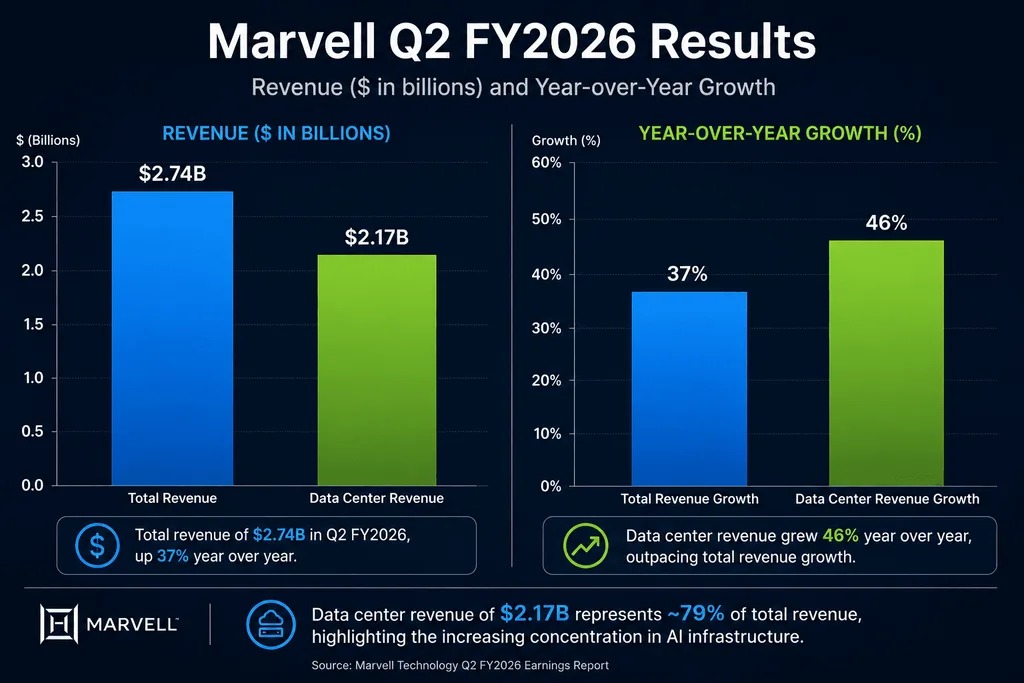
Data center revenue increased by 46%
AI Infrastructure remains the current main source of growth for Marvell. The company's data center business revenue increased by 46% year-on-year, reaching $2.17 billion, accounting for approximately 79% of the total revenue for that quarter. This growth mainly came from the increasing demand for custom chips and network products.
Management also raised its revenue forecast for the next quarter, estimating it to be around $3.15 billion. The company also increased its sales target for the fiscal year 2028 from $16.5 billion to approximately $18 billion. Reuters mentioned that Marvell currently expects revenue for the fiscal year 2027 to be around $12 billion.
Google's cooperative revenue may see a surge as late as 2029.
Investors are also paying attention to the expansion of the relationship between Marvell and Alphabet. The article states that this customized AI chip collaboration could generate cumulative revenue of up to $120 billion by the fiscal year 2033. As part of the cooperation arrangement, Google has also received warrants corresponding to a share value of approximately $12.2 billion.
However, the market is more concerned with the pace of revenue realization. Management stated that the maximum contribution to revenue from this collaboration may not appear until the fiscal year 2029. This also explains why the related positive news has not supported the stock price in the short term.
High expectations for compressed financial reports are positive.
This decline also reflects the current common characteristic of the AI sector: even with already high expectations, strong growth alone is no longer sufficient to continue driving valuation expansion. Similar pressures are also present in other data center-related companies, although AI infrastructure transactions are still attracting funds.
For Marvell, the current fundamentals remain solid. What the market is more concerned about next is whether the company's profit growth rate over the coming quarters will be able to continue to match the valuation levels that were previously driven up by the AI craze.