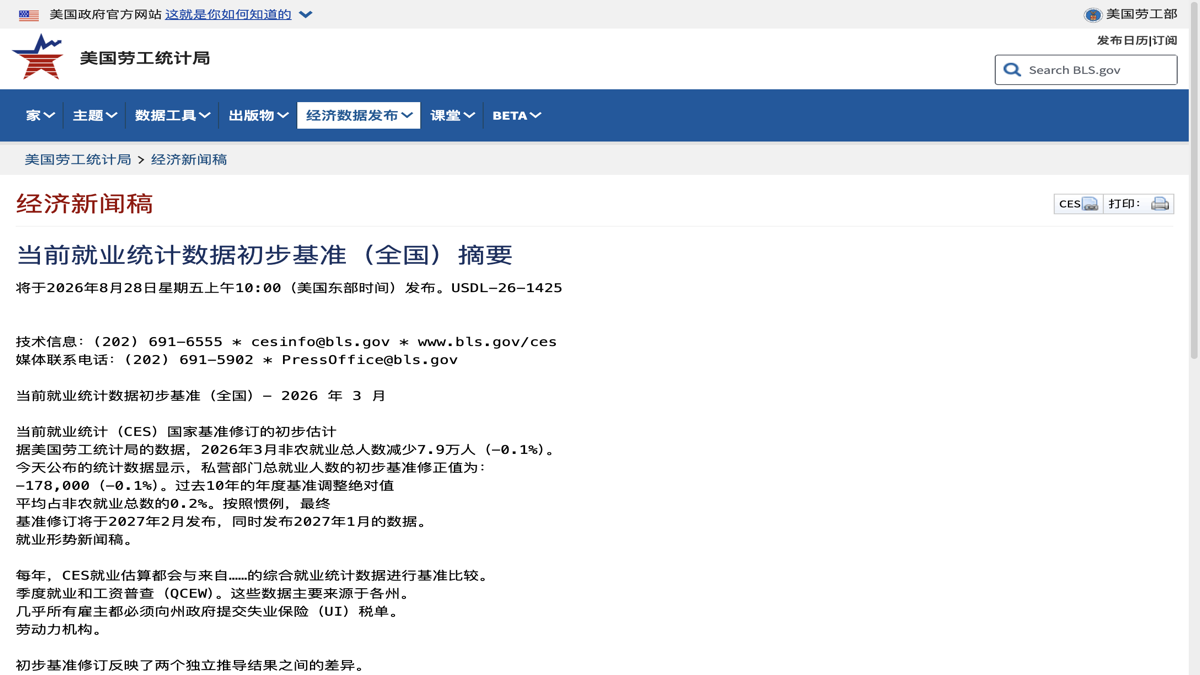


The preliminary baseline estimates of the national current employment statistics released by the U.S. Bureau of Labor Statistics on August 28 show that as of March 2026, the preliminary baseline revision for non-farm employment was -79,000 jobs, which is approximately -0.1%; the preliminary revision for the private sector was also -178,000 jobs, or -0.1%. These figures are often misinterpreted as meaning that "the United States has just lost 79,000 jobs." In reality, they are used to measure the potential total errors in monthly corporate surveys as of March 2026 after comparing two independently generated sets of employment counts. They do not represent new employment changes in August, nor are they the final revisions that have been incorporated into the official monthly series.
The baseline program for BLS aligns the annual estimates from corporate surveys with the more comprehensive counts from the quarterly employment and wage censuses, which are primarily derived from the state unemployment insurance tax records that almost all employers are required to submit. Sample surveys provide monthly updates in a timely manner, while administrative records cover a wider range but are released more slowly; combining the two is a trade-off that statistical systems must make between timeliness and completeness. Initial discrepancies do not indicate that either set of data is 'falsified' or completely invalid, but rather suggest that researchers need to wait for the final baseline processing to be completed.
What does negative 79,000 represent, and what doesn't it represent?
In terms of proportion, the preliminary revision of 0.1% is lower than the average level of 0.2% for national non-farm payroll revisions over the past decade. This comparison indicates that the overall deviation is within the historical range, but it does not mean that industry-level differences can be ignored. BLS points out that more detailed industry series usually show larger percentage revisions because sampling errors are greater in more finely segmented industries. Therefore, it is not appropriate to apply the 0.1% to the overall figure directly to each industry, state, or occupation.
More importantly, the official current corporate survey estimates will not be updated immediately due to this preliminary estimate. BLS clearly states that the final benchmark revision will be incorporated into the official estimates along with the employment situation report for January 2027, which will be released in February 2027. Until then, markets, businesses, and research institutions should continue to use the current official series, and at the same time, regard the preliminary benchmark as additional information to understand the uncertainty of the data, rather than revising the conclusions from previous months.
For macro analysis, the time frame is more crucial than the numbers.
Employment news can easily lead to the misunderstanding that "revisions" represent immediate directional signals, but in this case, the reference month involved is March 2026. The initial release date was August 28th, and the final incorporation into the data series occurred in February of the following year. These three dates indicate different stages: March is the time point when the data was calibrated, August is when the preliminary error assessments were disclosed, and it is not until February of the next year that the official sequence will be changed. If these distinctions are not made, technical revisions could be mistakenly interpreted as a sudden weakening or strengthening of the current labor market.
For those who make decisions based on non-farm data, a more appropriate approach is to maintain two layers of judgment: in the short term, continue to track the monthly releases of employment, hours worked, wages, and unemployment rates; in the medium term, pay attention to how benchmark revisions will affect the employment trends and industry structure of the past year. The significance of these benchmark revisions is not to create more sensational headlines, but to remind everyone that there are inherent margins of error in the monthly estimates. Understanding this will help one neither ignore these revisions nor engage in excessive trading when preliminary figures are released.
Interpretations at the industry level should be particularly cautious. The preliminary reduction of 178,000 jobs in the private sector and a total reduction of 79,000 non-agricultural jobs cannot simply be used to infer any real changes in job positions across various sectors; the final revisions will still need to be processed uniformly. Researchers can use these preliminary figures to assess the uncertainty in historical data series, but they should not regard them as a mechanical forecast for the next employment report. Once the final revisions are released, what is most worth comparing is whether there have been changes in the annual employment trend and the contribution of different industries, rather than just focusing on a single figure. Regarding media reports, it is best to clearly state "preliminary," "the benchmark month is March," "the official current series has not been updated," and "the final inclusion date is February 2027." This way, readers will understand the position of the data within the time frame.
Statistical revisions are not a topic exclusive to technical departments. Interest rate judgments, corporate budgets, local tax forecasts, and workers' understanding of industry prospects can all be adjusted due to re-evaluations of historical trends. A sound analysis should not regard the initial release as an unchangeable truth, nor should it consider each revision as a complete reversal of previous conclusions. A more reasonable approach is to focus on whether different data sources point in the same direction, whether deviations are concentrated in a few industries, and to what extent the original growth narratives need to be revised after the final benchmarks are established. Data has versions, and uncertainty has boundaries; acknowledging these facts is a more valuable macroeconomic skill than rushing to draw conclusions.
Methodologically speaking, administrative records cover a wide range but are released more slowly, while sample surveys are timely but suffer from sampling and modeling errors. The annual benchmark is a calibration mechanism that combines the advantages of both approaches. It does not render each monthly assessment meaningless, but it requires users to avoid dismissing the entire statistical system based on a preliminary revision. Incorporating uncertainty into the conclusions is a way of respecting the data itself.
Until the final figures are available, it is important to maintain the version, date, and source of information. This will ensure that subsequent reviews can refer to the specific public data on which the conclusions are based.
Before the final values are announced, it is advisable to maintain the conclusion as a conditional judgment. This approach not only preserves the value of the information but also avoids mistakenly interpreting a technical announcement as an economic turning point.
This is precisely the time boundary that should be retained most in the release of macro data.