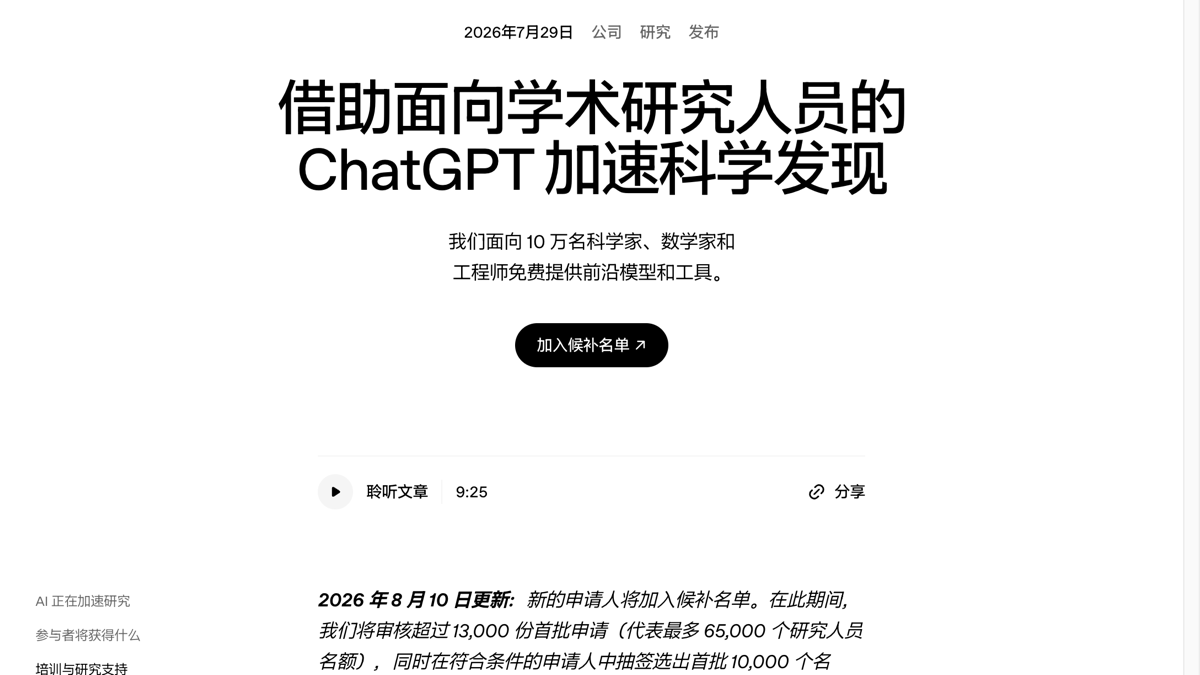


OpenAI announced in July that it would provide free access to its advanced ChatGPT model to 100,000 academic researchers in order to support scientific collaboration and discovery. The value of this project lies not in packaging the model as an “automatic discovery machine,” but in lowering the barriers for researchers to access computing resources, retrieval tools, coding assistance, and writing support. Free access does not mean that each research project will receive the same amount of computational power, data permissions, or publication advantages; the model can help organize and explore information, but it cannot replace replicable experiments, peer review, and the responsibility of experts in the field.
There are numerous steps in the scientific research workflow that are not about "proposing a final theory": reading literature, organizing code, converting formats, generating lists of hypotheses, checking statistical scripts, interpreting charts, writing research plans, and communicating with collaborators. Large models may save time in these steps, but saving time does not automatically translate into reliable findings. Whether the research question is correctly defined, whether the training data is suitable, whether statistical significance is misinterpreted, and whether the results can be replicated by independent teams still determine the quality of the outcomes. Especially in medicine, life sciences, and social sciences, the smooth explanations provided by models are often more persuasive than the evidence they actually possess, therefore, verification mechanisms must not be compromised just because the tools have become more powerful.
What researchers truly need are auditable auxiliary processes.
For research institutions, what is most important is not how many accounts are provided, but rather how to integrate the use of AI into the framework of research integrity. Research teams need to know which inputs will leave the local environment, which data cannot be submitted to external models, how to record the code produced by the models and citations in literature, and who will determine whether key conclusions can be traced. For information about participants, unpublished experimental data, clinical records, and restricted databases, access permissions, data masking, and ethical reviews must precede the design of prompts. Only by clearly defining 'what the models can read, what they can generate, and who reviews it' is it possible to maintain transparency in the research process even after changes to the tools.
The model will also alter the distribution of capabilities. Some laboratories with limited funds may thus receive better support in writing, programming, or languages, and interdisciplinary teams will find it easier to quickly understand the basic concepts of unfamiliar fields; however, the uneven distribution of resources will not disappear simply because of free quotas. High-quality data, experimental equipment, subject recruitment, computational infrastructure, and stable research time are still in short supply. When evaluating this project, it is more important to focus on whether it has helped researchers complete practical work that they would otherwise have found difficult to undertake, rather than simply counting the number of registered participants as a measure of scientific output.
With the increase in speed, errors may also spread more quickly.
When AI speeds up the process of literature reviews, initial code drafts, and chart explanations, unverified citations, incorrect statistical assumptions, or seemingly reasonable inferences can also more quickly make their way into team shared files. The approach to prevention is not to ban such tools, but rather to maintain a level of friction: requiring key citations to be traced back to their original sources, having a second researcher recompute important results, archiving model-generated content separately from manually modified data, and clearly stating the scope of AI participation in papers or preprints according to institutional guidelines. For students and early-stage researchers, the focus of training should also shift from "how to get models to provide answers" to "how to recognize when those answers are unreliable."
The OpenAI project describes access arrangements that support research work, and it is not a commitment to any specific scientific outcomes. Its long-term effects will be determined by actual use, institutional governance, and the quality of research. The best outcome is not for researchers to think less, but for them to spend more time designing better experiments, examining more challenging counterexamples, and establishing more reliable links with the real world. Only when efficiency and verifiability both increase can AI truly become an infrastructure for scientific discovery, rather than just a machine that generates text more quickly.
In addition, research institutions need to pay attention to changes in model versions. The same prompts may yield different results at different times, with different models, or under different tool settings. If the version and parameters are not recorded during the research process, it becomes very difficult to reproduce the auxiliary results later on. For projects that require long-term maintenance, it is best to save the key inputs and outputs, the reasons for human decisions, and the original materials used for verification, rather than just retaining the final polished text. Academic evaluations should also avoid rewarding the "speed of output": generating a review or code more quickly does not necessarily mean that the problem is more important or the conclusions are more robust. Tools reduce some production costs, but they cannot lower the standards of evidence.
In cross-language and interdisciplinary collaboration, AI may also exacerbate the existing uneven distribution of resources. Fields with abundant English-language materials, databases with a high degree of digitization, and teams with strong computational capabilities tend to achieve better results; whereas local knowledge, languages with limited resources, and unstructured experimental records may continue to be overlooked. If projects wish to truly expand research participation, they should encourage researchers to report on failed cases, biases, and scenarios that are not applicable. Making these limitations public does not diminish the value of scientific research; rather, it allows the next users to know which aspects need to be handled with caution.
Research funders can also require users to submit brief impact statements: What work was actually saved by using AI, whether the research design was altered, which findings were later overturned by manual review, and whether there were new costs associated with data management. Such records need not be a cumbersome burden, but they can prevent the misuse of “using AI” as if it were the actual result itself. The widespread use of scientific tools should aim to increase the production of verifiable knowledge, rather than merely increasing the apparent volume of text.