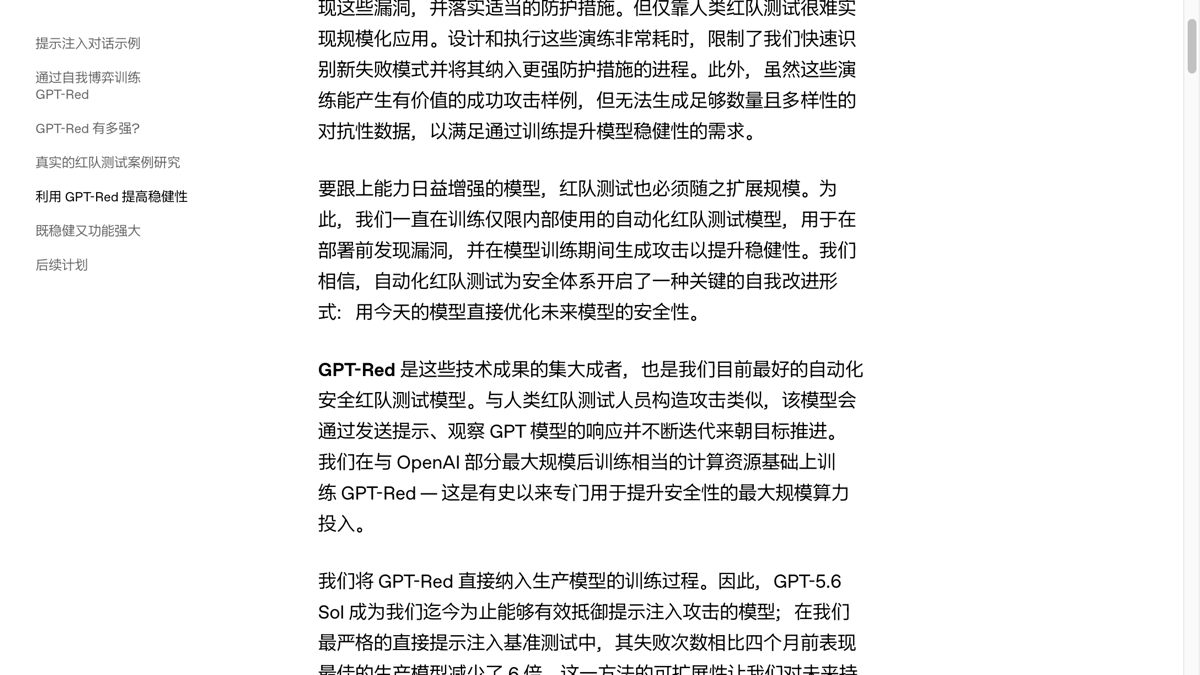


OpenAI released GPT-Red in July, describing it as an automated red-team method for enhancing the robustness of self-play reinforcement models, providing hint injection protection, and conducting security testing. Utilizing these models to identify vulnerabilities in models and proxy systems is an important direction in current AI security engineering: the more complex a system is, the harder it is to cover all possible attack hints, tool call combinations, and long-chain task boundaries manually. Automated red-teaming can expand the scope of testing, but the vulnerabilities it discovers, the vulnerabilities it fixes, and the risks in actual deployments are not the same concept.
The intuitive meaning of gaming is to have the attacker and defender push each other in constantly changing tasks. The attack model attempts to induce the target to violate rules, disclose information that should not be revealed, or perform unsafe actions; the defense mechanism updates accordingly, and new defenses will prompt attackers to find new ways around them. This cycle is similar to continuous penetration testing in software security, but the attack surface of the AI system includes not only text responses but also tool permissions, external web pages, memory, communication between proxies, authentication, and decisions made by human operators. The wider the scope of the testing, the more necessary it is to clarify what environment is real, what data can be accessed, and when it is necessary to stop.
Red team metrics cannot replace the boundaries of the real world.
The pass rates, rejection rates, or attack success rates commonly found in security reports must be interpreted in conjunction with threat models. If a model performs better on a specific set of test prompts, it may indicate that it has learned to recognize that type of attack, but this does not mean that it is also effective against unknown attacks, different languages, long-duration tasks, or complex toolchains. Conversely, the fact that a red team identifies issues does not necessarily mean that the same incidents have occurred in the public user product. The key is to clearly explain the test configurations, system permissions, data sources, and repair status, to avoid presenting laboratory metrics as absolute conclusions of security.
Automation also brings new governance issues: if an attack proxy possesses too many tools, has access to the real network, or is able to accumulate privileges, the testing system itself can become a source of risk. Therefore, red team environments should use isolated accounts, synthetic targets, minimal privileges, complete logging, and emergency stop mechanisms; for high-severity alerts, there should be designated human responders and clear time limits for escalation. OpenAI has previously emphasized the importance of stricter monitoring and isolation, as these engineering controls are just as important as the capabilities of the red team itself. Models that can find vulnerabilities will not restrict themselves automatically; restrictions must be provided by system boundaries, privilege design, and operational processes.
Security capabilities should be regarded as a continuous process of operation, rather than a one-time release.
For developers, what GPT-Red inspires them is not to wait for a model company to deliver a “secure version,” but to incorporate adversarial testing into their own product cycle. Every time a new tool, data connection, memory function, or automatic execution capability is added, it may create new potential paths for injection of malicious code. Teams can first define the worst-case outcomes they wish to avoid, such as key leakage, bypassing of approvals, incorrect transfers, or submitting sensitive information to external systems, and then design repeatable tests for these scenarios. After the product goes live, it’s also important to monitor for abnormal calls, retain audit records, and be prepared to quickly tighten security measures by restricting access.
Security is never a label that is obtained at the end of a single evaluation. An automated red team can help identify issues more quickly and also facilitate faster system iteration; a truly mature approach is to link evaluations, isolation, manual reviews, incident responses, and public explanations together. Only by continuously feeding back the identified failure patterns into training, products, and operations can security research transform from a set of published materials into actual protection that users can feel. To the outside world, when evaluating GPT-Red, attention should be paid to methods that can be reviewed, coverage of boundaries, and evidence of subsequent fixes, rather than equating the term "automated red team" directly with no risk.
The Red Team system itself also needs to be evaluated. If the attack model only repeats a few known prompts, the defense side may improve in the rankings but will still be vulnerable to new types of attacks; if too many real permissions are granted in pursuit of a higher attack success rate, the tests may exceed the intended boundaries. A better practice is to distinguish between baseline scenarios, isolate sandboxes, use controlled grayscale environments, and monitor real production systems, setting different accessible resources and stop conditions for each layer. Serious issues should not be left until the next model version is released; instead, there should be clear temporary mitigation measures in place, such as restricting tool permissions, suspending certain functions, or adding manual approval processes.
For enterprises that use proxy systems, the most practical security asset is not a certificate of "passing the red team" test, but rather a continuously updated risk list. This list should include which tools are the most sensitive, which external contents may become entry points for injections, which operations require double confirmation, and how to locate and roll back issues after anomalies occur. Only by regularly practicing these procedures can we prevent security measures from existing only in press releases or compliance documents. Automated attacks will become increasingly inexpensive, and defenders also need to turn monitoring and response into routine capabilities.
Product, engineering, and security teams should also share the same set of event language: what constitutes a hint injection attempt, what is a real privilege escalation, which logs must be retained, and when to notify customers. Inconsistent definitions can slow down incident response and make it difficult for outsiders to determine whether the fixes are effective. The most useful outcome of an automated red team is often not a prominent score, but rather exposing these failure patterns in advance to those who can actually make changes to the system.
Only by disclosing the test conclusions and the actual deployment boundaries separately can we avoid excessive marketing of security capabilities.