

In a set of trade data, an "expanding trade surplus" is often interpreted as stronger exports. However, the latest monthly report on agricultural and food trade released by the European Commission on September 28th presents a combination that deserves further scrutiny: from January to July 2026, the EU's cumulative trade surplus in agricultural and food products amounted to 30.1 billion euros, which is 2.9 billion euros more than in the same period of the previous year; yet, exports during the same period totaled 138.7 billion euros, which is 1.6 billion euros less, representing a decrease of about 1%; imports totaled 108.6 billion euros, a reduction of 4.5 billion euros, or about 4%. An expanding trade surplus does not necessarily mean that sales are going better; a significant part of this is due to the even faster decline in import amounts.
Agricultural and food trade serves as a window through which one can observe prices, consumption, and supply chains. It encompasses not only essential commodities such as grains, meats, and dairy products but also alcoholic beverages, coffee, cocoa, and processed foods. Changes in book amounts can stem from variations in the quantity of goods or from international prices. In this report, the European Commission specifically noted a decline in cocoa prices: import amounts from major producing regions have significantly decreased, with related prices being about half of their peak levels in the spring of 2025. Without distinguishing between price and quantity, it is easy to misinterpret "buying the same amount but spending less" as a "sudden disappearance of demand."
Why does the trade surplus expand when exports decline?
First, let's look at the absolute figures at both ends. In the first seven months, exports were 1.6 billion euros less, and imports were 4.5 billion euros less, resulting in a natural increase in the deficit of about 2.9 billion euros. This is a direct accounting explanation, but it is not yet a complete economic answer. A 1% decrease in exports indicates that the overseas sales of EU agricultural and food products have not generally increased significantly; a 4% decrease in imports suggests that there have been even greater changes in the pricing of external agricultural products and raw materials. If a news headline only states "trade surplus reaches a new high, competitiveness improves," it would conceal the most important background information. A more cautious statement would be: during this period, under this statistical framework, the trade surplus expanded; however, both export and import amounts also declined simultaneously.
The differentiation of specific product categories also indicates that a single overall figure cannot encompass the whole situation. The European Commission stated that exports of coffee, tea, cocoa, and spices decreased by 1.3 billion euros year-on-year, representing a 16% decline; exports of pork, olives, and olive oil also saw a noticeable drop. On the other hand, exports of other animal products increased by 549 million euros, a 11% rise, while exports of spirits and liqueurs increased by 470 million euros, a 10% increase. Different products face varying price cycles, consumer markets, and supply conditions. What is considered a prosperous period for one wine company may not be the same for a cocoa processing enterprise.
The changes on the import side are more concentrated. The report states that imports of coffee, tea, cocoa, and spices totaled 4.8 billion euros less, a decrease of 19%. Among these, imports from Côte d'Ivoire fell by 1.2 billion euros, or 21%; imports from Cameroon and Nigeria also decreased by 46%. These figures cannot be used directly to assert that the volumes shipped by growers or exporting countries decreased in the same proportion, as price changes play an important role in this. On the contrary, imports from Brazil increased by 528 million euros, or 5%, mainly due to an increase in soybean quantities; imports from Argentina increased by 240 million euros, which is related to sunflower seeds. Even though there is an overall decrease in imports, there is still an adjustment in the structure of raw materials involved.
What does it mean for businesses and consumers?
For food processing companies, a decrease in raw material import costs may alleviate the pressure on purchasing accounts, but price changes generally do not immediately and proportionally reflect in supermarket prices. Purchase contracts may be signed in advance, and costs related to energy, labor, transportation, and packaging are also subject to independent fluctuations. An expanding trade surplus does not necessarily mean that consumer food prices will fall; it is also necessary to consider factors such as import unit prices, domestic production, retail competition, and inventory cycles.
A specific example is cocoa. If the international cocoa price falls from a high level, the EU may spend less euros on importing the same quantity of raw materials, thereby improving its trade surplus; however, the high-priced inventory and long-term contracts purchased by chocolate factories earlier may still be reflected in their accounts. When and by how much prices will be reduced at the retail level is not determined by the monthly import volume recorded by customs. Conversely, if low prices stimulate processing companies to increase their purchases, the direction of both the amount and the physical quantity of imports could also be different. Therefore, when observing trade, it is best to consider quantity, unit price, and inventory simultaneously, rather than relying solely on the trade surplus as a substitute for a comprehensive analysis of supply and demand.
For agricultural exporters, a 1% decline in overall European agri-food exports is not a complete setback. The performance of different destinations varies greatly: The European Commission mentioned that exports to Egypt increased by 251 million euros, or 22%, mainly driven by wheat; there were also increases to Turkey and Ukraine. These changes may reflect demand from the destinations, but they could also be influenced by production levels, prices, and logistics arrangements. When making market assessments, companies should not use the average figure of "declining EU exports" to replace their own product and destination data.
There is another time frame that cannot be ignored: this monthly report covers the first seven months of 2026, not the annual settlement, nor is it the immediate trade volume for the month of September. If international prices, harvests, or transportation conditions change in subsequent months, the annual surplus may differ from the current trend. For macro observers, the next step that provides more information is to compare the synchronous changes in amounts with the physical quantities, especially by tracking commodities with higher weights such as cocoa, soybeans, and wheat. On the surface, the numbers show a “surplus of 2.9 billion,” but behind that are two forces at work—price and structure—re-distributing costs. It is important to understand this relationship clearly in order not to misinterpret a trade balance as a sign of a comprehensive strengthening of Europe’s food industry.
The trade balance is not equivalent to the profits of a particular industry. Exporters may experience reduced revenue due to falling selling prices, while importers of raw materials benefit from lower procurement costs; producers, processors, retailers, and consumers face different impacts. The agricultural and food supply chain is quite long, and the overall surplus is the result of aggregating figures across products and countries, which does not provide insight into the situation of each link in the chain. If subsequent reports show that export volumes continue to decline and import volumes are still affected by low prices, the surplus may remain high, but corporate profits may not necessarily improve accordingly. This is also why it is necessary to discuss "expanding the surplus" and "improving economic conditions" separately.
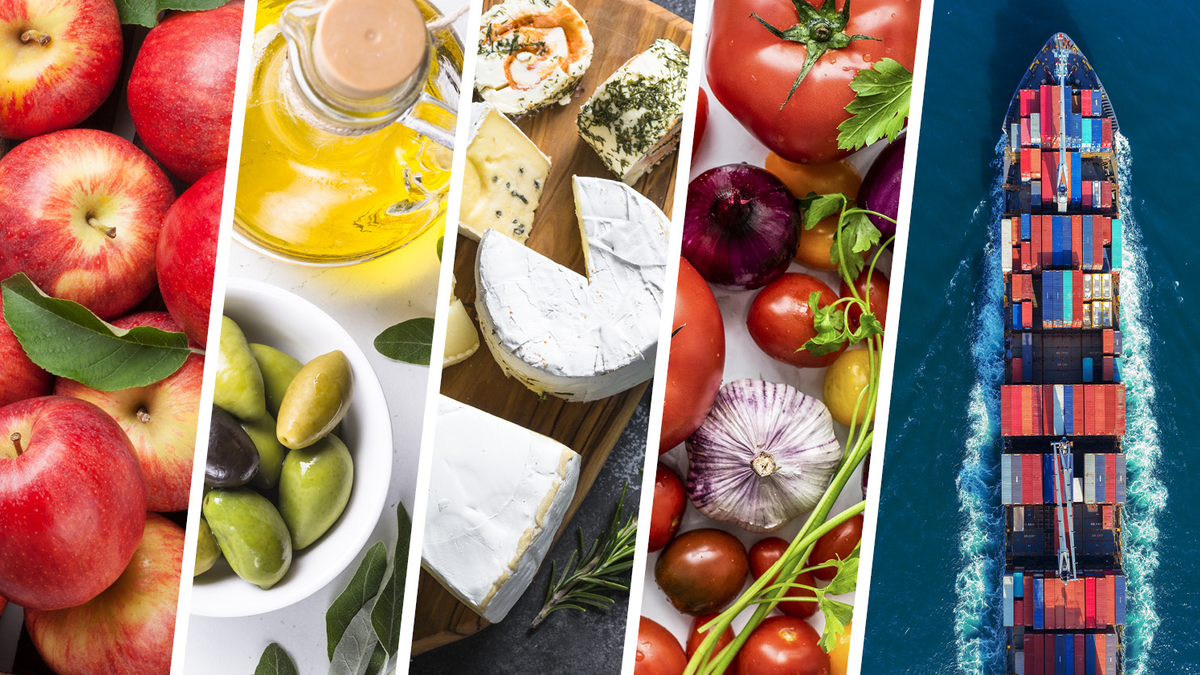
Cover material: Illustration for the EU Commission's report on agricultural and food trade this issue, consisting of a composite of real images of agricultural and food products and cargo ships, edited and cut together; it is not presented as a single scene from one location.