CBN News, October 18, 2026, 09:26:46 - Listen to the news
Author: Fan Zhijing Editor-in-Chief: Pan Yinru
This week, the international market has seen rapid changes, with the U.S. Consumer Price Index ( CPI ) in September expected to trigger concerns about interest rate hikes.
In terms of the market, U.S. stocks declined across the board, with the Dow Jones falling 0.67% for the week, the Nasdaq falling 4.48%, and the S&P 500 index falling 1.95%; Europe's three major stock indices rebounded collectively, with the UK FTSE 100 index rising 3.13% for the week, Germany's DAX DAX index rising 2.13%, and France's CAC CAC 40 index rising 1.97% for the week.
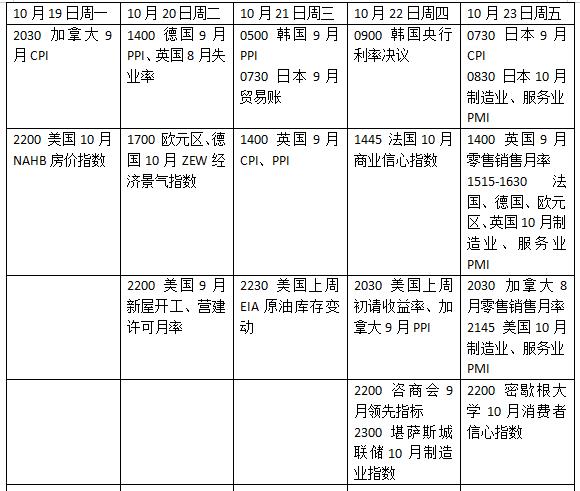
There's a lot to look forward to next week. The Purchasing Managers' Indexes ( PMI ) from the United States and Europe will provide insights into business sentiment and offer further clues as to the possible timing and pace of future interest rate hikes. Canada and the United Kingdom will release inflation data. Central banks in South Korea, Indonesia, and the Philippines will hold meetings, and current exchange rate fluctuations and rising energy prices are complicating decision-making. The international community continues to pay attention to the situation in the Middle East and the trend of oil prices. As the earnings season enters its second week, the performance of star stocks such as Meta and Tesla could cause quite a stir.
The earnings season brings star stocks
In October PMI, which will be announced next Friday (October 23rd), this index will reflect the recent activity levels of the U.S. service and manufacturing sectors.
Recent data shows that inflation in the United States in September was higher than expected, indicating a strong economy. However, it is considered unlikely that the Federal Reserve will raise interest rates multiple times later this month. Data from the London Stock Exchange ( LSEG ) indicates that the money market believes the likelihood of a 25-basis-point rate hike on October 28 is only 15%. Nevertheless, a rate hike in December has been fully anticipated, and it is expected that there will be a total of three rate hikes over the next 12 months, each of 25 basis points.
Other indicators worth noting include the number of people applying for unemployment benefits each week and the final value of the University of Michigan's Consumer Confidence Index for October, among others.
The trend in U.S. Treasury yields will continue to be closely watched over the coming week. Although long-term bond yields have recently fallen from multi-year highs, there are growing concerns about the sustainability of AI investments funded by debt. However, fears of rising energy prices remain. "Market participants will realize that we also have another positive factor: a low number of people applying for unemployment benefits, strong retail sales, and the U.S. Producer Price Index ( PPI ) inflation levels that are troublingly high. The market may use this as a basis to rebuild higher yields in the coming weeks," said Patrick Gavi, interest rate strategist at ING Group ING, in a research report.
As the financial reporting season enters its second week, companies such as Meta Platforms, Tesla, Netflix, Procter & Gamble, American Express, General Aviation, 3M, and General Motors will all release their quarterly reports.
Crude Oil and Gold
International oil prices have been fluctuating upwards, with producers facing higher freight costs and risk premiums for transporting goods through the Strait of Hormuz. The uncertainty of regional supply in the future has increased. The nearest-month contract for crude oil WTI rose by 10.41% week-on-week to $101.41 per barrel, while the nearest-month contract for Brent crude oil rose by 4.91% week-on-week to $109.86 per barrel.
Industry data shows that Iranian attacks on oil tankers have significantly reduced oil flows. In the week ending October 13, the average daily flow through the Strait of Hormuz dropped from a baseline of 17.15 million barrels to 11.62 million barrels. At the same time, Ukrainian drone attacks on Russian refineries have further limited fuel supplies. In the week ending October 9, US crude oil inventories decreased by 8.56 million barrels.
There is a risk of the situation in the Middle East continuing to escalate. According to reports from CCTV News, U.S. President Donald Trump stated during an interview at the White House that in order to ensure Iran cannot obtain nuclear weapons, the United States may launch another strike against Iranian nuclear facilities, including the underground nuclear facilities in Natanz.
The precious metals market weakened, with the COMEX gold futures for October delivery on the New York Mercantile Exchange falling 0.75% week-on-week to $4,159.50 per ounce, and the COMEX silver futures falling 6.06% week-on-week to $56.99 per ounce.
Federal Reserve Chairman Kevin Warsh expressed optimism about the U.S. economic strength this week, but did not reveal whether he believes further interest rate hikes are needed or when such hikes might occur. Independent financial market analyst Nix Sabras stated, "Warsh did not propose any new policies in his speech at the International Monetary Fund, allowing market pricing to remain unchanged and creating room for gold to rebound further in the short term."
Last month, PPI recorded its largest increase in over four and a half years, which is the latest sign of inflation spreading beyond energy products. This data was released following the consumer price report on Wednesday (October 14th), which indicated that prices accelerated in September. Although gold is generally regarded as an inflation-hedging tool, higher interest rates tend to reduce the attractiveness of low-yielding metals. “A decline in yields and the US dollar will pave the way for gold to rise back above $5,000 per ounce in 2027,” said analysts at ANZ Bank in a report.
The Bank of England's interest rate hike is imminent.
European Central Bank President Christine Lagarde stated during this week's annual meetings of the International Monetary Fund and the World Bank that the high inflation in the eurozone caused by high energy prices has not yet had an impact on the overall economy. ECB officials are determining the extent to which these indirect effects are being transmitted through the economy.
The key data for the eurozone in the coming week will be the October PMI figure, which will measure the recent activity in the services and manufacturing sectors in France, Germany, and the eurozone. "Given that market sentiment has improved over the past few months, we expect the data to show a slight decline by then," said an analyst from the German financial institution LBBW in a report. "In itself, this could further support the recent positive trend in bonds."
On October 12th local time, British Prime Minister Barnham delivered a speech in the House of Commons, calling for closer ties between the UK and the EU. He emphasized that maintaining the current relationship was no longer sufficient to meet the UK's needs, and refusing to explore new possibilities for cooperation would constitute a "major dereliction of duty." Barnham stated that reaching an agreement conducive to economic growth was in the UK's interests, and he would work hard to advance relevant negotiations over the next five weeks. He believed that the UK should discuss its long-term relationship with the EU with an open attitude in order to promote economic growth, manage immigration, uphold shared values, and ensure security.
In the coming week, the UK will release a series of economic indicators, including employment data and consumer price inflation data for September. Investors are increasingly anticipating whether the Bank of England will raise interest rates at its next meeting on November 5th. The money market believes that there is a 93% chance of a 25-basis-point rate hike by then, and the market has fully priced in at least four 25-basis-point rate hikes over the next year.
Sandra Hosfield, an economist at Tianda Group ( Investec ), stated in her report: "Members of the Bank of England's Monetary Policy Committee seem to be reaching some consensus that the current situation requires some policy tightening, but to a degree less than expected. If CPI and wage forecasts are close to the targets, this could strengthen the members' conviction to follow this path at the next meeting."
Next Week's Highlights
Article Author
US Stock Gold Rush | Three-Month High! Bottom-Fishing Funds Flowing Back into AI Trading. How Will the Market Start in October?
Will non-farm payroll data trigger a huge market shock?
Next Week's Overseas Market Highlights | Can Two Key Indicators Determine the Fed's Interest Rate Hike in October?
What is the trend of the global bond market and the situation in the Middle East?
The Horn of Oman sees a new dawn of recovery; the Dow Jones rises nearly 500 points with Microsoft leading the way. AI trading has resumed, and crude oil prices plummet by over 2%.
Gold and silver prices stabilized and rebounded.
The US Dollar Index breaks below 101! US Treasury yields soar! Will the Fed raise interest rates again in October?
The yield on 10-year U.S. Treasury bonds broke through the 5.10% mark.
U.S. Treasuries under pressure, Dow Jones falls by over 300 points; chip stocks and telecom sectors bear the brunt, SanDisk leads the decline; Brent oil rebounds by over 3%, gold and silver decline
The market is betting that the Federal Reserve will raise interest rates consecutively.