Key Points
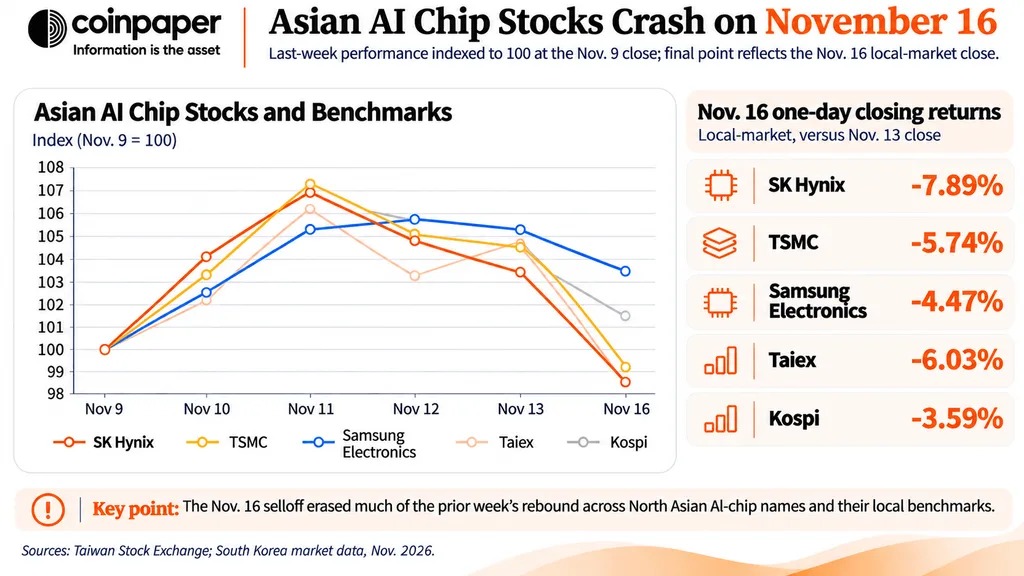
- As Taiwan's stock market tumbled, TSMC's stock price fell by 5.74%
- SK Hynix and Samsung Electronics experience significant declines in the semiconductor sector
- NVIDIA's financial report may determine the future direction of the AI sector.
Before NVIDIA's financial report was released, stocks in the Asian AI chip supply chain tumbled significantly. TSMC fell by 5.74% to NT$2,215; South Korean SK Hynix plummeted by 7.89%; Samsung Electronics declined by 4.47%. Previously, NVIDIA had seen a decline of nearly 13% in a single week, and Jensen Huang, who had served as CEO for a long time, has resigned.
This indicates that the recent selling of AI shares has further intensified. Market concerns have spread from American chip design companies to Asian manufacturers that provide them with processors and memory.
TSMC tumbles 5.74%, Taiwan stock market plunges 6%
On Monday, Taiwan's weighted stock price index ( Taiex ) tumbled 6.03% to close at 41,040.08 points, a decrease of 2,635 points.
According to data from the Taiwan Stock Exchange, the semiconductor sector fell by 6.33%, while the broader electronics index declined by 6.72%.
Nevertheless, TSMC's fundamental business remains strong.
The company's official monthly revenue report shows that sales in October increased by 59.7% year-on-year to NT$586.9 billion, highlighting the contrast between business performance and investor sentiment.
Due to TSMC's significant exposure to NVIDIA, the uncertainties surrounding this chip design company may affect market expectations for future wafer foundry orders, even though there is currently no evidence of actual order cancellations.
Samsung Electronics and SK Hynix decline, AI memory stock falls back
South Korean semiconductor giants also experienced a similar degree of decline.
SK Hynix closed at 1.12 million KRW, down 7.89%; Samsung Electronics fell 4.47% to 196,800 KRW.
The South Korean Composite Stock Price Index ( Kospi ) fell by 3.59% to 5,100.50 points, with foreign investors selling approximately 1.38 trillion Korean won worth of South Korean stocks.
Both of these manufacturers supply high-bandwidth memory (HBM), which is a key component in advanced AI accelerators.
SK Hynix has always been the main supplier of memory used by the NVIDIA AI system, while Samsung Electronics is also continuously expanding its competitive HBM business.
Their decline highlights market concerns that once infrastructure investment in AI slows down, it may not just be NVIDIA's own revenue that is affected.
Similar issues have recently emerged regarding the future prospects of Micron Technology's AI storage business. Investors are assessing whether the exceptionally strong demand and pricing capabilities can continue.
The broader sell-off in the Asian market also affected semiconductor equipment manufacturers, with Japanese companies such as Advantest, Tokyo Electron, and Kyocera also recording significant declines.
NVIDIA's financial reports may determine the next trend.
Investors will next face a crucial test: NVIDIA will announce its financial results for the third quarter of fiscal year 2026 on November 17.
According to NVIDIA's official financial report schedule, the financial results will be released around 4:20 p.m. Eastern Time, followed by a teleconference at 5:00 p.m.
The company previously estimated its quarterly revenue to be around $108 billion. Despite recent market concerns regarding management stability and financing issues for the AI infrastructure, this forecast still sets a quite high bar.
This financial report is particularly important for TSMC and suppliers such as SK Hynix, as NVIDIA's revenue guidance affects the market's expectations for future manufacturing and memory demand.
Coinpaper Previously, the outlook on NVIDIA's financial reports indicated that profit margins, data center orders, and the company's next generation of Vera Rubin processors would be the key highlights.
The author, Ethan Mercer, is a financial journalist who covers cryptocurrency, stocks, and the global economy. He studied economics and finance before turning to market reporting, with a particular focus on Bitcoin, stocks, monetary policy, and investor sentiment.