Web3: World's WLD price drops after completing a $52.5 million token sale.
Coinpedia
07-25 14:30
Ai Focus
The World Foundation completed a $52.5 million institutional sale of WLD tokens, after which WLD fell nearly 10%, amid market concerns about short-term pressure from the new supply.
Helpful
No.Help

Following the World Foundation's completion of a $52.5 million institutional funding round, the price of WLD briefly fell by nearly 10%. This funding will be used to advance the expansion of World ID and AI identity infrastructure, but the market's primary focus is on the token sale itself and the resulting short-term supply pressure.

Funding to expand World ID

The foundation stated that the funding was secured through a private sale of WLD to institutional investors, led by Pantera Capital, with participation from other crypto firms. The funds will primarily be used to expand the global deployment of World ID, covering enterprise applications, consumer scenarios, and AI agent-related identity verification needs.

Based on the disclosed information, this money is not primarily used for daily operations, but rather invested in infrastructure construction and network expansion. World is attempting to make "real-person identity verification" one of the fundamental services of the AI era, and continue to promote the implementation of its identity network.

The on-chain data shows that 217.4 million WLD tokens were transferred out.

According to on-chain monitoring account Lookonchain, the World Foundation transferred approximately 217.4 million WLD tokens and received approximately 47.5 million USDC in this transaction. The market therefore views this as a large institutional sale rather than a direct sell-off on the secondary market.

  • The transfer amounted to approximately 217.4 million WLD tokens.
  • The corresponding repayment is approximately 47.5 million USDC.
  • The total amount of funding in this round was US$52.5 million.

Despite the alleged lock-up arrangements among the participants, the market's focus remained on the potential for increased circulating supply after the announcement. The crypto market typically reacts more quickly to supply changes, and the prospect of long-term adoption did not dominate short-term trading.

The daily unlock limit has been reduced this week.

Earlier this week, the World Foundation also disclosed that the daily release of WLD has been reduced by 43%, with community distribution and team allocation decreasing accordingly. This move is intended to slow down the rate at which new tokens enter the circulating market and alleviate persistent inflationary pressures.

However, this has not significantly eased market concerns. The reason is that a large amount of WLD is already unlocked and trading, and simply slowing down the release of new tokens is not enough to fully offset the pressure from short-term sales. Subsequent price performance will still depend on network adoption, usage demand, and whether sustained buying pressure keeps pace.

Prices fell back below the key range

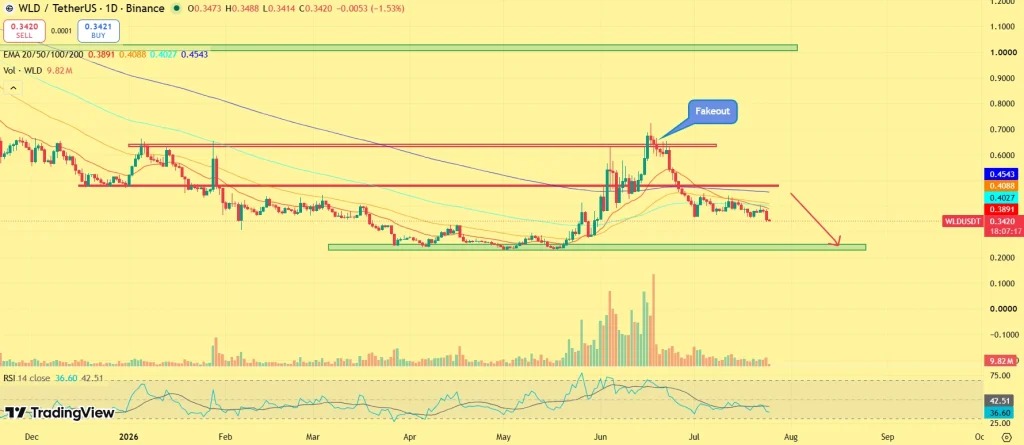
The article mentions that WLD had previously broken through the resistance near $0.65, but failed to hold and subsequently fell back quickly, rendering the short-term rebound ineffective. After the price fell back below the short-term moving average, sellers regained the upper hand.

The next support level currently under market attention is around $0.25. If selling pressure continues, prices may face further downside; to recover the short-term trend, prices first need to rise back above $0.45 before testing the upper resistance zone of $0.65 to $0.70.
Overall, this funding reinforces World's plans to continue expanding World ID and demonstrates that institutional investors remain willing to participate in its long-term narrative. However, in the short term, market trading logic still revolves around supply changes, thus putting pressure on WLD's price performance.

Tip
$0
Like
1
Save
1
Views 485
HQYC reminds readers to view blockchain rationally, stay aware of risks, and beware of virtual token issuance and speculation. All content on this site represents market information or related viewpoints only and does not constitute any form of investment advice. If you find sensitive content, please click“Report”,and we will handle it promptly。
Submit
Comment 0
Hot
Latest
No comments yet. Be the first!
Related
SAND Price Analysis: Can The Sandbox Rise to $0.10 by 2026?
The Sandbox token SAND has recently rebounded along with an increase in trading activity, but it is still uncertain whether the buying momentum can be sustained. The article suggests that if the broader crypto market improves and the project ecosystem attracts more investor interest, SAND could have a chance to reach $0.10 in 2026, but this would still be considered an optimistic scenario rather than a definite goal.
Coinpedia
·2026-10-18 14:47:31
18
Mastercard and BVNK launch a multi-currency platform: Stablecoins begin to compete for corporate capital flows
Mastercard and BVNK announced on October 15 the launch of Global Money Platform, bringing together capabilities such as fiat accounts, stablecoin balances, exchanges, card purchases, and local bank payments under one API. According to the press release, the platform is already able to provide services through BVNK; companies like Nuvei and Marqeta will be among the first integrators. When reading this news, it's important to distinguish between “the platform is now live” and “all the listed features are available in every country, for every currency, and for every customer.” For example, regarding the goal of covering more than 40 currencies and over 200 countries and regions, Mastercard mentioned that this is expected to be achieved by 2027.
币界网
·2026-10-18 12:22:41
80
More than 92 million people in the EU at risk of poverty or social exclusion: What regional disparities does the average figure conceal?
Regional data released by the European Statistical Office on October 16 brought to light an issue often obscured by macroeconomic growth rates: By 2025, approximately 92.7 million people in the EU will be at risk of "poverty or social exclusion," accounting for 20.9% of the total population. This indicator does not refer to the number of people who are already in absolute poverty, nor to the unemployment rate. It comprehensively reflects risks such as relative income poverty, severe material and social deprivation, or living in families with very low labor participation rates. Even if the EU's overall economy continues to grow, housing costs, income distribution, and job opportunities in certain regions may still prevent many people from benefiting from this growth.
币百科
·2026-10-18 12:22:38
41
U.S. import prices rose 1.1% in September, export prices rose 2.2%: Where does the cross-border price pressure come from?
The U.S. Bureau of Labor Statistics released the September import and export price indices on October 16, providing another perspective on inflation for the macro market: import prices rose 1.1% month-on-month, up from 0.5% after revision in the previous month; export prices rose 2.2% month-on-month, compared to 1.2% in the previous month. Import prices increased by 8.1% year-on-year, while export prices rose by 11.6% year-on-year. These figures are notable, but they are not the Consumer Price Index, nor can they be directly applied to calculate the increase in the cost of a basket of goods purchased by residents. Price indices measure changes in the prices of goods and services in cross-border transactions, and it takes time for these changes to be reflected in corporate costs, retail prices, and profit margins through contracts, inventory, exchange rates, and competition, among other factors.
币百科
·2026-10-18 12:22:36
44
Anthropic Reveals Internal Employment Research: Are People Getting Busier as Agents Do More Work?
On October 16th, Anthropic released a study on work and employment using itself as a case study. The figure that is most likely to be intercepted and circulated is: as of August, the ratio of the operating time of the company's internal interactive AI agents to the working hours of employees was approximately six to one. However, interpreting this as "one employee being replaced by six agents" is neither in line with the research methodology nor does it accurately represent the findings. The operating time of these agents does not equate to the total human working hours; model generation, waiting times, rework, and acceptance processes are all part of the actual production workflow. What is truly worth noting in the report is that after AI was introduced into the organization, there were changes in job structures, work rhythms, and management costs simultaneously.
CoinMeta
·2026-10-18 12:22:31
43
View More