Novo Nordisk (Novo Nordisk) surpassed market expectations in its third-quarter performance and promptly raised its full-year performance forecast, indicating that this Danish pharmaceutical giant is regaining momentum for growth after a turbulent year.
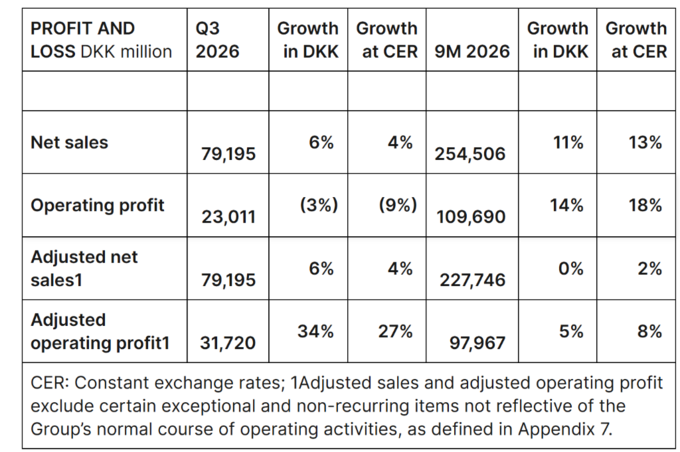
The financial report released by the company on November 4th showed that in the third quarter, the adjusted sales amount reached 79.2 billion Danish kroner, which was higher than the market's expectation of 73.55 billion Danish kroner; the adjusted earnings before interest, taxes, and depreciation (EBITDA) were 31.72 billion Danish kroner, also significantly exceeding the expected 28.71 billion Danish kroner.
Boosted by this, the company has raised its full-year adjusted sales and operating profit growth forecasts to a range of -2% to +2% based on a fixed exchange rate, which is better than the previous range of -6% to flat set in August. The company CEO Mike Doustdar stated that third-quarter performance was better than expected, with the obesity business portfolio performing particularly well.
The core highlight of this performance lies in the increased sales of the oral version of Wegovy. This weight-loss pill, launched earlier this year, achieved sales of 5.39 billion Danish kroner in the third quarter, far exceeding analysts' expectations of 4.64 billion Danish kroner. Meanwhile, the sales of the injectable version of Wegovy amounted to 20.4 billion Danish kroner, and the sales of the popular diabetes drug Ozempic reached 29.7 billion Danish kroner, both exceeding market expectations. These above-expected performances effectively alleviated market concerns regarding Novo Nordisk's ability to cope with competitive pressures.
Third-quarter performance far exceeded expectations
In the third quarter, Novo Nordisk's adjusted sales increased by 4% year-on-year when calculated using a fixed exchange rate, mainly driven by the continued growth in sales of GLP-1 drugs in the United States and international markets, particularly in the field of obesity. Adjusted earnings before interest, taxes, and depreciation (EBITDA) increased by 27% when calculated using a fixed exchange rate, a significant growth rate. Part of this was due to a provision for approximately 9 billion Danish kroner in corporate transformation costs in the third quarter of 2025, which created a lower base for comparison.
It is worth noting that the operating profit (before adjustments), calculated using a fixed exchange rate, decreased by 9%. The reason for this decline is that 8.7 billion Danish kroner in non-cash impairment losses were recognized during this quarter, including 4.6 billion Danish kroner in impairments related to ziltivekimab, as well as 4.1 billion Danish kroner in impairments resulting from the optimization of the production network scale.
On a cumulative basis for the first three quarters, the reported net sales amounted to 254.5 billion Danish kroner, representing a year-on-year increase of 11%; after adjustment, the net sales were 227.7 billion Danish kroner, with a year-on-year increase of 2%.
Wegovy Oral Version Becomes a New Growth Engine
Wegovy Oral Version is the product that has received the most market attention this quarter. As of the end of the third quarter, the product has been launched in the United States, the United Arab Emirates, the United Kingdom, and Germany, and since then, it has successively entered four new markets, currently covering eight countries.
Novo Nordisk also disclosed that the oral version of Ozempic was launched in the United States in May this year, with the weekly new prescription volume (NBRx) increasing by about 100% compared to the level of the Rybelsus brand before its launch. The company stated that the 2.0 mg dose version and the 7.2 mg single-dose injection pen of Ozempic are also being rapidly introduced in international markets.
Wegovy continues to lead in the number of new patients launched in the United States, holding a market share of over 50% in the branded obesity market.
Pipeline progress supports long-term expectations
In terms of product lines under development, Novo Nordisk also disclosed several advancements this quarter. In the field of obesity, the combination therapy CagriSema (1.0/1.0 mg) showed a 21% weight reduction in week 68 of trial REDEFINE; the Phase 3 clinical trial of the oral zenagamtide AMAZE was launched in September.
In the field of diabetes, CagriSema demonstrated in REIMAGINE trials that among adult type 2 diabetes patients with obesity, there was a 12.4% weight reduction by week 60, which is superior to the 9.1% achieved by tirzepatide and mg. Additionally, the weight loss achieved by HbA1c was not inferior to that of the control group.
In the field of blood and endocrine diseases, Frehemgo ( denecimig ) received positive feedback from the European Medicines Agency ( CHMP ) on September 17th and is planned to be launched in Europe for the first time around the end of the year; regulatory reviews in the United States are still ongoing. If approved, it is expected to be launched in the US in the first half of 2027. The company also stated that CagriSema is preparing to be launched in the US at the beginning of 2027, but it is still subject to regulatory approval.
The competitive landscape remains the core variable.
Despite the financial report data exceeding expectations in all aspects, the external competitive landscape remains the core focus of investors. Novo Nordisk is the pioneer of GLP-1 weight loss drugs, and currently about 10% of Americans are using such medications. However, its competitor Eli Lilly (Eli Lilly) has managed to surpass Novo Nordisk in this largest single market, the United States, thanks to its own GLP-1 products. At the same time, several pharmaceutical companies are also actively making arrangements in this high-profit sector.
Another key issue that the market is currently focusing on is whether the next-generation weight loss products of these two companies will be able to effectively address obesity-related complications, including heart disease, kidney disease, sleep apnea, and arthritis, among others. This will largely determine the future direction of each party's market share.