With the concentrated disclosure of 13F reports in the third quarter of 2026, the position adjustment strategies of global top investment institutions have come to light: NVIDIA faced a rare major reallocation among institutions, Bridgewater shifted towards the AI hardware industry chain, George Soros completed a "internal repositioning of chips," Druckenmiller significantly reduced its holdings in semiconductors and turned to gold and SpaceX, while Berkshire Hathaway continued to stay away from technology and focused on real estate and aviation.
This position holding report, as of September 30th, coincides with a highly sensitive time point: NVIDIA CEO Jensen Huang was removed from his position by the board of directors on November 12th, which led to drastic fluctuations in the stock price. All of this occurred after the time frame reflected in the third-quarter position holding data. According to the 13F data compiled by holdingsintel.com from 497 institutions, NVIDIA became the single stock with the greatest disagreement this quarter – among those reducing their holdings were Sixth Street Partners who sold off 160 million shares, Renaissance Technologies reduced their holdings by 99.7%, while those increasing their holdings included ARK who increased by 85%, DekaBank who increased by 648%, and Tepper also increased their holdings.
In addition, the 13F report shows that the weight of NVIDIA in the portfolio of Castle Investment (Citadel Advisors) under Ken Griffin has decreased slightly by about 1.31% (with a reduction of approximately 1.17 million shares held), and during the same period, the market value of its holdings was about $2.7 billion, accounting for about 1.46% of the portfolio.
Outside of NVIDIA, several hidden main trends have emerged simultaneously: ARK, Druckenmiller, and Tepper all made new investments or increased their positions in SpaceX during the third quarter; "reducing computing power and increasing storage/equipment" has become a hidden main trend. Bridgewater has bought application materials and Micron, George Soros has purchased SK and Hynix, while Druckenmiller has shifted to Seagate and Western Digital; Berkshire Hathaway, on the other hand, has repurchased its own shares for $9.6 billion, continuing to confront the market noise with cash and patience.
Bridgewater: Reduce tech giants, increase the AI hardware industry chain
According to an article by Wall Street Journal, Bridgewater Associates disclosed in the third quarter that its 974 investment positions had a total market value of $23 billion. The direction of portfolio reshaping this quarter is very clear: reducing holdings in tech giants and ETF, and shifting funds towards AI chip hardware, storage, and energy sectors.
In terms of increases in holdings, Qualcomm's stake increased from 162,000 shares to 878,000 shares, a growth of about 440%, corresponding to an increase in market value of about $132 million; AppLovin A class shares saw an increase of 536,000 shares to 683,000 shares, with a market value increase of about $123 million; there was also a significant increase in holdings in the memory chip sector, with Micron's stake rising from 120,000 shares to 237,000 shares, and a market value increase of about $118 million; SanDisk's stake increased by 66,000 shares to 668,000 shares, with a market value increase of about $115 million. In addition, RF chip company Qorvo increased its holdings by more than 1.037 million shares this quarter, bringing the total stake to 1.068 million shares.
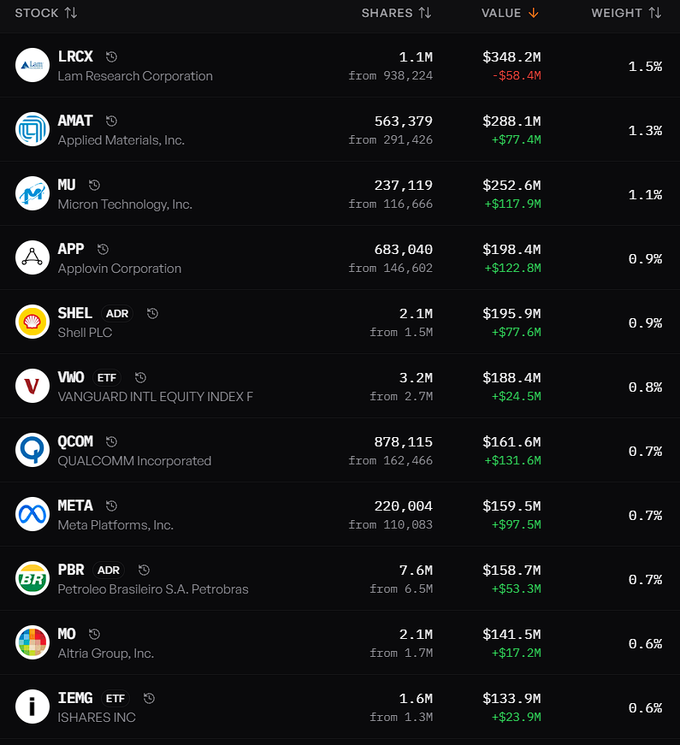
Nevertheless, NVIDIA still ranks third among Bridgewater's top five largest positions with a market value of $614 million, holding 2.688 million shares. During the quarter, it reduced its holdings by about 1.178 million shares, a decrease of approximately 30%, and remains the most important individual position in the portfolio for semiconductor stocks. Broadcom follows closely with a market value of $462 million, and its holdings have remained almost unchanged.
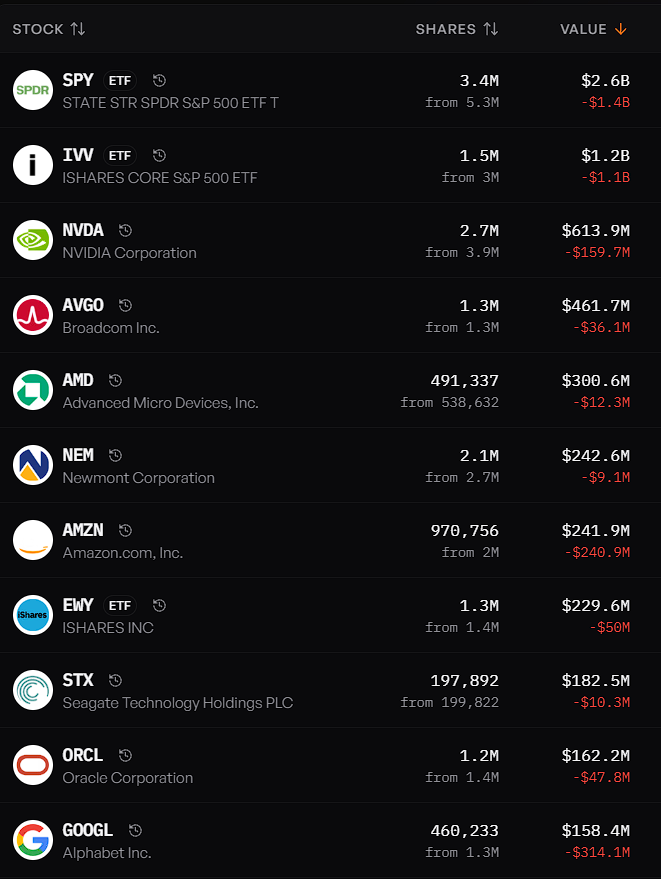
The industrial sector saw the largest decline in holding weight this quarter. Bridgewater completely exited its positions in Union Pacific Railway (reducing holdings by 514,000 shares, with a market value decrease of approximately $140 million) and truck manufacturer Paccar. In the energy sector, Bridgewater established a new position of 1.55 million shares in Western Petroleum, with a market value of about $85.77 million, and also newly purchased about 1.516 million shares in the power company Dominion Energy.
George Soros: Reducing positions in NVIDIA, making large purchases of Intel and SK Hynix
According to an article by Wall Street Journal, based on data compiled by Bloomberg from quarterly regulatory documents, George Soros' family office with the same name reduced its holdings in NVIDIA by nearly one-fifth during the quarter ending September 30. This is the first time the institution has disclosed a reduction in holdings this year, as it had been increasing its stake in the stock previously.
Specifically, last quarter, Soros Fund Management sold approximately 206,000 shares of NVIDIA, with a market value of up to $47.4 million based on the stock price at that time. As of September 30th, the remaining position in NVIDIA was valued at nearly $200 million. Meanwhile, NVIDIA put options were also reduced from 400,000 to 350,000.
However, this is not merely a simple "de-technology" move, but rather a directional shift within the chip industry itself. Soros significantly increased his holdings in Intel from 100,000 shares to 2.83 million shares, a growth of about 28 times, with a market value of approximately $340 million, making it the largest single stock holding in that fund; during the same period, he also made a new position in SK Hynix ADR with 325,000 shares; and increased his holdings in Meta by nearly 6 times. The overall strategy indicates a reduction in "expensive computing power" and an increase in "inexpensive logic chips and storage."
In terms of macro hedging, Soros increased his put options on energy select SPDR from 2 million underlying shares to 10.9 million shares (with a notional value of about $670 million), and added about $328 million in put options on oil and gas exploration ETF. In total, this constitutes a notional short hedge of about $1 billion. At the same time, he purchased long-term U.S. Treasury TLT call options for about $237 million and utility XLU call options for about $215 million.
According to Bloomberg's Billionaires Index, George Soros, who is 96 years old this year, has a net worth of $9.7 billion, and his fund is managed by a former senior executive from UBS Group Dawn Fitzpatrick.
Druckenmiller: Clearing chips, buying gold, testing the waters SpaceX
According to an article by Wall Street Journal, legendary investor Stanley Druckenmiller made significant adjustments to the portfolio of his Duquesne family office in the third quarter of 2026. He sold off shares in several semiconductor and technology giants and simultaneously added new positions in targets such as SpaceX and Palantir, while shifting his focus to the gold mining sector.
In terms of liquidation and significant reduction of positions, Druckenmiller completely exited from AMD (72,900 shares), SanDisk (34,900 shares), and Alphabet A class shares (336,300 shares). TSMC was the target with the largest reduction, with holdings plummeting from 589,700 shares to 32,700 shares, a decrease of 94%, leaving a market value of only about $14.9 million. STMicroelectronics reduced its holdings from 3.1 million shares to 1.62 million shares, a decrease of about 48%; CRH also saw a reduction of about 71% in holdings. In addition, positions in United Airlines (794,800 shares), Delta Air Lines, DR Horton, as well as call options on the S&P 500 and Russell 2000 indices, were all liquidated. Overall, this position adjustment involved exiting approximately 48 holdings.
In terms of opening new positions, Druckenmiller purchased SpaceX 202,125 shares (approximately $30.5 million), Palantir 80,100 shares, and AppLovin 109,460 shares. The gold mining sector saw concentrated investment: Newmont Gold Corporation Newmont acquired 380,400 shares (with a market value of about $43.9 million), Barrick Mining bought 1,050,000 shares (with a market value of about $42.9 million), and Agnico Eagle also made purchases. In total, these three gold mine stocks accounted for an investment of approximately $129 million.
It is worth noting that while Druckenmiller reduced its holdings in TSMC, AMD, and Sandisk, it significantly increased its stake in storage hardware—up to 341,800 shares of Seagate Technology, with a market value of approximately $315.2 million, making it the second-largest holding, representing a 180% increase. At the same time, TTM Technologies and Western Digital also saw new additions to its portfolio. This move is not a departure from the tech sector but rather a shift from high-valued computing power chips towards storage and cheaper hardware.
From the current position structure, the clinical genetic testing platform company Natera is the largest holding, accounting for 29.2% of the overall portfolio of approximately $4.47 billion, indicating a very high concentration. According to Bloomberg's Billionaires Index, Druckenmiller has a net asset value of about $12.5 billion.
Berkshire Hathaway: Stepping away from the noise of technology, betting on real estate, aviation, and "_App renovating factories"
According to an article from Wall Street Journal, in the third full quarter since Greg Abel ( Greg Abel ) took over from Buffett as the CEO, Berkshire Hathaway's trading activities remained restrained: they added positions in 1 stock, increased holdings in 4 stocks, reduced holdings in 6 stocks, and did not sell any positions, with a turnover rate of only 3.33%.
The increase in holdings is highly concentrated in residential construction and aviation. The number of shares in the Lennar A class held by housing builders increased from 13.1117 million to 26.0344 million, a growth of 98.6%, nearly doubling the holding size; the number of Class B shares also increased from 298,100 to 553,000, an increase of about 85.5%. Delta Air Lines has seen an increase in holdings for the third consecutive quarter, with the number of shares rising from 57.32 million to 64.45 million, an increase of about 12.4%, representing a new holding value of approximately 620 million US dollars.
The most notable new position this quarter is that of the Italian technology company Bending Spoons ( BSP ), which as of September 30 held approximately 20.69 million shares, with a disclosed market value of about $689 million. This company specializes in acquiring outdated software that already has users but has seen slowing growth, and then reworking it. Its portfolio includes well-known internet products such as AOL, Vimeo, Evernote, Eventbrite, WeTransfer, etc. Berkshire invested about $600 million in July during its IPO transaction, and added another $330 million in October, for a total of about $930 million across both investments.
In terms of reduction in holdings, Capital One's holdings decreased from 3 million shares to 1.15 million shares, a decrease of about 61.7%; VeriSign's holdings fell from 8.9899 million shares to 5.9221 million shares, a decrease of about 34.1%; Bank of America's holdings decreased by about 27.53 million shares, a decrease of about 5.7%, corresponding to a market value of about $1.5 billion; Kroger's holdings decreased by about 10.3%.
From a perspective of overall capital allocation, Berkshire Hathaway repurchased about $9.6 billion of its own shares in the third quarter, while its trading of external stocks was almost balanced (buying for $2.37 billion and selling for $2.79 billion). As of September 30, the company held approximately $352.3 billion in cash, cash equivalents, and U.S. Treasury bonds. Apple ($75.9 billion), American Express ($46.2 billion), Coca-Cola ($34.4 billion), Alphabet A class shares ($27.1 billion), and Bank of America ($24.8 billion) still constitute its top five largest positions.
“Stock God” AI, Situational Awareness Fund: Assets Shrink by $18.7 Billion in a Single Quarter
According to the latest disclosed 13F documents, as of September 30th, the holding size of the Situational Awareness fund established by Leopold Aschenbrenner was $1.58 billion, whereas three months prior on June 30th, this figure was $20.24 billion – a reduction of $18.7 billion in just one quarter, representing a sharp decline of 92%. This document provides a complete written record of the margin call incident that had already been widely circulated in the market before. The direct cause of this sudden drop in holdings was the mandatory liquidation in late July.
It is reported that most of the fund's positions in the public market were sold in bulk to Castle Investments (Citadel) at a discount of about 10%, which also explains to some extent the latter's impressive performance that month. However, not long after clearing its positions, the fund re-established its positions using almost the same trading logic and suffered another heavy blow in September.
The file shows that Situational Awareness originally held 26 positions, of which 21 were completely liquidated during the reporting period. The closed positions included Sandisk worth $5.67 billion, Micron Technology ($BJWKEEP_00004__) worth $5.57 billion, Bloom Energy stocks worth $1.9 billion, TSMC ($BJWKEEP_00005__) worth $1.27 billion, and Nebius worth $1.23 billion.
According to previous reports by Bloomberg, more than a month before the margin call incident occurred, analysts had warned that the use of large-scale swap leverage related to AI could lead to risks of forced liquidation similar to those of Archegos. In late July, those risks finally materialized.
As of September 30, approximately two-thirds of the currently reported positions were call options, rather than direct stock holdings. This indicates that after the original stock leverage was forcibly cleared, the fund chose to re-establish a similar exposure in the form of options.
Specifically, the position of Bloom Energy expanded from a base of 145,800 shares to a subscription option corresponding to 1.4 million shares, with a nominal value of $389 million; there was also an addition of a subscription option for Nebius with a nominal value of $333 million, a subscription option for Sandisk with a nominal value of $183 million, and a subscription option for a memory chip ETF with a nominal value of $140 million.
The only notable direct increase in stock holdings comes from SharonAI — the number of shares held has increased by 50% to 8.07 million shares, with a market value of approximately 441 million US dollars.
NVIDIA: A rare major division in the company's history
NVIDIA was the most controversial stock in this quarter's 13F position report.
Reduction Camp: Sixth Street Partners liquidated 160 million shares; Renaissance Technologies reduced its holdings by 99.7%, from 7.09 million to 230,000 shares; Bridgewater reduced its holdings by about 30%; Soros reduced his holdings by nearly one-fifth; Druckenmiller significantly cut its chip holdings in TSMC, etc.; According to Bloomberg, there were at least a dozen family offices involved in the reduction, but they all retained some NVIDIA positions, with a total market value of NVIDIA shares held at the end of the quarter still exceeding $1 billion.
Position-building camp: ARK increased its holdings by 85%, with NVIDIA rising to 3.4% of the portfolio; DekaBank increased its holdings by 648%; David Tepper's Appaloosa increased its holdings in NVIDIA by 31% to 2 million shares, raising the chip holding's proportion in the portfolio from 35% to 39%.
It is worth noting that NVIDIA's own 13F report shows that its holdings of Intel shares have decreased from 214.8 million to 161.1 million shares. Based on the stock price at the end of the quarter, NVIDIA sold approximately $6.5 billion worth of Intel shares, which exceeds the $5 billion it paid about a year ago to acquire those shares. At the same time, NVIDIA increased its holdings of SpaceX to its largest position, with a market value of about $19.68 billion. Overall, NVIDIA's 13F holdings have decreased by 24% to $48.3 billion.
Against the backdrop of intensifying chip divisions, SpaceX has become another point of contention this quarter.
ARK increased its holdings of SpaceX by 51% to $1.02 billion, raising it to the second-largest position after Tesla; Druckenmiller made a new purchase of 202,125 shares for approximately $30.5 million; Tepper expanded its holdings of SpaceX by about 17 times to $557 million; NVIDIA has listed SpaceX as its largest holding, with a market value of about $19.68 billion.
Meanwhile, BlueCrest, under Michael Platt, took the opposite action, reducing its holdings of SpaceX by 94%, from $242 million to approximately $13 million, becoming one of the few investors who reduced their holdings against the trend.
This divergence reflects the deeper logic of the current market: while the high concentration of AI computing power transactions is causing disagreements among institutions, commercial aerospace, as another long-term growth narrative, is attracting an increasing amount of top-tier capital to make quiet arrangements.
In this quarter's 13F reports, there is a hidden theme that is worth noting across multiple institutions: several key players have concurrently shifted from NVIDIA's computing power chips to storage and semiconductor devices.
Bridgewater has bought Micron, Sandisk, Qualcomm, and Qorvo; Soros has newly added positions in SK Hynix ADR; Druckenmiller has reduced positions in TSMC, AMD, and Sandisk, but significantly increased positions in Seagate Technology to become its second-largest holding, and also newly bought TTM Technologies; ARK has increased holdings in AI cloud by 58%. Lone Pine has reduced positions in Seagate, while Tepper has increased positions in Micron.
Movements of Other Institutions
Cathie Wood's ARK: The combined scale increased from $15.4 billion to $17.4 billion. NVIDIA increased its holdings by 85%; AMD reduced its position by 52%, dropping from about 4.6% of the portfolio weight to 2.4%; SpaceX increased its holdings by 51% to $1.02 billion; Meta doubled; CoreWeave increased by 58%; the stablecoin company Circle increased by 50%; Tesla increased further by 22%. Together, Tesla and SpaceX account for 12.75% of the portfolio. Roblox was reduced by 79% and is nearly cleared out.
Panxing Plaza of Bill Ackman: Total market value increased from 25.5 billion to 30.8 billion US dollars. New positions in Intercontinental Exchange ( ICE ) and ophthalmology giant Alcon ( ALC ) each amount to about 1 billion US dollars; Microsoft decreased by 34.51%, Meta decreased by 11.35%; Netflix increased its holdings by 17.82%.
GaoLin HHLR: Increased holdings in Pinduoduo by 789% and in Alibaba by 1,250%; together, these two accounts for nearly 40% of the portfolio.
Duan Yongping's H&H: Total market value is approximately $17.2 billion. Pinduoduo increased its holdings by 2.9688 million shares, rising to the third largest position (12.69%), while Tesla's shareholding increased to 8.42%; NVIDIA saw a reduction of 63%, with its proportion dropping from 6.58% to 3.08%. Duan Yongping subsequently stated publicly that he is "not bearish but will not increase his holdings for now," and mentioned that "most of the reasons for buying NVIDIA still exist, it's just that Jensen Huang is no longer there." He plans to buy back the shares that were sold by call.
Gao Yi Asset: Reduced positions in NVIDIA, Micron, and Sandisk; significantly increased positions in Alibaba, BOSS direct hire.