


After the S&P 500 index quickly fell into a technical correction zone, the market faces a key question: is this the beginning of a larger-scale decline, or is it a sign that the stock market is about to rebound?
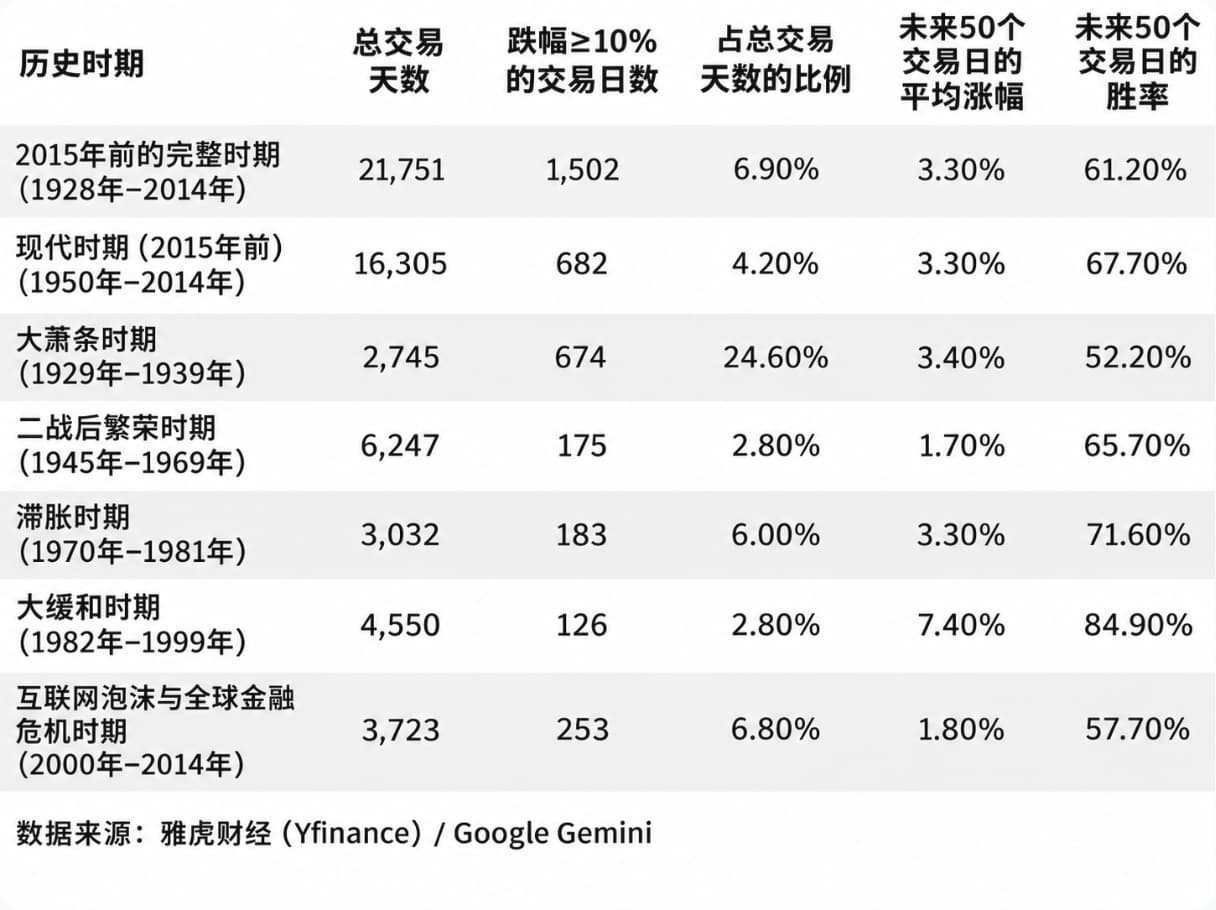
Historical statistics and the judgments of some strategists on Wall Street are providing a basis for the latter. Jessica Reeb ( Jessica Rabe ), co-founder of DataTrek Research, pointed out that since 2015, in cases where the S&P 500 index fell by 10% within 50 trading days, there was a 91% probability of a rise in the following 50 trading days, with an average increase of 10.5%.
It is worth noting that the 11 instances in history where there was no rebound in the following 50 trading days all occurred during the period of aggressive interest rate hikes by the Federal Reserve in 2022. Considering that the market is also currently concerned about the Fed sending hawkish signals, whether it will continue to maintain a tough stance amidst market turmoil remains uncertain. This historical pattern may provide some comfort to investors.
MarketWatch statistics from other historical periods also show that buying in after a 10% market decline, although the win rate and average increase are not as good as those since 2015, is still relatively effective overall. Even during the Great Depression, according to the historical data of the predecessor of the S&P 500 index, this strategy also achieved positive returns in most cases.
Volatility indicators also send out signals that deserve attention. Reb pointed out that the CBOE Volatility Index (_VIX) , which measures market panic, closed at its ninth-highest level since 2021. In the previous eight similar high levels, seven times it turned out to be a good entry point.
Analyst Nancy Berg (Nancy Berge) also noticed the changes in VIX. She told her clients that when the weekly VIX falls below 30, the market often sees a considerable rebound. Although this does not necessarily mean a significant increase or a reversal of the medium-term trend, it could at least temporarily alleviate the pressure of continuous selling.
In the early trading session on Monday, the S&P 500 index futures rose by about 2%, indicating that market sentiment has improved to some extent.
Morgan Stanley strategists shift to a bullish outlook
Morgan Stanley's chief equity strategist, Mike Wilson ( Mike Wilson ), has also shifted to a more optimistic stance in his latest report. He believes that the market's previous expectations for a decline in corporate earnings next year were overly pessimistic, and the stock market correction has created entry opportunities that deserve attention. This is also his most bullish outlook since April.
In his "Weekly Warm-up" report released on Monday, Wilson summarized the reasons for being bullish into three aspects: market sentiment, valuation, and investors' positions. He stated that the team would use technical indicators and other objective signals to determine the timing of entry, saying, "This is exactly the moment we've been waiting for," and described the current market environment as an "excellent opportunity" that investors can easily seize.
Morgan Stanley's proprietary market sentiment indicator combines 10 data points, including volatility, capital flows, and investors' positions, to measure market stress and risk appetite. Currently, this indicator has dropped to -1.6, which is the lowest level since December 2018 and the outbreak of the Iran-Iraq war in March 2026.
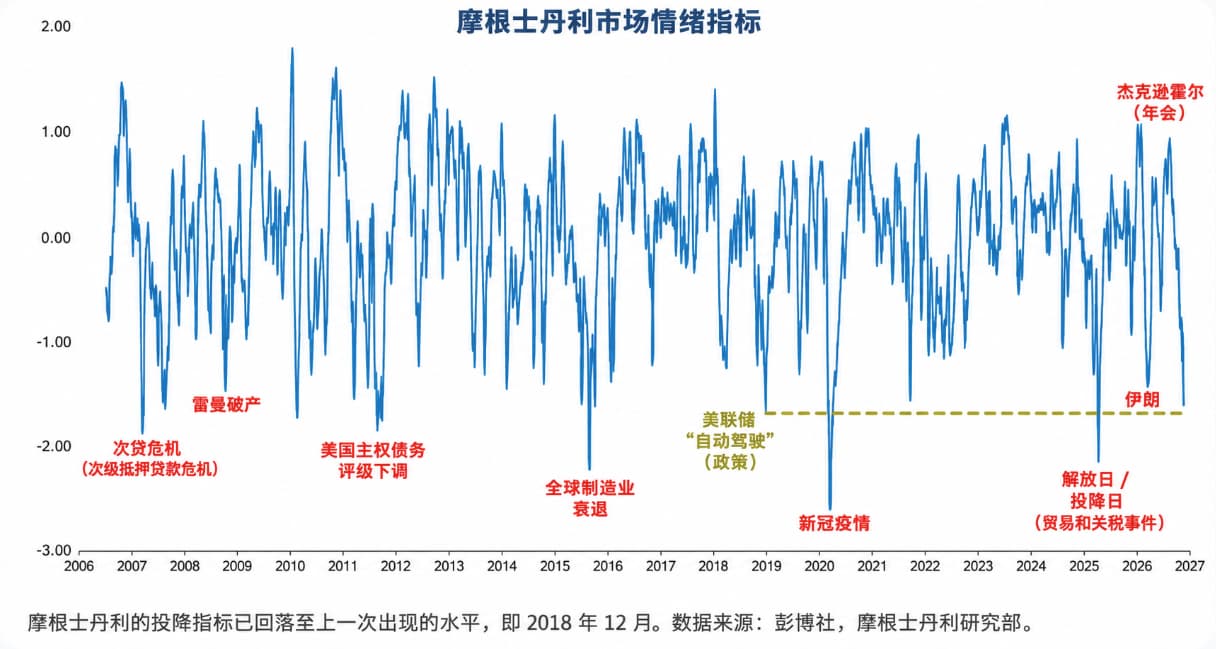
Other position data also shows that investors are significantly reducing their risk exposure. The VIX indicator once rose to 36, which is comparable to the level in December 2018; meanwhile, the net leverage ratio of hedge funds has dropped to 41%, slightly lower than that of December 2018. Wilson had been waiting for a clear sign of market sentiment and investor position liquidation, and these changes in indicators have strengthened his bullish outlook.
Corporate fundamentals are another form of support. Wilson believes that the current adjustment in profit expectations is at a positive 10%, whereas in December 2018, this figure was at a negative 10%. At the same time, the U.S. labor market remains quite robust, with the number of initial jobless claims at the lowest percentile of historical distributions.
In his view, with the upward revision of profit forecasts, corporate profit growth, and the resilience of the job market, there is no sufficient reason to interpret the current stock market correction as a precursor to an economic recession in 2027.
Valuation has taken into account significant profit risks, and the Federal Reserve remains a variable factor.
Wilson's team believes that the current stock price already reflects the expectation of a 6% decline in earnings per share next year, but Morgan Stanley analysts predict a 14% increase in earnings per share for next year, while the market consensus expectation is even as high as 17%. The gap between the two indicates that the market has already factored in a considerable degree of risk to earnings deterioration in advance.
Valuations also show similar changes. The current price-earnings ratio of the S&P 500 index is around 16 times, which is lower than the reasonable valuation range of 19 to 19.6 times suggested by Morgan Stanley. Wilson believes that this round of selling has created attractive entry points, and such opportunities are not common and will not last too long.
However, there is still an important risk associated with the bullish outlook: the Federal Reserve may continue to send hawkish signals.
Wilson's explanation for this is that previous market adjustments have, to a large extent, helped the Federal Reserve tighten financial conditions. The strengthening of the dollar and rising energy prices are compressing market liquidity, which has dropped to its lowest level since 2022 and is even more tight than in December 2018.
Therefore, Wilson believes that the current market pricing of the Fed's policy path may be too hawkish. He expects that the policy signals released by Federal Reserve Chairman Kevin Warsh ( Kevin Warsh ) at the December interest rate meeting may be more modest than what the bond market currently anticipates.
At present, the rapid correction of the S&P 500 index is still testing investors' confidence. Historical data, position liquidation, and valuation adjustments provide a basis for a rebound, but the subsequent policy direction of the Federal Reserve remains an important variable that determines whether the market can continue to recover.