RDDL's entire value proposition is built on verifiable, tamper-proof data. 🌋
Physical devices notarize performance data at the Cosmos/Tendermint layer. Settlement occurs on Blockstream Liquid. The upper tokenization layer queries this notarized data via API to drive on-chain records.
Each layer must operate stably, or the chain of trust will break.
1/3 - 🧵
This is precisely why RPC reliability is crucial.
When BESS cell charge/discharge data, health status, and operational events are read, notarized, and settled at fixed time intervals across multiple layers, any delay or downtime will create gaps in the audit trail.
Such gaps are unacceptable for MiCA-compliant tools.
2/3
Lava provides this stability for RDDL.
RPC ensures efficient data transfer throughout the entire process from device to notarization to settlement without disrupting the custodian chain at the infrastructure layer.
For @RDDLNetwork, the RPC layer is not a technical detail, but rather part of the trust architecture itself.
3/3
315
0
0
32
Mario Nawfal
07-26 12:30
フォロー
The surge in Grok 4.5 on Augment's Cosmos isn't just another spike in model selector numbers.
Interestingly, this growth stems from real engineering teams tackling large, complex, and production-ready codebases.
Augment's context engine already grants models exceptionally strong codebase-level understanding.
As developers begin to delegate more of these demanding tasks to Grok 4.5, it demonstrates the model's excellence in what truly matters in everyday work:
Multi-file inference, architecture awareness, and stable performance even with massive context sizes.
Most of the hype surrounding "AI coding" remains confined to demos and small codebases.
On a platform built for serious agent work, consistent weekly growth signals something different.
This suggests Grok is transitioning from a "fun alternative" to a "trusted main tool," becoming a valuable asset for developers delivering real software.
Source: @grok / Author: Claudio
305
0
0
27
Tesla Owners Silicon Valley
07-26 05:27
フォロー
News: Grok 4.5 saw the highest weekly usage increase among all models in Augment Code's Cosmos selector.
• Grok 4.5's weekly usage growth was the highest among all supported models.
• More and more developers are choosing Grok to handle large, complex codebases.
• Combined with Cosmos's context engine, Grok 4.5 can better understand massive codebases, software architectures, and the relationships between different parts of the codebase.
• This growth reflects real-world usage by developers, not just benchmark performance.
Grok 4.5 is rapidly rising to become one of the leading AI coding models suitable for serious software engineering.
@elonmusk
425
0
0
45
Whale Insider
07-22 22:59
フォロー
Breaking news: 🇪🇺 @BTQ_Tech $BTQ is expanding in Europe. QPerfect is collaborating with the aQCess project at the University of Strasbourg to develop a digital twin for France’s first public 400+ qubit neutral atom quantum computer.
417
0
0
39
火星财经
07-16 13:39
フォロー
🔔NVIDIA Releases Multiple Physics AI Products, Two Robot Computing Modules to Launch Next Year
Mars Finance News, July 16th: From the evening of July 15th to the morning of July 16th (Beijing time), NVIDIA announced a series of new products, enriching its robot hardware lineup. NVIDIA announced the launch of the Jetson T2000 and T3000 robot computing modules based on the Thor architecture. The Jetson T2000 boasts 400 TFLOPS (FP4 precision) at 40 watts of power, while the T3000 achieves 865 TFLOPS (FP4 precision) at 70 watts of power. It is understood that the two new computing modules will be available in the first quarter of next year, after which NVIDIA's Jetson computing modules will cover a computing power range from 70 TOPS to 2000 TFLOPS. On the model front, NVIDIA announced the expansion of its Cosmos 3 open-source foundational model family for physics AI, adding a lightweight model, Cosmos 3 Edge, compatible with the Thor architecture platform, in addition to Cosmos 3 Super and Nano. The new model has 4 billion parameters and can be used to assist embodied systems in perceiving the world, inferring in real time, making on-device predictions, and generating actions. For vision applications, NVIDIA's Visual AI Application Platform and Partner Ecosystem, Metropolis, has also added several toolkits to assist developers in creating visual AI agent functions and generating synthetic data. (Yicai)
352
0
0
48
Solana Foundation
07-15 03:56
フォロー
I'm compiling a list of potential debate topics for this fall's @solana Breakpoint conference—looking for exciting topics that can spark real debate. Participants need to demonstrate genuine conviction, a firm stance, and excellent speaking skills.
Here are a few topics I've listed:
- Venture capital is doomed
- Collectibles will decline like NFTs
- Prediction markets should be banned
- The stablecoin war—the debate between USDG/USDC/USDT/OUSD/PYUSD
- Atom is popular, but not a good investment choice
What other topics should I add? Who do you think would be the best speakers on these topics?
336
0
0
32
余烬
07-03 23:28
フォロー
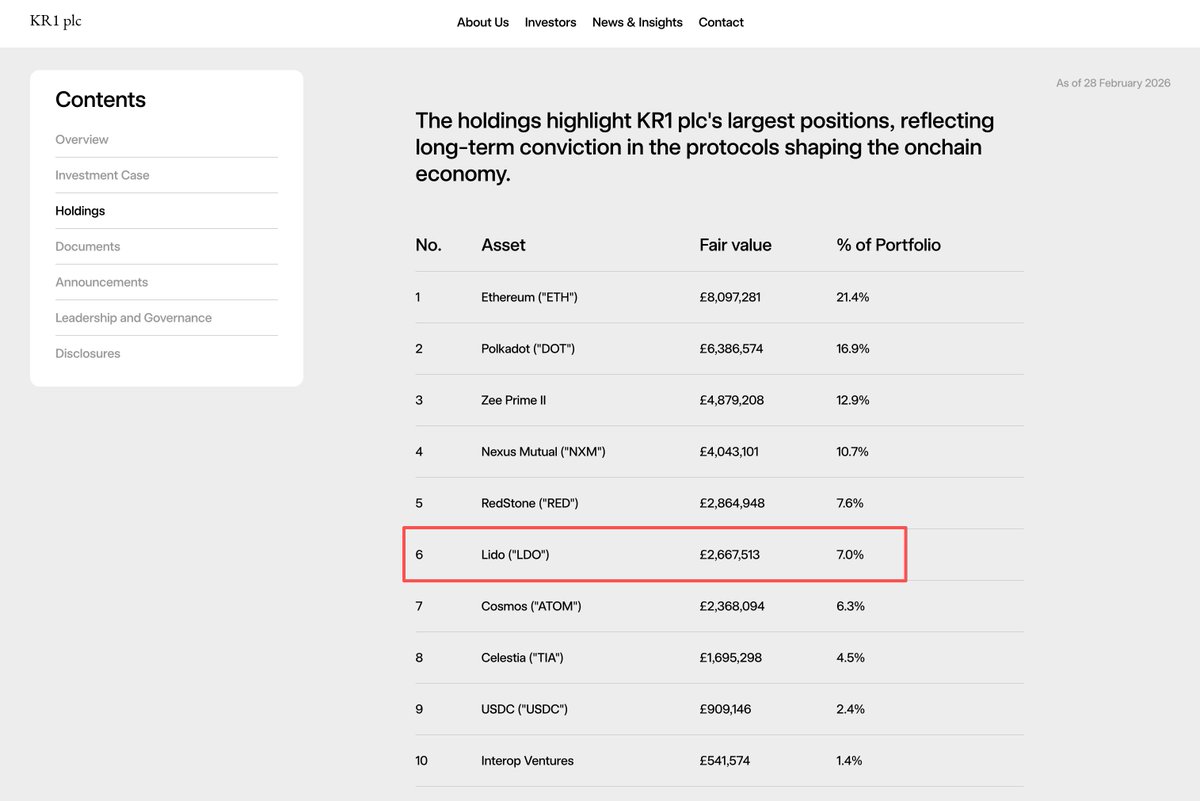
KR1plc, a London Stock Exchange-listed digital asset technology company and an investor in Lido, transferred 3.7 million LDO tokens ($990,000) to Kraken an hour ago.
Even listed companies can't hold on and are selling at such a low price?
However, considering their holdings, it's understandable. In today's terms, they're mostly "old hands": they hold ETH, DOT, NXM, RED, LDO, ATOM, TIA, etc., all of which have basically halved in value this year.
Address:
-------------------------------------------------------------------------- #Bitget VIP membership! Crypto, US Stocks, CFD, global opportunities all in one place.
380
0
0
37
Lava Network 🌋
07-03 04:06
フォロー
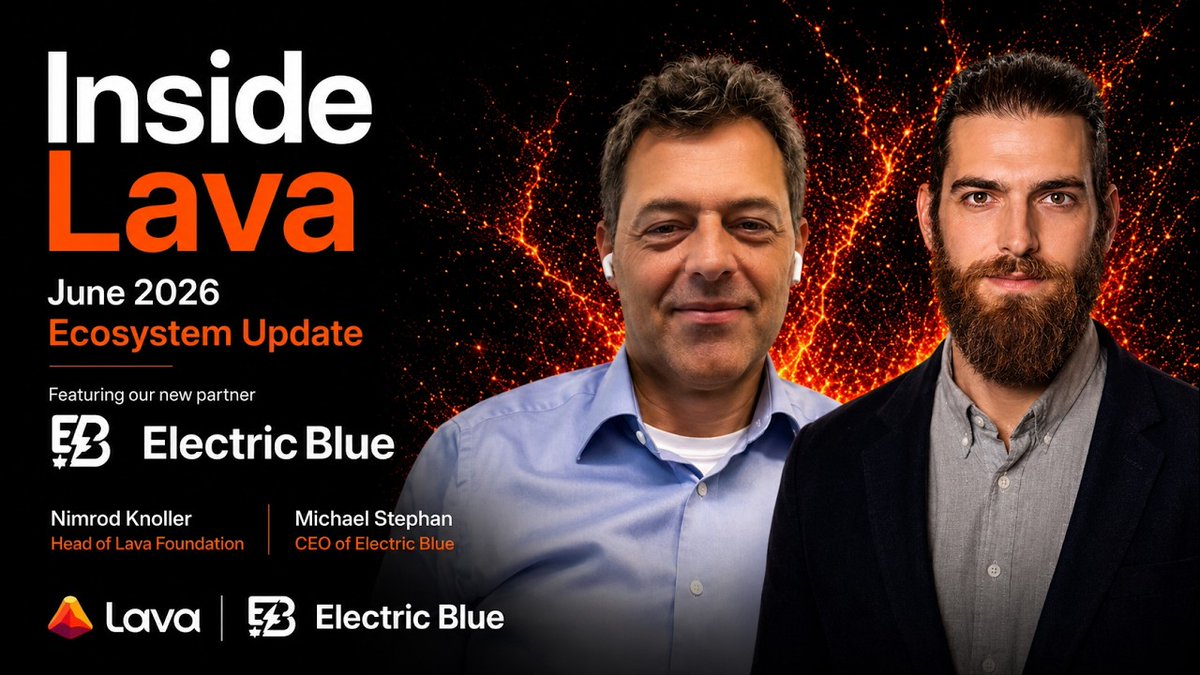
Lava's June ecosystem call is now live, featuring our newly announced partner, Electric Blue. 🌋
Summary:
• Two tokenization sandbox initiatives are underway: Alba Bay and Electric Blue's battery storage project in Germany.
• Gateway V2 is in testing and scheduled for release next week, streamlining the registration and payment process.
• Delay optimizations are being rolled out incrementally, starting with Cosmos Hub and then expanding to the main EVM chain.
• A brand-new chain dashboard is coming into Beta testing, improving transparency of network activity and the token economics model.
Watch the full call:
460
0
0
31
Edgy - The DeFi Edge 🗡️
06-30 21:59
フォロー
This quarter saw the collapse of many genuine cryptocurrency projects.
Not scams, not empty promises, and not spooky ghost chains. These were real teams with funding, users, well-known investors, released products, and years of hard work.
Here are some examples:
• Yupp, backed by a16z, boasted over 1.3 million users and generated revenue through its AI lab.
• Loopring, with a peak Total Value Locked (TVL) of approximately $760 million, was one of Ethereum's early zero-knowledge proof (zk-rollup) decentralized exchanges (DEXs).
• NFTfi processed over $730 million in NFT-secured loans over six years.
• Syndicate raised $27.8 million to build its on-chain infrastructure.
• Legend raised approximately $15 million to develop more streamlined mobile DeFi applications.
• Leap was one of the most well-known wallets on Cosmos.
• Satori and Ranger Finance are attempting to compete in the cryptocurrency space.
• CharmVerse built DAO tools and handled grant coordination.
• Dmail operated a decentralized email service for five years.
And that's not all.
Disturbingly, most of these products weren't entirely without merit. Some even succeeded.
• NFTfi is perhaps the most obvious example. In six years, it issued $750 million in NFT-backed loans and never lost a single NFT. The product itself wasn't flawed; it was simply that the market around it was too small to sustain.
• Yupp surprised me the most. It was an application combining artificial intelligence and cryptocurrency, boasting top supporters, over 1.3 million users, and a revenue-generating AI lab. On paper, it was the combination everyone dreamed of, yet it still failed.
• Loopring was no small-scale anonymous experiment either. As one of the early zero-knowledge-sharing (ZK-rollup) decentralized exchanges (DEXs), it raised substantial funds and reached true Total Value Locked (TVL) in the last cycle. However, the L2 crypto landscape has shifted, with newer design approaches taking over.
• Syndicate faces similar issues, albeit in a different category. It boasts a strong team, robust infrastructure, and has raised nearly $28 million over five years. But infrastructure only makes sense if enough people use it and pay for it.
• Legend also feels familiar. For years, there has been a craving for a DeFi mobile app with a clean interface, more like a traditional fintech application. It turns out that a better user experience and opening the app weekly are two different things.
Next comes trading and malicious projects. SatoriRanger Finance and 0xPPL have encountered similar bottlenecks:
- Trading activity remains concentrated on a few exchanges.
- Everyone else is vying for the remaining resources.
- Decentralization, multi-chain support, or better design help, but none of these alone can solve the allocation problem.
• The Leap wallet market is extremely competitive. It has a strong brand presence within Cosmos and supports over 100 blockchains, but its survival depends on the health of its surrounding ecosystem. If the ecosystem doesn't generate demand, brand recognition is useless.
• CharmVerse and Dmail face similar issues from both a consumer and tool perspective. Utility software doesn't always reach venture capital-scale markets. DAO tools, decentralized email, authorized coordination, on-chain social networking, etc., are more likely to thrive when there is more funding, more attention, and more people trying new things.
• Oxium, a Sei-based decentralized exchange. However, its revenue is no longer enough to cover operating costs.
This is precisely where it's underestimated. A protocol can have users, tokens, investors, and even a real product. But profitability is key if revenue isn't enough to cover the costs of maintaining its operation.
Ultimately, all protocols must operate like businesses to survive.
It's noteworthy that some teams have handled the end-of-life phase well. For example, ux.xyz employed an orderly liquidation process, using reserves to cover funding gaps. BuckToken allows holders to redeem 100% of their principal from its full backing assets. A dignified exit is far better than pretending everything is fine until users are harmed.
More importantly, the market no longer just filters out scams and obvious failures; it also filters out excellent products designed for larger, more liquid markets. More experimental cryptocurrencies don't yet exist.
Let's look at how things have changed:
• NFT liquidity is only a fraction of what it used to be.
• Fund flows continue to concentrate on a few exchanges.
• Gaining the attention of wallet users has become increasingly difficult in each cycle.
• The development of DAO tools is no longer as urgent.
• Consumer-grade cryptocurrencies remain extremely difficult to access.
So, when people ask why there are fewer mid-sized winners in this cycle, here's the answer.
375
0
0
30
飞凡
06-20 23:38
フォロー
Major altcoins that have fallen below their 2022 bear market lows:
$ADA
$AVAX
$DOT
$ATOM
$LTC
$SHIB
$UNI
$FIL
$XTZ
While Bitcoin remains above $60,000.