It seems that the South Korean stock market has stabilized. If the South Korean stock market stabilizes, the hardware sector in the US stock market will probably stabilize as well. This includes a series of stocks that have corrected this time, such as Hynix, Micron, SanDisk, Marvell, Intel, etc. So:
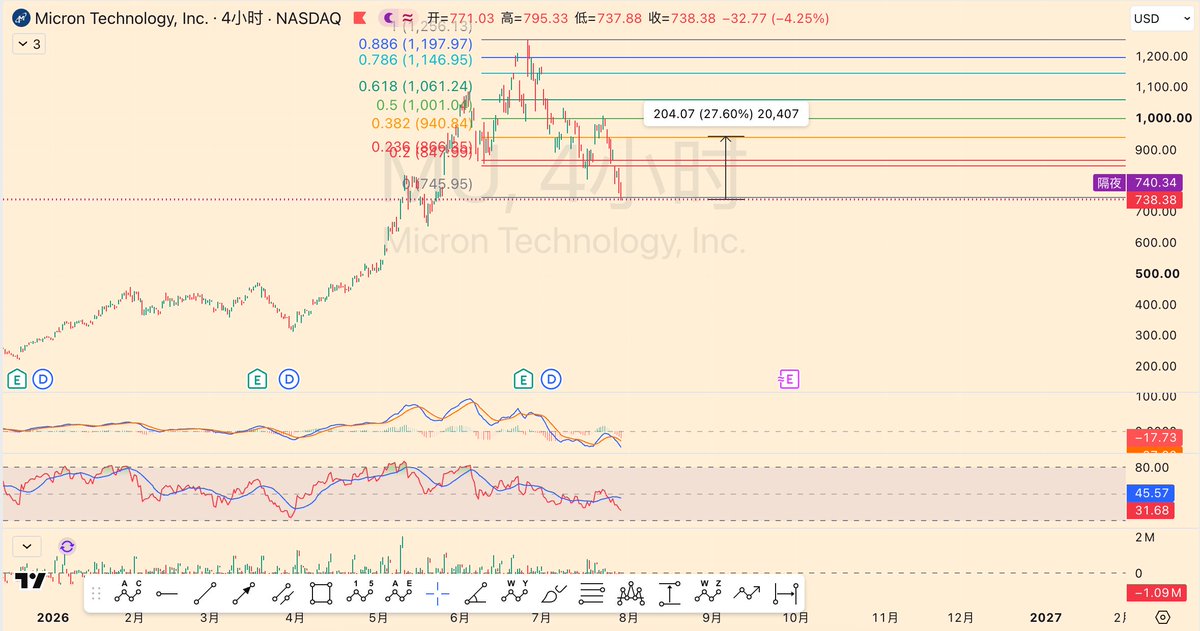
1⃣️I think my trading skills are average, and my bottom-fishing entry points were passable. My personal thought is to hold on, since I've already held on during the worst times, there's no reason to sell just because things seem to be improving. (Micron example, Figure 1)
2⃣️Here's a point worth mentioning: during a violent sell-off, if a complete chart pattern, a key price level, and a surge in sentiment resonate, providing an entry opportunity, then based on the characteristics of hardware stocks during this period, a large margin of error is necessary. Simply put, a stop-loss of less than 10% is essentially giving away free money. The correct approach is to enter in 2-3 batches, giving me about 20% margin of error. If managed well, the average entry price will be at most about 10% higher than the lowest point.
3⃣️Even now, when the market is forming a bottom, significant fluctuations are still unavoidable. As I mentioned before, these stocks have risen so much that they are expected to exhibit these characteristics.
370
0
0
30
币安Binance华语
フォロー
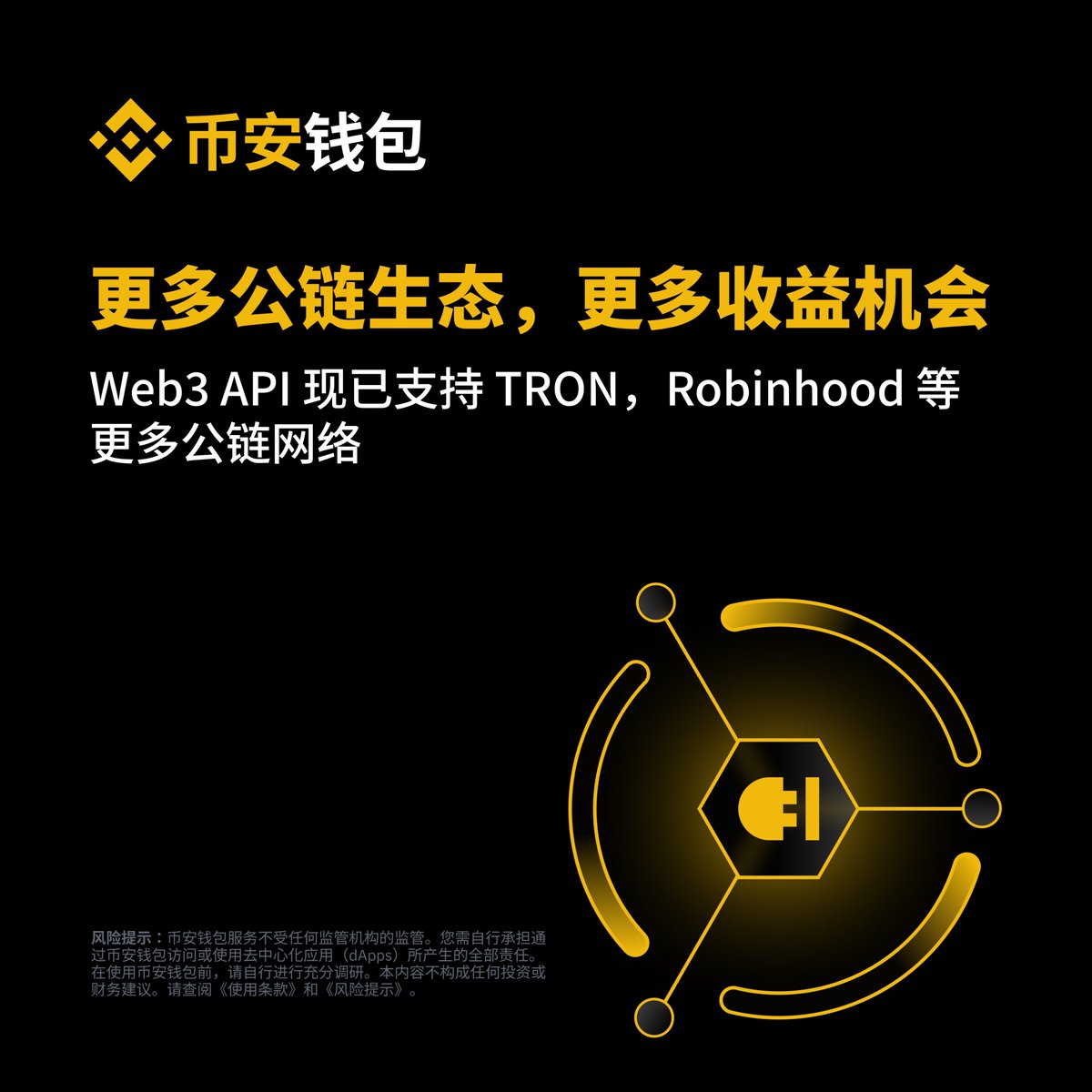
🚀 Binance Web3 API now supports more public blockchain networks.
You can now develop on the following public chains:
✅ TRON
✅ Robinhood Chain
✅ Avalanche C-Chain
✅ Scroll
✅ Mode
✅ Sonic
✅ Katana
✅ Metis Binance Web3 API now supports 18 chains (including Ethereum, BNB Chain, Solana, Base, Polygon, Arbitrum, Optimism, etc.), allowing you to easily integrate with more ecosystems with a single API.
👉 Learn more:
361
0
0
44
Pantera Capital
フォロー
Agents can plan and schedule multi-step tasks, but can get stuck at the registration form. @orthogonal_sh replaces account creation, API keys, and billing with an integrated solution.
@chrisspickett and @berasogut1 (Orthogonal) are guests on the Stateful podcast hosted by @masonnystrom.
In this episode, they discuss the infrastructure needed for the agent economy:
- Access to dozens of verified service providers via a single API
- Agents can discover, invoke, and pay based on usage (in cents)—no accounts, keys, or subscriptions required
- Truly effective micropayments, supporting both automated spend tracking and manually configured payment strategies
- Support for all major agent payment standards (X402, MPP, etc.)
YouTube:
Spotify:
Apple Podcasts:
404
0
0
46
链研社|AI First🔶💧
フォロー
Always lacking storage, with such strong fundamentals and such a low P/E ratio, how did I get trapped? The biggest lesson learned in the market is not knowing how to invest effectively.
It took me several years to figure out how to invest effectively; misjudging stocks was the real challenge. I used to think that progress in investing meant learning more methods: technical analysis, market sentiment, financial statements, value investing, momentum, swing trading—I wanted to learn everything.
Later, I discovered that the mature path is the opposite: constant elimination.
Eliminate those without a margin of safety, those requiring predictions of tomorrow's price, those requiring eight hours of constant monitoring. The fewer methods I used, the clearer I became about what I was doing. It took me a lot of tuition to understand this.
In 2022, I was liquidated after going long on a 3x position in cryptocurrency; that was the most emo moment of my life. The lesson is etched in my bones: even if you think something is very cheap, cut your losses when necessary; don't hold onto losing positions. Losing money taught me a lesson.
But later I discovered that a more insidious pitfall than leverage was those investments where the direction was correct, but you couldn't hold onto them, or investments you held onto, but the fundamentals and market sentiment had changed.
Many people bought Tesla because they saw a long-term story that no one else had: Robotaxi, Optimus, Physical AI. If the story comes true, valuing it within the framework of an automotive company would certainly underestimate it, but the problem is, you don't know how long you'll have to wait.
When will Robotaxi achieve large-scale commercialization? When will Optimus be meaningful for EPS? 2027? 2030? We don't know.
You might be on the right track, but you can't know how far you are from the answer.
I later understood a concept: the shelf life of a narrative. Some assumptions have a time frame—the next quarterly report, product cycle, gross margin—every three months you get new evidence, and even if it drops, you know what you're waiting for.
Some assumptions don't have a time frame. Humanoid robots will one day be a huge market—yes, when? We don't know. Every investor has their own real time zone. People talk about long-term investing, but get anxious when stocks don't rise for a year, and start to doubt when they drop 30%. This doesn't mean they lack discipline; it might just mean the real time zone is different from what they think.
There's another point many people misunderstand. The market is a ranking game, not just a valuation game. If fundamentals haven't worsened, it doesn't mean the ranking hasn't changed. If A's fundamentals haven't deteriorated at all, but B's expected return suddenly becomes higher, funds have no obligation to return to A. A may not have worsened, and might even be cheaper, but it's no longer number one.
The best example is storage. With storage revenue already so large, doubling it again is incredibly difficult. There's a ceiling to how much money can be made in the market, and on the other side, there are undervalued software stocks, etc. So now I often ask myself, starting today, is this the most worthwhile place to put a dollar among all my options?
As for why I don't just copy expert strategies, you see experts adding to their positions when the price drops 30%, but you don't see they originally only had a 2% position, no leverage, 30% cash on hand, and had researched the company for ten years.
You have a 25% position with leverage, you've been researching for two weeks, and you're adding to your position too. It seems like the same thing on the surface, but it's a completely different trade, especially with the storage sector this time – it's easy to get carried away, and some people have suffered huge losses.
Never just copy actions; understand the entire system supporting those actions.
This is my biggest takeaway from the past few years: I've started to know which money I shouldn't be making. Some people can do memes, some can hold onto companies with only a ten-year vision for five years, some can make many times their initial investment in options trading every day – that's great, but that might not be my money.
When I see opportunities where others make a lot of money, I no longer rush to ask why I didn't. I can calmly know that it's not my game. This is probably the true sign of maturity.
Later, when I see a good opportunity, I ask three questions:
Why this company?
Why now?
Why is this money suitable for me to make?
The third question has no answer. Even if it increases tenfold, I can accept that it's not my money. The market, having paid this tuition, is probably trying to tell you that you should start to know how to invest effectively.
461
0
0
38
Shiv
07-29 04:11
フォロー
We taught Claude Code and Codex how to create videos using HTML and video generation models.
This skill, called /goose-video, contains many different video "recipes."
Running this skill in Claude Code or Codex will:
> Understand your brand
> Draft video concepts, scripts, assets, etc.
> Download videos from Gooseworks to create recipes
> Create ads using HTML and/or video generation models
> Watch videos for review, iteration, and fixing any issues
> Add end credits
> Stitch the final mp4 videos together and present them to you for review.
Oh, and if you need any modifications…
Please feel free to suggest them.
Here are some templates 👇
366
0
0
43
吴说区块链
07-28 20:55
フォロー
According to CNBC, U.S. Representative Jodey Arrington's H.R. 9172 bill proposes to extend the "wash sale rule" of traditional financial markets to crypto assets. If an investor sells crypto assets at a loss and then repurchases substantially the same asset within 30 days before or after the sale, the loss will not be immediately deductible from taxes. The IRS currently generally treats crypto assets as property, therefore directly held BTC, ETH, etc., are generally not subject to current wash sale rules. The bill has not yet passed, but eligible USD stablecoins and certain mining and staking assets are proposed to be exempt.
461
0
0
22
撸币养家 | lubiyangjia.eth
07-27 22:25
フォロー
I've been following @okxchinese's US Stock Dual-Currency Winner. I think its greatest value isn't its pursuit of high returns, but rather that it transforms strategies previously only accessible to option traders into products that ordinary users can understand.
For popular instruments like NVDA, TSLA, and AAPL, market expectations for volatility typically amplify before earnings season, leading to higher implied volatility (IV). For professional traders, higher IV usually translates to higher premiums from selling options; however, trading options requires researching strike prices, expiration dates, margin requirements, etc., which is quite a barrier to entry.
I understand Dual-Currency Winner as a simplification of this logic: you only need to decide in advance at what price you're willing to buy or sell, then set your target price and timeframe, and settle according to the rules, without needing to study complex option parameters yourself.
Of course, this doesn't mean there's no risk. All investment products carry opportunity costs and price volatility risks. I think it's more important to treat it as a supplementary trading tool, not a form of short-term speculation.
The above is just my learning experience and does not constitute any investment advice.
317
0
0
40
Anndy Lian
07-27 17:30
フォロー
Listing fees are almost always considered non-refundable if a project is delisted simply because of low trading volume, poor liquidity, or failure to meet sustainability requirements.
A project pays a listing fee and gains access to the exchange's users; even if the outcome is disappointing, the service has been delivered. Exchanges usually explicitly state this in their listing agreements.
The situation appears different when the exchange itself shuts down: the project hasn't done anything wrong, but the ongoing value of the listing (continuous trading pairs, order books, market exposure, etc.) vanishes overnight. From a purely business perspective, many believe centralized exchanges (CEXs) should at least refund a portion of the fee.
Listing fees/margin/marketing packages are typically considered one-time payments for listing. Contracts almost never include clauses triggering refunds in the event of an exchange's closure.
If you still want to pay for listings and still believe more CEXs will go bankrupt:
Remember to include this clause in your contract next time.
497
0
0
30
蓝狐
07-27 14:32
フォロー
On-chain finance is an almost unstoppable trend: first the tokenization of the US dollar (stablecoins), then stocks/bonds, and then gold/real estate, etc.
The vast majority of assets in the future will operate on-chain. Stablecoins are similar to the early days of newspapers/magazines moving online; this can be seen as the early days of the internet.
Ethereum will be one of the most important players in the era of on-chain finance.
327
0
0
42
Anndy Lian
07-27 11:50
フォロー
Listing fees are almost always considered non-refundable if a project is delisted simply because of low trading volume, poor liquidity, or failure to meet sustainability requirements.
A project pays a listing fee and gains access to the exchange's users; even if the outcome is disappointing, the service has been delivered. Exchanges usually explicitly state this in their listing agreements.
The situation appears different when the exchange itself shuts down: the project hasn't done anything wrong, but the ongoing value of the listing (continuous trading pairs, order books, market exposure, etc.) vanishes overnight. From a purely business perspective, many believe centralized exchanges (CEXs) should at least refund a portion of the fee.
Listing fees/margin/marketing packages are typically considered one-time payments for listing. Contracts almost never include clauses triggering refunds in the event of an exchange's closure.
If you still want to pay for listings and still believe more CEXs will go bankrupt:
Remember to include this clause in your contract next time.