The recent phasing out of low-adoption assets and networks on the Aave platform should not be interpreted as a sign of a shift in attitude towards any L1 or L2 layer. The goal is simply to reduce Aave's operational, technical, and economic risks so that we can focus on more impactful priorities, such as developing existing high-value markets and expanding securities financing.
L2 layers remain crucial for the Ethereum user experience. For example, the Aave App's stablecoin uses an L2 layer as its ledger layer, which will facilitate integration with the mainstream DeFi user base. Similarly, networks like Avalanche play a vital role in bringing RWA (Risk-Weighted Assets) onto the blockchain for institutional business expansion, a historically weak area for Ethereum.
331
0
0
27
币安Binance华语
フォロー
🚀 Binance Web3 API now supports more public blockchain networks.
You can now develop on the following public chains:
✅ TRON
✅ Robinhood Chain
✅ Avalanche C-Chain
✅ Scroll
✅ Mode
✅ Sonic
✅ Katana
✅ Metis Binance Web3 API now supports 18 chains (including Ethereum, BNB Chain, Solana, Base, Polygon, Arbitrum, Optimism, etc.), allowing you to easily integrate with more ecosystems with a single API.
👉 Learn more:
361
0
0
44
Token Terminal 📊
07-29 00:23
フォロー
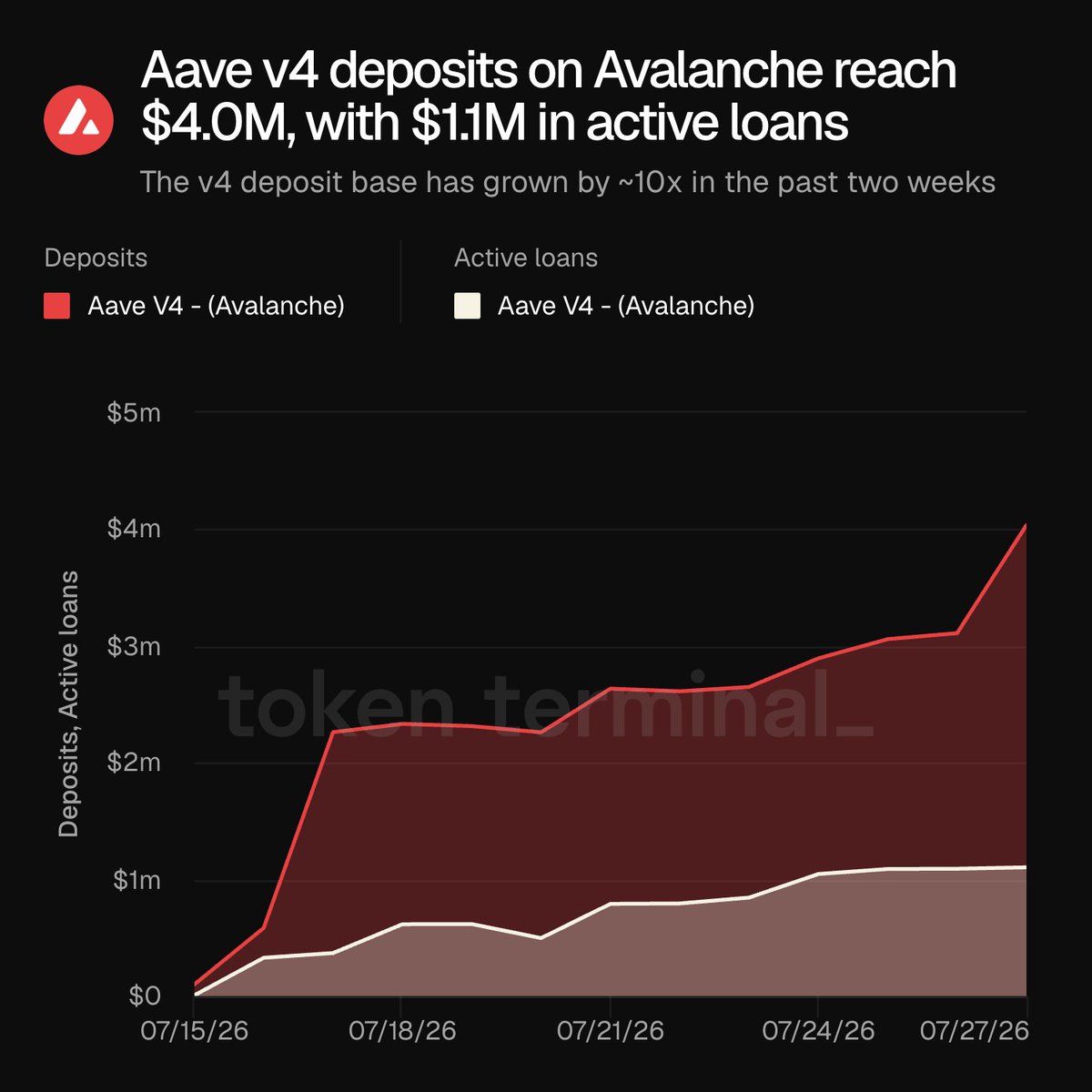
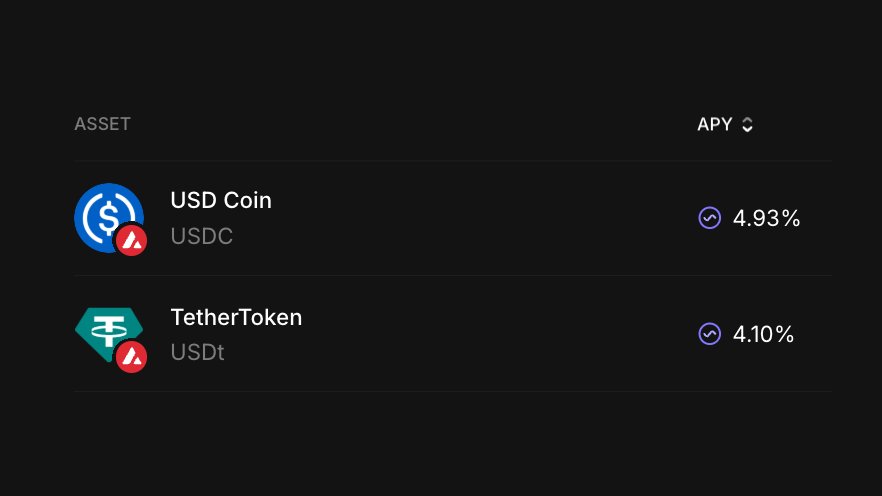
Aave v4 has reached $4 million in deposits on the @avax platform, with $1.1 million in active loans.
In the past two weeks, v4's deposits have grown approximately tenfold.
Products and networks to watch 👇
306
0
0
47
CoinMarketCap
07-28 16:27
フォロー
Breaking news: 📊 Data from Bitwise shows that despite the prices of Ethereum (ETH), Solana (SOL), and Avalanche (AVAX) all falling by about 50% or more over the past year, trading activity for Ethereum, Solana, and Avalanche has increased, and transaction costs have decreased.
349
0
0
34
Crypto Tony
07-28 05:02
フォロー
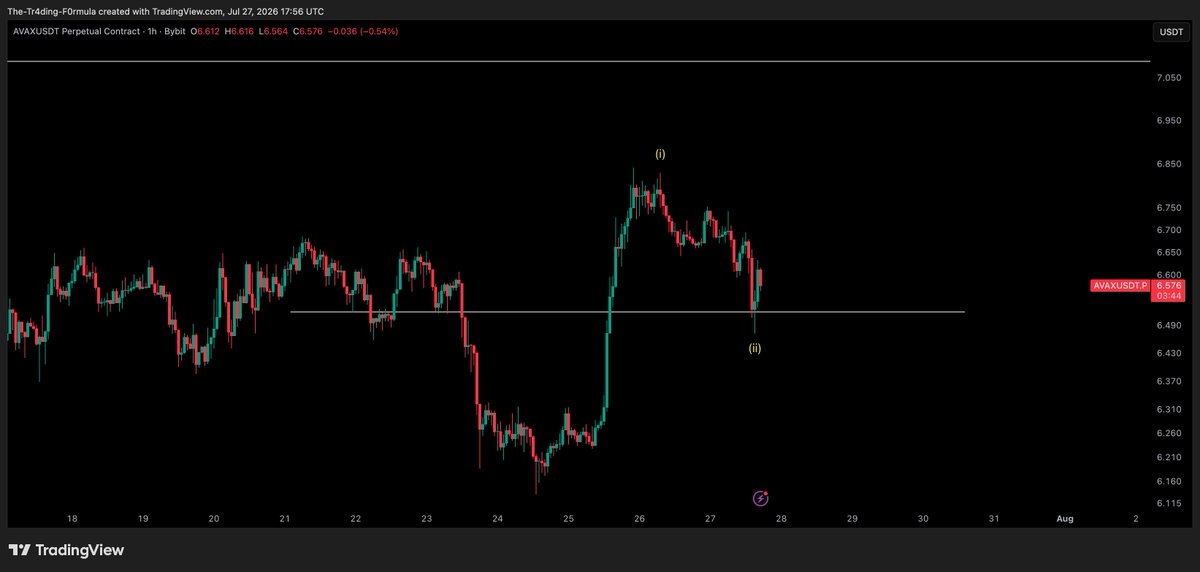
$AVAX / $USD - Latest Updates
Keep a close eye on this; if Bitcoin can remain stable, AVAX/$USD could see another surge.
380
0
0
45
Stani
07-26 21:06
フォロー
Incentives are still available for USDC and USDT vendors who deploy the V4 version of @aave on @avax.
364
0
0
43
PlanB
07-26 01:02
フォロー
The topic of fork filters.
I usually don't have time, but this morning I listened to a discussion on Twitter earlier this week featuring some well-meaning Bitcoin newbies sharing their thoughts and concerns, and why they thought supporting #110 was reasonable.
After listening, my feeling was that if these were the people with #110 in their usernames, I regret to see them fork and ultimately be disappointed because they don't understand why Bitcoin strongly rejects #110.
So, I'm offering a more empathetic, constructive, and higher-level explanation of why #110 shouldn't be supported. I hope this explanation is simple enough to understand, starting from basic principles.
They seem to want to understand people's thoughts and are skeptical of people's intentions. So, if someone asks me why Bitcoin is important, what it is, I would say that my personal mission and expectation for Bitcoin is to build a cypherpunk future, and the "avalanche" event is just a blueprint, from which to work backward. I hope that Bitcoin can ultimately achieve a completely free market through non-seizure, mathematically sound hard currency. Not everyone can accept this level of freedom, but that's just my opinion. And surprisingly, I think it's a positive development that even today, many governments are beginning to understand and value Bitcoin's gold-like mathematical reliability. Others may hold more moderate views than I do, but still appreciate this currency's ability to effectively resist censorship.
For the sake of motives (if that's not obvious enough): I utterly despise spam, which is why I designed HashCash nearly thirty years ago when I was researching decentralized bearer currencies with others and running nodes in privacy-focused cypherpunk P2P networks.
People seem unhappy about the change in Bitcoin's default refund policy. I just want to assert that the reasons for Bitcoin changing its default relay strategy are perfectly valid and simple, but most people haven't done their homework and don't know what those reasons are. Perhaps it's due to a lack of technical understanding, despite thousands of posts attempting to explain it in various simplified ways. This lack of understanding leads to the spread of misinformation. So, here's a higher-level explanation from a fundamental perspective.
The decentralization required to create cypherpunk currencies has several implications: a side effect is that you can't impose your views on others. This very mechanism that facilitates decentralization runs counter to the goal of BIP 110, whose fundamental purpose is to regulate others. I understand supporters disagree, but please consider this carefully.
You can modify your own software, but you can't modify other people's. Another crucial and extremely powerful technological immune system of Bitcoin is that it cannot allow those who lack technical understanding to deliberately compromise its security, decentralized robustness, and core properties. Doing so would quickly lead to disastrous consequences, and people would fight back.
Therefore, Bitcoin's message is: it politely says "no" to what you want. I'm sorry, Bitcoin users do understand and sympathize with your good intentions, your lofty ideas are reasonable, and your proposed defense of Bitcoin is reasonable, but these ideas lack a practical basis. Moreover, without realizing this, your approach to realizing these ideas fundamentally conflicts with the free, permissionless nature of cypherpunk currencies.
My advice is to listen to those with more experience who understand the system and how it works. No matter how many details you want to know, delve into the fundamental reasons why decentralization and cypherpunk currencies inevitably lead to these consequences.
I can assure you that the developers and the protocol ecosystem value and prioritize bearer hard currency (and their aversion to spam) as much as, or even more than, you. You may disagree with individual developers' choices, opinions, or ways of expression. However, you also need to understand that decentralized technical consensus mechanisms like the IETF build a protective anti-change mechanism that effectively protects Bitcoin's mission. This means that no developer can change anything without the technical consensus of hundreds of other developers and protocol observers. These observers are meticulous, knowledgeable, and intelligent individuals who won't overlook any unresolved technical issues. It is precisely because of this technical consensus that this protective anti-change mechanism is so powerful, decentralized, and has a multiplier effect.
Many technically skilled mainstream developers, with their cypherpunk-esque mission-driven mindset, are likely more committed than you to understanding and appreciating freedom on permissionless networks. This is because many of you may still be subconsciously influenced by the "Matrix," which they have long since transcended and immersed themselves in decades ago. They think naturally in this field, while you are still only scratching the surface. Many haven't truly understood or experienced how the internet works—a field without police, without policy authority, only mathematics, free markets, and hard currency. Unfortunately, this will also influence your perspective.
Now, face a harsh reality: if you are unwilling to listen to rational opinions, unwilling to educate yourself, unwilling to learn, then the same freedom applies to you: your permissionless action is to unite and create a fork. But Bitcoin will not join in. (No offense intended.)
Rejoin Bitcoin now, or if you still have doubts and need to experience the failure of the 110 fork firsthand to begin your reflection and learning journey, you can join later. It would be a regrettable thing if Bitcoin lost confidence due to a lack of understanding of how it works. We are all working hard to defend Bitcoin and keep it moving towards its intended goals. Incidentally, this includes the technical advocates of 110.
487
0
0
42
Crypto Tony
07-25 22:52
フォロー
Looking back at 2021-2023, we witnessed:
AVAX rose from $9 to $50
SOL rose from $8 to $120
INJ rose from $1.10 to $45
FET rose from $0.05 to $0.75
LINK rose from $4.90 to $17.00
What's next, you legendary figures?
306
0
0
22
吴说区块链
07-24 07:34
フォロー
Wu learned that Bitwise released its "Q3 2026 Staking Report," analyzing staking, on-chain activity, and network revenue for Ethereum, Solana, Hyperliquid, Avalanche, NEAR, and Tempo based on data from Q2 2026. The report indicates that most public chains experienced a phenomenon of "increased on-chain activity and decreased protocol revenue," primarily due to increased block space supply from scaling and fee reductions, rather than a general decrease in demand. Ethereum's active staking rose to 40.2 million ETH, representing approximately 33% of the supply, but network revenue fell to $64 million; Solana's staking rate was approximately 68%, with 9.8 billion non-voting transactions, and network revenue decreased to $51 million.
The report also shows that Hyperliquid's perpetual contract trading volume reached $652 billion in the second quarter, with non-crypto asset trading accounting for 32%; NEAR base chain revenue declined, but Intents-related fees increased; Tempo processed approximately $386 million in stablecoin transfers in its first full quarter after launch. Bitwise stated that institutional participation is entering the public chain ecosystem through staking funds, tokenized assets, and on-chain payments, and various networks are also upgrading to improve scalability and transaction performance.
376
0
0
34
Grayscale
07-23 22:43
フォロー
Multiple blockchains are driving tokenization in different ways.
Ethereum (ETH) → Home to the largest RWA market
Sol (SOL) → Home to xStocksFi
Link (LINK) → Home to DTCC
AVAX → Home to Apollo's tokenized credit platform