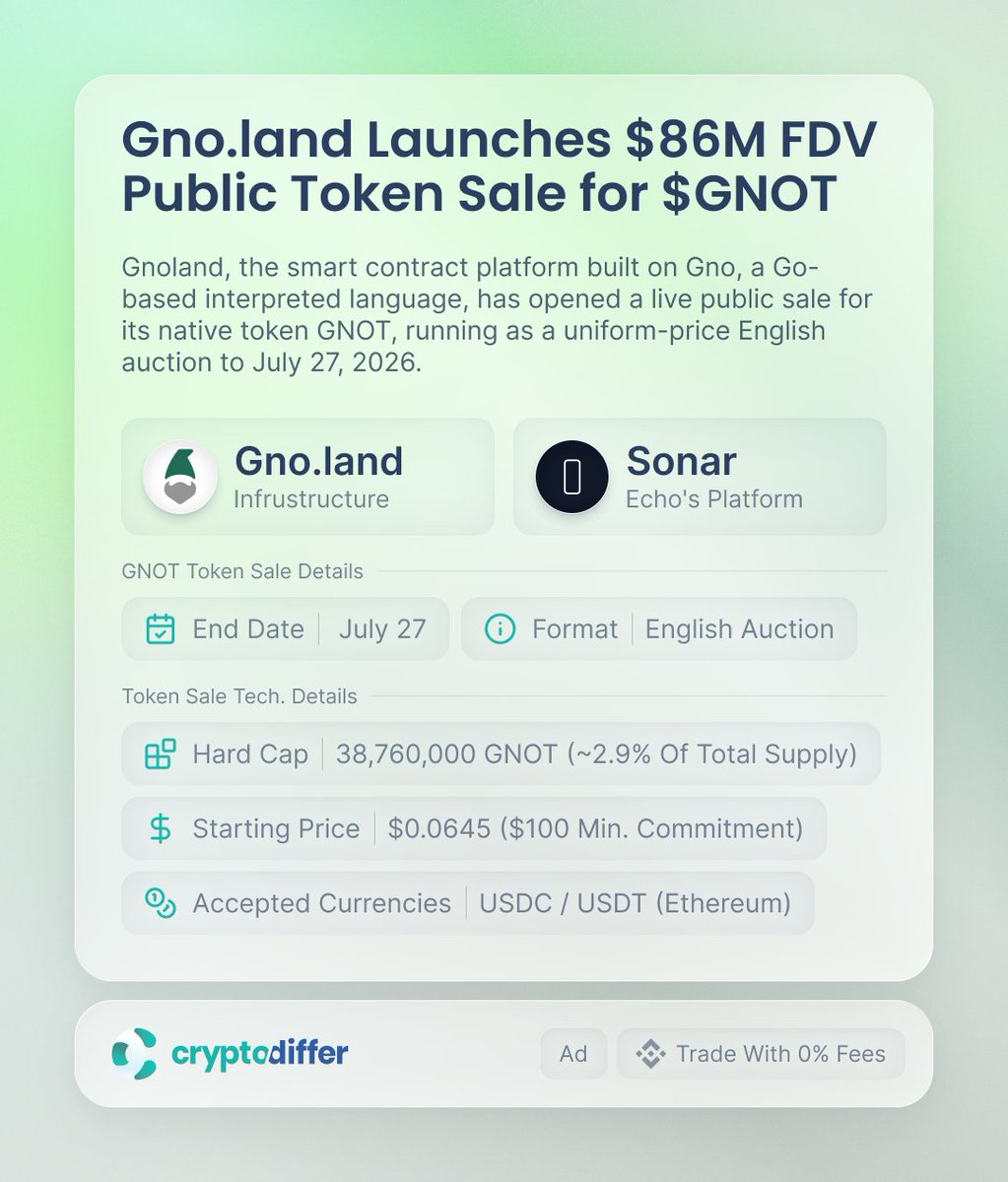
❗️@_gnoland Launches $86 Million FDV Token Public Sale, Token Name: $GNOT
Gnoland, a smart contract platform built on the Go interpreted programming language Gno, has launched a public sale of its native token #GNOT. The sale will use a uniform-price English auction format and will end on July 27, 2026.
👉
446
0
0
28
Nancy
07-14 19:34
フォロー
$WALLET
Deployment Address: 0x542718c390ef1e4beb46ce2023ffaa627db8aa33
This wallet is interesting. It provides funds for the "demo" wallet used by Vlad. However, it's not a standard "mnemonic phrase" wallet, but a smart contract wallet. Its address exists on multiple blockchains.
In other words, it's a deterministically deployed multi-chain smart contract that has existed for years and is associated with Robinhood.
This is not a mnemonic phrase wallet that automatically deploys across chains through mathematical operations. It's a "create2" deterministic multi-signature wallet (similar to the gnosis safe wallet).
This doesn't sound like a wallet that would "accidentally" deploy tokens.
ca: 0x0339f5459FC690aC85F1782e15782A151b4A9E1b
443
0
0
28
Wu Blockchain
06-09 18:00
フォロー
Humanity has confirmed that over $36 million was stolen and dumped on the Ethereum and BNB chains after an employee's laptop was compromised. The attackers gained control of multiple Gnosis Safe keys, escalated the bridging contract to a malicious implementation, and transferred or minted H tokens. The project has suspended affected bridging operations and is cooperating with exchanges and law enforcement.
364
0
0
21
Wu Blockchain
06-09 13:24
フォロー
According to Lookonchain data, the attackers obtained 18,510 ETH (worth $30.83 million) and 1,548 BNB (worth $924,000) by selling H tokens. The attackers currently still hold 111.36 million H tokens, worth approximately $14 million, which could be sold at any time, but on-chain liquidity is nearing depletion.
Humanity confirmed that over $36 million was stolen and dumped on the Ethereum and BNB chains after an employee's laptop was compromised. The attackers gained control of multiple Gnosis Safe keys, escalated the bridging contract to a malicious implementation, and transferred or minted H tokens. The project has suspended affected bridging operations and is cooperating with exchanges and law enforcement.
384
0
0
47
Token Terminal 📊
05-05 21:15
フォロー
🐮🛎️ Breaking News: @CoWSwap's historical transaction volume has surpassed $200 billion.
Top-ranked networks by historical transaction volume: Ethereum, Arbitrum, Base, Gnosis, and BNB Chain.
See the image below 👇
473
0
0
32
Token Terminal 📊
05-05 01:17
フォロー
🐮🛎️ Breaking News: @CoWSwap's historical transaction volume has surpassed $200 billion.
Top-ranked networks by historical transaction volume: Ethereum, Arbitrum, Base, Gnosis, and BNB Chain.
See the image below 👇
360
0
0
42
CryptoMaid加密女仆お嬢様 .stand
05-02 18:16
フォロー
It's finally official!
Polymarket will be switching its user vault from the previous EOA/Gnosis Safe path to DepositWallet + timelock on Monday.
This is to completely resolve the issue of ghost fill orders.
Simply put, the previous problem was: for orders already matched off-chain, the asset state could still be changed by the user before on-chain settlement. For example, withdrawal of funds, revocation of authorization, or modification of the nonce. Thus, while it might appear filled on the front end, it could ultimately fail on-chain.
What DepositWallet does is place this "matchable asset state" in a more constrained execution environment, reducing the potential for state changes before settlement.
This time, it's about the consistency of state between order matching and settlement.
The cost is also clear: increased transaction certainty, a more platform-like execution layer, and reduced self-custody attributes.
This is probably Polymarket's current trade-off: prioritizing trading experience and system throughput, rather than maintaining the most crypto-native fund control model.
For rule disclosure, more details, strategy discussions, and to join Alice's prediction discussion group:
465
0
0
44
Edgy - The DeFi Edge 🗡️
04-21 19:14
フォロー
Following the KelpDAO/Aave vulnerability, DeFi seemed to be heading towards decline.
However, despite these vulnerabilities, DeFi still saw many noteworthy catalysts and developments this quarter.
Here are 7 exciting things.
@AskVenice released end-to-end encrypted AI.
Instead of relying on Venice not reading your prompts, you verify them yourself. Inference runs within a hardware segregated area, prompts are encrypted on your device, and decrypted only within that segregated area, generating a proof receipt with each response.
Neither Venice nor its GPU providers can see your data. VVV rose 10% on the day of release.
xStocks is now available on @Mantle_Official.
Tokenized stocks are now tradable 24/7 on Mantle's native DEX, Fluxion. Compliant with the Swiss DLT Act, fully collateralized, and using Bybit as the deposit/withdrawal channel.
Flowdesk also launched a marketplace on Morpho, allowing users to borrow AUSD on the mainnet and exchange it for SPYx. Leveraged trading of tokenized stocks using DeFi stablecoins and Swiss-regulated collateral.
Current lending rates are -11%, meaning you can earn money while borrowing.
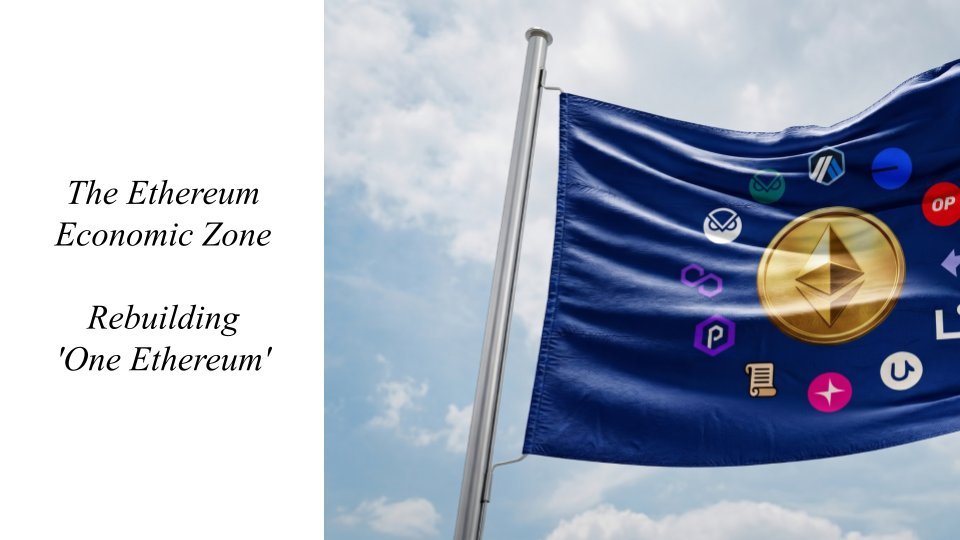
@gnosis_ is building the Ethereum Economic Zone.
This is the most serious attempt I've seen to solve the fragmentation problem. It achieves synchronous composability on the L2 layer and mainnet without bridging, and uses ETH as the gas fee and settlement asset.
The Ethereum Foundation is a co-funder of the project, with Aave, Centrifuge, Flashbots, Safe, CoW Swap, and xStocks as founding members.
Fragmentation has been Ethereum's biggest "self-destructive" problem for years. This is the first time people have truly begun to coordinate and work together to address it. And there's a strong team behind it.
@megaeth is about to trigger its Initial Coin Offering (TGE).
Any of the following three Key Performance Indicators (KPIs) will trigger the merger:
• USDM 30-day average trading volume reaches $500 million
• 10 MegaMafia applications are fully deployed and in practical use
• 3 applications generate over $50,000 in daily transaction fees for 30 consecutive days
Six of these 10 applications are already live on Stomp and will officially launch this week. Last week, Polymarket predicted a 93% probability that MegaMafia would complete its TGE by May 31st.
Go for it! Some of my former TGE buddies are starving.
@AerodromeFi is progressing with its merger with Aero as planned, expected to be completed in July.
This merger will combine Aerodrome and Velodrome into a single decentralized exchange (DEX). The merger will add two new revenue streams.
• The AER engine captures value currently flowing to the aggregator, solver, and routing layers and redirects it back to veAERO.
• The REV engine captures MEV at the decentralized exchange (DEX) level through the auction mechanism embedded in Slipstream V3. Therefore, searchers do not need to extract from liquidity providers (LPs); the protocol auctions and redistributes it.
• Cross-link functionality for MetaSwaps is now live in beta.
@Morpho Midnight
Morpho also released a new product line, different from version V2.
Blue is a pool-based, floating-rate, open-ended product. Midnight is a fixed-rate product.
428
0
0
34
Steven
04-21 11:59
フォロー
Okay, I'm a bit confused.
I know the Arbitrum team can prevent its L2 address from spending ETH by freezing it, yes, but do they also allow that address to send ETH to 0x0000000000000000000000000000000000DA0?
Does this mean the Arbitrum security council can control any address on its blockchain to send its assets wherever they want?
Well, this seems to involve the security council upgrading their bridge contract and informing the contract that the funds are now located elsewhere.
I'm sure this is the first time I've seen this.
The closest last example was the Gnosis hard fork to reclaim funds from the Balancer hack.
Oh, they explained it on the forums.
377
0
0
26
Ethereum Daily
04-21 11:10
フォロー
$292 million vanished in minutes due to a bridging failure. EEZ is the only upgrade that can completely solve this problem.
Last week's Kelp DAO disaster was devastating: $292 million worth of rsETH was stolen in minutes via LayerZero bridging.
There were no smart contract vulnerabilities or reentrancy vulnerabilities on Kelp. It was simply a "ghost" cross-chain message. Ethereum mistakenly thought Unichain had sent a valid data packet, but it wasn't. A validator was tricked, the bridging released the real tokens, and the attacker absconded with the money.
This wasn't bad luck. This is the result of the standard bridging model functioning as expected: asynchronous messaging, external validators, locking, and minting mechanisms. Every major bridging attack in history (Ronin, Wormhole, Harmony…) follows the same pattern. Bridging is the biggest attack surface in DeFi.
@etheconomiczone is the first to truly attempt to completely eliminate this attack surface.
Built by Gnosis and Zisk and funded by the Ethereum Foundation, EEZ doesn't add a new bridge; it completely eliminates the dependency on bridges. Rollups within the EEZ area can be synchronized and combined with the mainnet. Contracts on EEZ L2 can call mainnet contracts (or other EEZ Rollups) in the same atomic transaction. No data packets, nonces, or encapsulated tokens need to be stored in bridge contracts. All operations either happen simultaneously or roll back simultaneously, with security directly guaranteed by Ethereum L1.
This is not an exaggeration, but the architectural solution we've been desperately needing since the L2 summer, effectively addressing the fragmentation issues introduced by L2.
Ethereum has solved the scaling problem; EEZ solves the resulting fragmentation problem—while avoiding the risks associated with bridges, thus preventing the loss of hundreds of millions of dollars.
This is the right next step. We don't need more chains; we just need a unified economic zone.
A unified Ethereum.