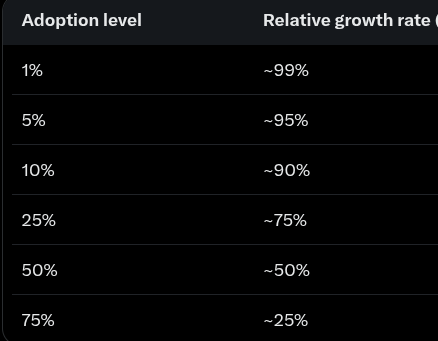
The number of Bitcoin holders worldwide is estimated at around 365 million, representing 4-5% of the world's population.
The ratio of Bitcoin's market capitalization to that of gold (approximately $1.28 trillion to $28 trillion) also indicates a Bitcoin adoption rate of around 4-5%.
From the perspective of the logistic curve (S-curve), a 4-5% Bitcoin adoption rate represents a still relatively high growth rate.
331
0
0
38
Mario Nawfal
フォロー
A war with Iran could make $100 a barrel the new normal for oil and force the US to print money to escape its $39 trillion debt crisis.
Lawrence Leipard, who manages hundreds of millions of dollars in assets, saw his fund achieve a 175% return last year by betting on gold and silver mining companies.
Currently, his trusted oil analysts tell him that oil prices could reach $200 a barrel, and the deeper change lies in the bottom of the price: in the past, the bottom of oil prices was usually around $40 to $60 a barrel, but now it could be between $80 and $100 a barrel.
If this sounds extreme, remember that the oil embargo of the 1970s caused oil prices to rise tenfold.
The bill for this war will exacerbate the US government's debt burden, which already pays $1.3 trillion in interest alone annually, and the Pentagon has requested hundreds of billions more in funding.
Rising prices push up interest rates, which in turn increase debt costs, creating a vicious cycle until Washington repeats its post-World War II mistakes by using its own printed money to buy domestic bonds.
As Lawrence stated, "Yield curve control is just another way of saying money printing."
The last time the US tried this, inflation lasted a decade, and bondholders suffered heavy losses.
His solution is to hold two assets that governments cannot print: gold and Bitcoin. He predicts Bitcoin will rise again to $180,000 to $200,000 within a few years.
Wars are fought with missiles, paid for with printed money, and the latter will eventually end up in everyone's wallet on Earth.
@LawrenceLepard
448
0
0
21
Mario Nawfal
フォロー
A war with Iran could make $100 a barrel the new normal for oil and force the US to print money to escape its $39 trillion debt crisis.
Lawrence Leipard, who manages hundreds of millions of dollars in assets, saw his fund achieve a 175% return last year by betting on gold and silver mining companies.
Currently, his trusted oil analysts tell him that oil prices could reach $200 a barrel, and the deeper change lies in the bottom of the price: in the past, the bottom of oil prices was usually around $40 to $60 a barrel, but now it could be between $80 and $100 a barrel.
If this sounds extreme, remember that the oil embargo of the 1970s caused oil prices to rise tenfold.
The bill for this war will exacerbate the US government's debt burden, which already pays $1.3 trillion in interest alone annually, and the Pentagon has requested hundreds of billions more in funding.
Rising prices push up interest rates, which in turn increase debt costs, creating a vicious cycle until Washington repeats its post-World War II mistakes by using its own printed money to buy domestic bonds.
As Lawrence stated, "Yield curve control is just another way of saying money printing."
The last time the US tried this, inflation lasted a decade, and bondholders suffered heavy losses.
His solution is to hold two assets that governments cannot print: gold and Bitcoin. He predicts Bitcoin will rise again to $180,000 to $200,000 within a few years.
Wars are fought with missiles, paid for with printed money, and the latter will eventually end up in everyone's wallet on Earth.
@LawrenceLepard
484
0
0
44
OpenAI
フォロー
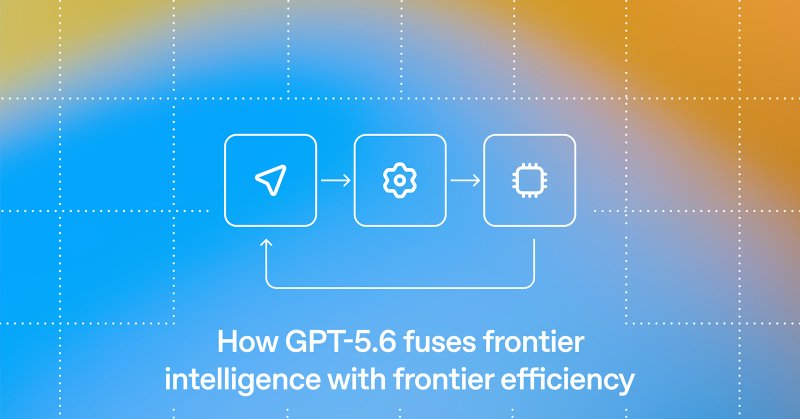
After deployment, we applied GPT-5.6 Sol to further improve efficiency by enhancing its own runtime performance.
Results:
- Service costs were reduced by 20% through improvements to the production environment's GPU kernels.
- Token generation efficiency was improved by over 15% through improvements to speculative decoding.
These optimizations were implemented throughout the entire technology stack, ultimately achieving optimal performance at every point on the cost intelligence curve.
399
0
0
31
andrew chen
フォロー
The AI Smile Curve
Artificial intelligence has created a new "smile curve," where user retention/usage increases over time. Recall that smile curves once appeared only in a few areas, but once they did, they became "must-buy" products.
- In the social media era, this referred to social networks. Consumers created accounts, added friends over time, and usage grew, eventually becoming a daily habit (e.g., Facebook, Instagram).
- In the "Uber for X" era, this referred to applications. Consumers increased usage over time, and as availability improved, so did spending (e.g., Uber, DoorDash).
- In the SaaS era, this referred to collaboration tools widely adopted in the workplace. Account revenue grew over time (e.g., Slack, Zoom).
In the AI era, we see the smile curve based on improvements to the underlying model:
- Trying an AI application with poor results
- Releasing a new model with better results
- Eventually integrating it into your workflow
- Your usage and spending grow over time
In the AI smile curve, what initially seems unremarkable eventually becomes indispensable.
362
0
0
31
Mister Crypto
フォロー
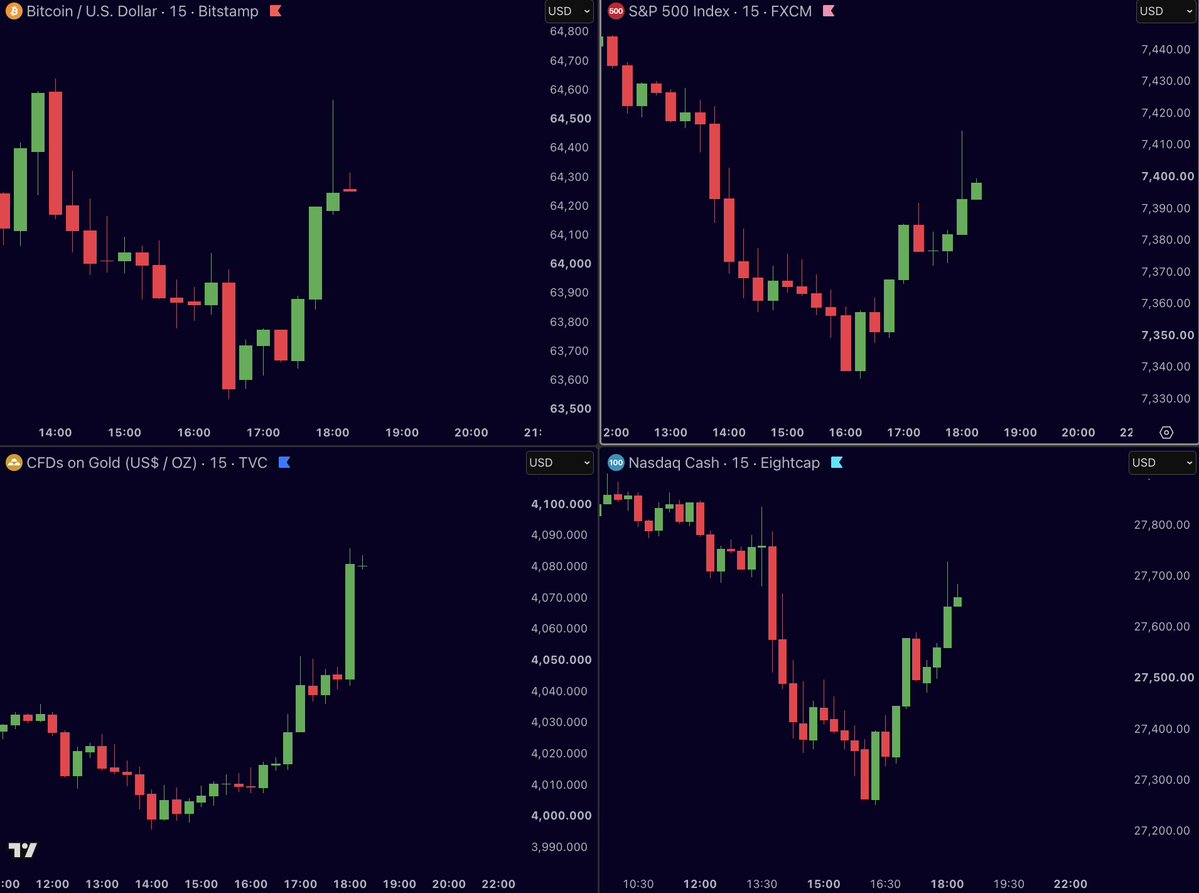
🇺🇸 The Federal Reserve kept interest rates unchanged, and all markets surged instantly.
The decision caused synchronized market movements.
The stock market gained $330 billion in three minutes.
Gold and silver gained $350 billion in two minutes.
Bitcoin prices soared, and $20 million in short positions were liquidated during the price surge.
The reason for the synchronized market movements is simple. The market had previously anticipated a possible Fed rate hike. With the Fed keeping rates unchanged, this concern dissipated, and funds flowed into all assets along the risk curve.
But this is merely a market reaction, not the final outcome.
The 2 PM decision is headline news. The real determinant of the market's direction is Warsh's press conference, which has yet to take place.
Pay close attention to his comments on inflation. If inflation is moderate, this rally will continue. If inflation is tough, every rising candlestick will fall back.
The market rally is just the beginning; the press conference will be the real test.
461
0
0
38
andrew chen
07-29 14:59
フォロー
The AI Smile Curve
Artificial intelligence has created a new "smile curve," where user retention/usage increases over time. Recall that smile curves once appeared only in a few areas, but once they did, they became "must-buy" products.
- In the social media era, this referred to social networks. Consumers created accounts, added friends over time, and usage grew, eventually becoming a daily habit (e.g., Facebook, Instagram).
- In the "Uber for X" era, this referred to applications. Consumers increased usage over time, and as availability improved, so did spending (e.g., Uber, DoorDash).
- In the SaaS era, this referred to collaboration tools widely adopted in the workplace. Account revenue grew over time (e.g., Slack, Zoom).
In the AI era, we see the smile curve based on improvements to the underlying model:
- Trying an AI application with poor results
- Releasing a new model with better results
- Eventually integrating it into your workflow
- Your usage and spending grow over time
In the AI smile curve, what initially seems unremarkable eventually becomes indispensable.
334
0
0
26
Mario Nawfal
07-29 12:50
フォロー
🇮🇷 Over a billion barrels of crude oil from China remain unaccounted for, yet oil prices are nearly unchanged from pre-war levels.
Last week, Brent crude prices briefly touched $100 a barrel before falling back to just over $90 in the following days, during which time there were no major conflicts or diplomatic news. In reality, there were no substantial changes to support a price increase.
According to the International Energy Agency (IEA), as of mid-May, the Gulf of Mexico had lost over a billion barrels of crude oil supply, with over 14 million barrels of oil production shut down daily.
Furthermore, there was the Russian export terminal shot down by a Ukrainian drone.
This crude oil has never returned.
What's really at play is position volatility.
Futures trading volume is several times that of actual crude oil trading volume; therefore, even if no oil tankers set sail, a ceasefire announcement can readjust the entire futures curve.
Traders who went long during the conflict will take profits at any sign of calm.
Political statements cannot replenish crude oil reserves, nor can they convince insurance companies to cover ship damage. These decisions have their own mechanisms, and they haven't changed.
Source: @jackprandelli, CNBC / Author: Daniel
370
0
0
28
Raoul Pal
07-28 05:27
フォロー
Bitcoin's correlation with global liquidity is 87%, while the Nasdaq's is 97%.
This reveals a fact most people are unaware of: these assets aren't traded based on profits, news, or any weekly hot topics, but rather on tracking the total amount of money in the system.
Bitcoin simply fluctuates more within this range because, besides liquidity, it's young, volatile, easily influenced by emotions, and still undergoing a network adoption curve. Sometimes it's hot, sometimes it's cold. Currently, it's cold, so people think there's something wrong with the system.
Actually, everything is normal; it's just operating as usual.
So the question arises: if these assets are so closely correlated with liquidity… then what if it were possible to predict liquidity itself?
In fact, it is possible.
As I explained in the "Everything Code" framework, liquidity is driven by currency devaluation, and currency devaluation can be predicted years in advance because the interest payments that drive currency devaluation are now fixed and lead liquidity by about three years.
Incredible.
483
0
0
49
Moby
07-28 01:29
フォロー
$CATE was bought in early trading. You saw it on the Moby platform.
The purchase price was $256,000, representing a 29-fold increase since the start of the rally. Savvy investors have been watching closely.
Get ahead of the curve with one-click trading. 🐳