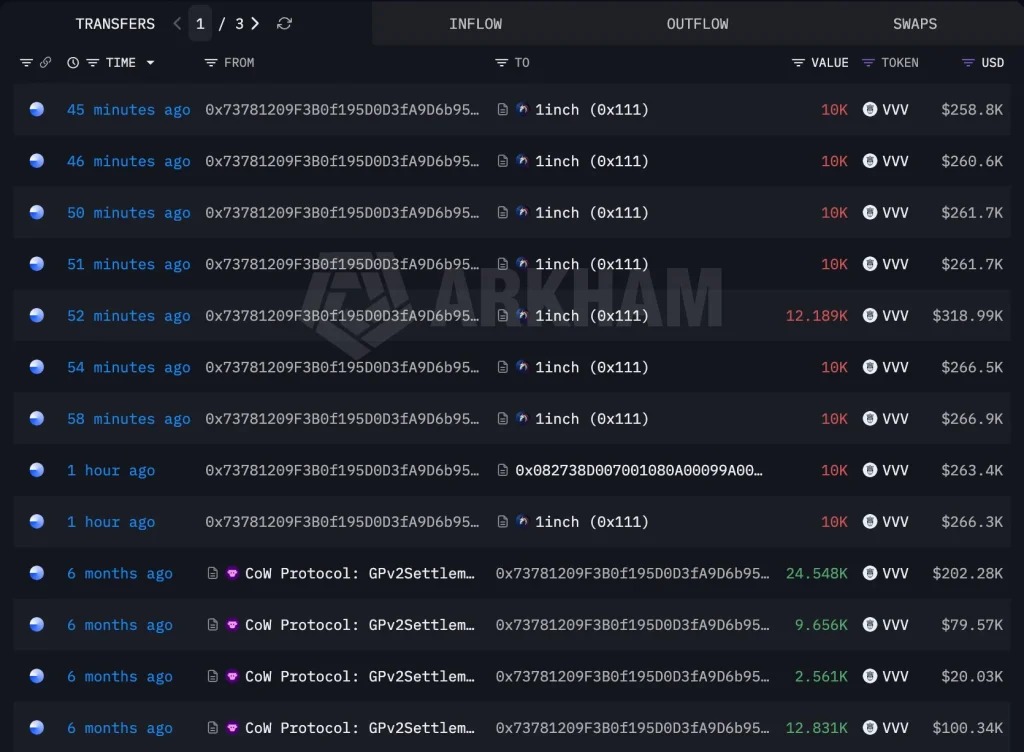
Two updates to Venice Token Economics will go live today:
1. Added a buy-and-burn trigger condition for the base token: 0xacfe6019ed1a7dc6f7b508c02d1b04ec88cc21bf
2. Increased the target supply for the base token: 0xf4d97f2da56e8c3098f3a8d538db630a2606a024
🧵Detailed explanation of the updates follows.
330
0
0
43
Erik Voorhees
07-06 18:31
フォロー
I canceled my ChatGPT and Claude Pro subscriptions two months ago because my local, state-of-the-art AI agent stack has completely replaced them. This stack is implemented using @NousResearch's Hermes Agent and @AskVenice's AI inference API, and at virtually no cost.
Here's how I did it and why it's so important:
Stake base: 0xacfe6019ed1a7dc6f7b508c02d1b04ec88cc21bf and lock it. Mint and stake base: 0xf4d97f2da56e8c3098f3a8d538db630a2606a024.
1 base: 0xf4d97f2da56e8c3098f3a8d538db630a2606a024 = $1. The Venice Inference API refreshes its daily calculation limit. The VVV supporting your DIEM will still earn approximately 80% of the normal staking yield. At the current interest rate, this translates to an annualized yield of approximately 7% (8.86 * 0.8). Therefore, your principal earns yield while also generating API credits daily.
Your VVV will not be spent. It is held, continuously earning yield and generating computing power as a byproduct.
With my current setup, the credits I earn daily are generally sufficient for my daily tasks (research, automation, Q&A, productivity, etc.). Mid-range LLMs like the Xiaomi Mimo V2.5/Minimax M3 are perfectly capable of handling these workflows. For more complex/critical tasks, I delegate to GLM-5.2 and enable maximum inference power.
If I overtrade on a high-volume day, I'll immediately sell the day's staking rewards for my staked asset (0xacfe6019ed1a7dc6f7b508c02d1b04ec88cc21bf), convert them to USDC, and then use the proceeds to buy Venice Credits to maintain my workflow.
Now, this is why it's a better fit for my use case than ChatGPT/Claude subscriptions. It's not entirely about the model's intelligence level. Closed models still have a slight edge in benchmarks. The key is the architecture.
My agent has local file system access. It can read my Obsidian data, write to files, and run scripts. It can control my personal browser, execute terminal commands, and manage my calendar. It maintains persistent memories across sessions, accumulating contextual information and understanding my behavior over time.
Because of this… the agent's ability to help me continuously improves. Understanding me is key. Without privacy, none of this is possible. Unless you want to hand over all your data to large tech companies to use for advertising/and later sell it to governments.
Venice's inference endpoint is private. This means I can provide it with sensitive data without sending it to Frontier Labs' data collection servers. No cloud assistant can do that right now. The real obstacle isn't the model itself, but the systems and privacy protections surrounding it.
Furthermore, if you missed the previous news, the capability gap between open-source state-of-the-art models (e.g., GLM-5.2/Kimi K2.7) and GPT/Claude has narrowed enough to compensate for most tasks. Perhaps that was more important 3-6 months ago? But not anymore.
Some things to note:
1. Your underlying asset: 0xacfe6019ed1a7dc6f7b508c02d1b04ec88cc21bf is locked and has insufficient liquidity during the lock-up period (7-day unfreezing period).
2. This is not free money; it's money you've invested. The credit rate and collateral yield of the underlying asset, 0xf4d97f2da56e8c3098f3a8d538db630a2606a024, are variable and not guaranteed. However, if you re-mint base:0xf4d97f2da56e8c3098f3a8d538db630a2606a024 from the locked base:0xacfe6019ed1a7dc6f7b508c02d1b04ec88cc21bf at a more favorable minting rate, the amount of computational resources you receive may increase.
3. The open model remains somewhat inadequate for handling extreme-case reasoning and extremely complex tasks. If your workload involves "solving novel mathematical proofs," then this may not be suitable for you.
4. The price risk for base:0xacfe6019ed1a7dc6f7b508c02d1b04ec88cc21bf is real. If VVV crashes, your principal will also decrease. However, the amount of computing resources you receive remains the same.
In short, this is not a risk-free hack. It's a bet that open-source AI technology will continue to become cheaper and better, and that agents with local access and private inference capabilities are more valuable than models that are smarter in a sandbox environment.
For base:0xacfe6019ed1a7dc6f7b508c02d1b04ec88cc21bf and base:0xf4d97f2da56e8c3098f3a8d538db630a2606a024, this means that as the model improves, the computing credits you have today can give you more powerful and intelligent computing capabilities.
To date, early investors have reaped substantial returns on their investment.The deeper I delve into my research, the more I realize that the true moat is never the model itself, but rather privacy protection. It is privacy protection that allows the system to continuously accumulate and grow.
Venice is one of the most important companies currently dedicated to building this future.
I value privacy because, to me, privacy means freedom. The freedom to think, create, and utilize cutting-edge AI technology to reach the pinnacle. That's why I support this team.
What about you?
402
0
0
26
梭教授说
07-06 11:19
フォロー
7.06 All-in Morning Report:
Slept until now, groggily opened my eyes in the middle of the night to check 0-0, then 0-1, then 1-2 😂. Brazil isn't the Brazil of the past anymore; the first penalty taker isn't even decided yet, and I'm totally confused.
1. bitcoin:native: Workday is here, Bitcoin hit 64,000, great news!
2. ethereum:native: Let's see if it can break 1800.
3. solana:So111111111111111111111111111111111111112: BSC stole the spotlight.
4. Dragonfly Partner Haseeb: VVV's essence is being misunderstood; Venice is essentially a company, not a decentralized network or on-chain protocol.
The allure of equity-based token distribution is here!
5. The Miners' Cycle Stress Index has fallen to a new low since 2026, entering a historically undervalued range;
6. AI capital spending by the five major tech giants has surged, projected to account for 3.2% of US GDP in 2027, surpassing defense spending for the first time;
7. "Garrett Jin, the whale entity," has increased its short position in ZEC to $15.08 million, with a floating loss of $530,000;
This guy keeps switching between long and short positions, is he a swing trading whale?
8. The South Korean KOSPI index rose by 2% intraday;
The Koreans are back, but what about our positions, guys?
9. Spot gold hits a two-week high, surpassing $4200/oz;
10. The probability of the Fed keeping interest rates unchanged in July is 77%;
11. SemiAnalysis: NVIDIA Kyber NVL144 delayed by over 12 months, release date pushed back to 2028;
12. Kraken allows tokenized stocks to power leveraged cryptocurrency trading;
Crypto enthusiasts' hearts are set on maximum leverage!
13. The Clarity Act failed to be signed into law on July 4th, August 7th becomes a key date;
14. A rare FIFA Article 27 ruling allows Balogun to represent Belgium, triggering a surge in Polymarket trading volume;
Who's the biggest in the US? Trump is the biggest, red cards don't ban wishful thinking;
15. Citi: The reasons for raising interest rates have disappeared, the Fed is expected to resume rate cuts in October;
This is the good news;
16. @BNBCHAIN's counterattack is just constantly diverting traffic and attracting new users, or do we have to wait for the couple to spit it out? ------------- Back to watching the World Cup now! Will the Three Lions be able to beat the drug lords? See you in two hours!!!
#Bitcoin #Ethereum #Solana #Crypto #NASDAQ
409
0
0
20
韭菜兄弟👬 ² 🧪
07-03 19:36
フォロー
🚀Latest News: Bitcoin market sentiment has shifted as pressure on Saylor eases.
This shift in strategy may eliminate previous headwinds limiting Bitcoin's rise.
A new Venice token demo showcases the practical operation of equity governance.
Will stablecoin fees flow to holders or remain with the issuer?
312
0
0
45
Erik Voorhees
07-02 02:58
フォロー
VVV and Capital
By revenue, Venice has become the largest company at the intersection of artificial intelligence and cryptoeconomics.
Today, we are announcing the completion of Venice's first external funding round, a $65 million Series A round led by @dragonfly_xyz, valuing Venice at $1 billion in equity.
Because we are an atypical company, this post will explain the relationship between this equity funding and our most valuable asset on our balance sheet—our capital token base: 0xacfe6019ed1a7dc6f7b508c02d1b04ec88cc21bf.
In short:
• Venice will receive more funding
• Scale will expand further
• User base will grow further
• Token burning will increase further
• Long-term interests of venture capitalists, the company, and the community will be more aligned
Venice was profitable as of the end of Q1.
So, why did we raise funds?
To scale.
We are developing Venice into a mass-market consumer application, an open and unrestricted AI platform serving at least hundreds of millions of users and billions of AI agents.
Achieving this goal requires funding.
Part of the funding will be used for vertically integrating computing resources; we have begun building data centers, which will be Venice's first time owning its own computing resources.
This ensures sufficient capacity during the upcoming period of resource scarcity and improves gross margins, making larger-scale VVV burning possible.
The remaining funding will be used to expand our user base, explore new markets, acquire value-added services, and recruit top talent.
To raise this funding, we could have chosen to sell a portion of Venice's VVV tokens directly to the market or to sell equity. We chose the latter. Despite year-to-date growth of over 700%, we still do not want to sell tokens.
Venice remains the largest holder of VVV, holding over 30 million tokens, representing nearly one-third of the current total supply of 80 million. The company and team each currently hold more VVV than at genesis. The company has not sold any shares to date.
After investing $65 million in new capital, Series A investors received the following returns:
• 8.98% stake in the company
• Ownership of 1.5 million VVV tokens
• The right to purchase 5 million VVV tokens over the next eight years.
To exercise this right (token warrants, also known as call options), investors must pay Venice approximately $66.5 million. The total funding raised reached $131.5 million.
The VVV tokens (including grant rights and warrants, if exercised) will be locked for one year, then linearly unlocked over the next three years.
This means that when the first VVV tokens are unlocked for institutional investors, more than two years will have passed since the Venice token launch. What does this mean?
We aim to go against the grain of most other projects: Most projects pre-sell to venture capitalists on undisclosed terms, promising to develop the product or find users later. Venice, however, did not conduct any pre-sales and demonstrated product-market fit for a year before the VVV airdrop to the community.
The token had been publicly traded for 18 months before Venice introduced external capital. Participants in Venice's Series A funding round agreed to these terms because they aligned with Venice's long-term vision.
Regarding supply dynamics, assuming investors pay an additional $66.5 million to exercise warrants, approximately 6,000 VVV will be released to the market daily after about a year, representing approximately 0.2% of the current daily trading volume. If any portion of this $66.5 million is not paid, these 6.5 million VVV will remain on Venice's balance sheet.
As for how all this will change Venice's token plans, the answer is no. We develop products, increase revenue, and use a portion of that revenue to buy and burn tokens, thereby reducing carbon emissions. Our motivation for doing this is that we hold more VVV than anyone else.
We hope this will demonstrate a more harmonious model between the company, venture capital, and the community.
In this way, we will scale up private and unrestricted intelligence, transforming Venice into a port city of intelligent civilization.
Looking to the future…mindset
300
0
0
25
吴说区块链
07-01 22:41
フォロー
According to TechCrunch, privacy-focused AI platform Venice AI has announced the completion of a $65 million Series A funding round, led by Dragonfly, with participation from Coinbase Ventures, North Island Ventures, and others. This round values the company at $1 billion. Founded by Erik Voorhees, an early Bitcoin advocate and founder of ShapeShift, Venice AI aims to provide users with access to over 200 AI models while ensuring data is not stored on the Venice system through client-side encryption and external proxy routing. Venice AI also allows users to stake their AI service credits through its tokens VVV and DIEM. The company plans to use the funds raised to build its own data center and purchase GPUs to improve gross margins.
337
0
0
35
CrypτaoShluϙ | Dubai
06-21 18:39
フォロー
$ZERO's market capitalization of only $11 million is negligible.
Computing networks are experiencing explosive growth.
Everyone has realized the truth:
>This is not a role-playing game.
>NVIDIA is well aware of this.
It's widely considered to be $VVV 2.0.
400
0
0
35
无颜
06-14 20:21
フォロー
The recent surge in Venice ($VVV) has fueled the hype surrounding privacy AI, highlighting its potential and the upcoming TGE of Arcium ($ARX).
What's the difference between Venice and Arcium? Venice ($VVV) is more like the application layer of privacy AI, allowing users to intuitively experience the importance of AI privacy for the first time. Arcium, on the other hand, is the underlying encrypted execution network for privacy AI, handling private input, encrypted computation, and verifiable execution in more complex scenarios. This enables AI to securely process critical data such as corporate data, financial data, medical data, institutional policies, and on-chain execution paths.
Simply put, Venice ($VVV) proves that there is real user demand for privacy AI. Arcium provides the underlying execution environment needed for this demand to expand further, determining the potential of privacy AI. Venice ($VVV) proves the demand; Arcium determines the ceiling.
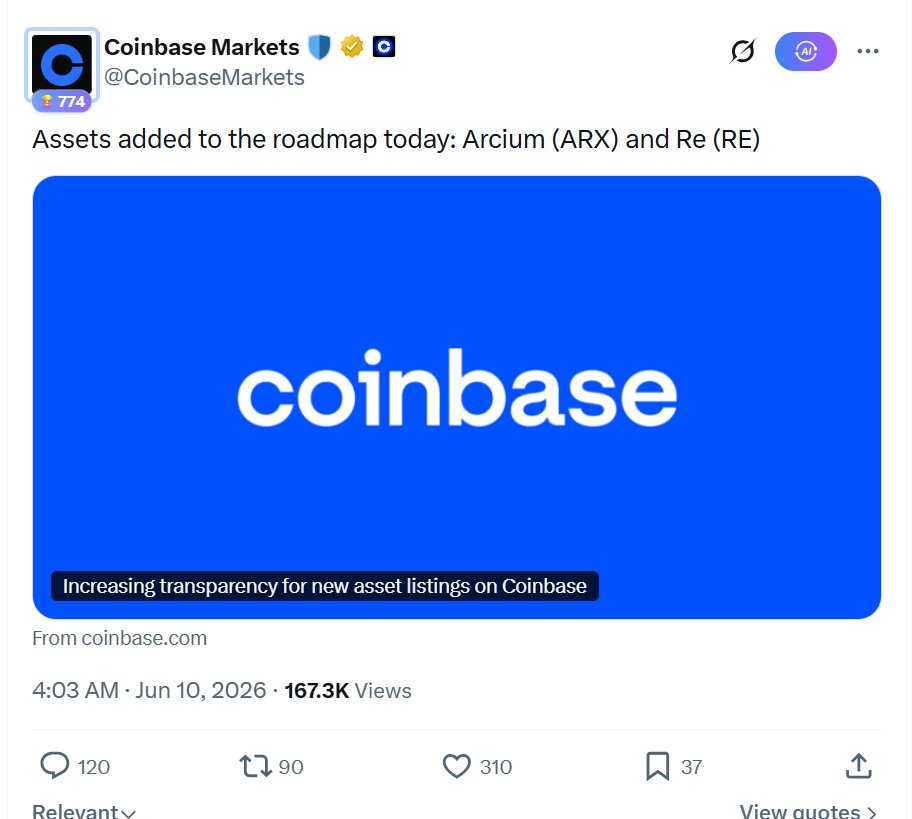
In Aspecta's pre-market trading, Arcium's pre-market valuation has risen from $90 million to $200 million. On June 10, ARX was added to Coinbase's listing roadmap. Both of these events indicate that Arcium's potential has been recognized, and this sector is expected to have a better future.
489
0
0
23
梭教授说
06-07 17:41
フォロー
✍️ Opportunities abound, seize them (Crypto Edition)
Recently, I've seen many interesting things. Some say crypto is dead, others say it still has a wealth effect. Opinions vary, so I can only offer my own interpretation.
Mainly, the simplest thing I do every day is write some random thoughts to pass the time.
🌟Specialization is key
Actually, recently there have been opportunities to easily earn 100x by joining super-large pools, but honestly, I haven't seen any pure crypto groups or pure casual trading groups.
However, I have seen groups of the ultimate on-chain kings.
For details, check out @buzuoyuwenzuoye's Q-god tweet. All I can say is, regarding crypto trading, every question is about 100x, every other question is about selling for several million, every other question is about the Trump era 🤣.
I can't get through to my "Starry Sky Brother" anymore. Anyway, with these kinds of Ponzi schemes, it's always so inexplicable how I end up profiting.
I can't get cheap tokens, but I can still make a lot. After all, those who live on the blockchain have their own understanding of each chain, which is good.
I'm going to sleep anyway. I'll see if I can buy in when I wake up. The key is that this situation of "Brothers, buy quickly!" won't happen. I'm just trying to trade within a range.
🌟I really can't hold on.
Thinking back to a few months ago when $Binance Life was falling, everyone was mocking it. Now, after several months of gains, everyone's still mocking it.
It's actually quite funny.
Not discussing this further, but purely about how to not sell during a drop and even add to your position, and not sell everything at once during a rise, but still hold on.
Perhaps it's about having a real belief.
@Mango2026ath That son of a bitch kept buying, and it kept rising. He sold everything at the beginning, and keeps telling me he's had an epiphany about the true meaning of trading. I know he's just figured out how to make empty promises.
This kind of thing is really interesting.
I've reviewed my trades countless times and I still feel that I really couldn't hold onto them. After all, in the current market environment, out of 100 successful trades, you'll lose 99 times, with only one chance to break even.
Then I reviewed what I could actually hold onto.
What I could hold onto were the ones I was already holding, and the longer I held them, the deeper the losses.
What couldn't I hold onto?
Those I planned to hold long-term, then they kept falling, and when they finally rose, I planned to trade them in a swing, and then... nothing.
It's tough.
🌟There are indeed many opportunities, but you have to seize them.
Actually, if you're on-chain and have grasped the recent market trends, you can actually make quite a bit of money.
I'm not talking about paid groups or being a developer; I'm talking about genuinely being an alpha hunter.
Whether it's the so-called hook summer, the base AI summer, or the Solana application summer, there are tons of representative works.
You can check out @Arron_finance and @real_dr_pump; they've basically mastered it all.
Some have market capitalizations of $40-50 million, while countless others have smaller caps.
Even more, driven by the $VVV ecosystem, are poised for even higher and stronger gains, theoretically capable of generating substantial profits.
However, the key is timing. The potential returns are indeed high, and the timeframe is short.
The crucial question is when to sell. Unless you bought in at the bottom, anyone who bought on FOMO (Fear of Missing Opportunities) and held on has missed out.
So, it's a real headache. I really want to know how those who can sell at the peak and then buy back in at the peak manage to think.
🌟Unlimited Opportunities
Opportunities truly are unlimited; the key is whether you can seize them when they arise.
If you can't seize them, become a mentor. After all, mentors can grasp all the opportunities and scam as many as they can.
Ultimately, being a mentor is the most profitable path.
Confused, money is hard to earn, and life is tough – the crypto world.
425
0
0
32
Aidang 🦅
06-06 19:49
フォロー
From Venice to Arcium: The Narrative of Privacy AI is Completing a Closed Loop from Application to Infrastructure
Every explosive development in the blockchain industry has typically started with applications first, followed by infrastructure development. This was true for DeFi in the past, and the current AI sector is following the same path.
Recently, Venice has truly brought the concept of privacy AI into the spotlight. Its historical mission is very clear: to prove PMF (Product-Market Fit) to the market. Many people previously considered privacy AI a pseudo-demand, but Venice's user base and popularity have proven them wrong. It demonstrates that both retail and institutional investors have a natural obsession with absolute sovereignty over AI data.
Once the application layer breaks through the ceiling, the market's focus will inevitably shift to the underlying network capacity. At this point, you can no longer define @Arcium using the past's generalized privacy computing.
Let's break down their ecosystem roles:
Venice (VVV) is the application side of Privacy AI: It is responsible for creating scenarios, providing user-friendly interactions, and attracting users and high-value data.
Arcium is the underlying Encrypted Execution Network for Privacy AI: it provides the underlying hardcore computing environment.
Data is collected and generated at the application level, but the final confidential computation, policy execution, and on-chain verification need to be handled by a specialized network like Arcium. Without Venice, the underlying infrastructure would become a ghost road abandoned by everyone; and without an encrypted execution layer like Arcium, upper-layer privacy applications would forever remain at the stage of simple dialogue, unable to move towards more complex business scenarios. The two complement each other, which is the foundation for the long-term sustainability of this narrative.