


ログイン

BTC
$78,799.99
+1.97%


ETH
$2,529.99
+1.03%

BNB
$725.72
+0.70%

XRP
$1.42
+4.93%

SOL
$102.62
+1.89%

TRX
$0.3414
+0.00%

HYPE
$80.81
+3.09%

ZEC
$1,140.59
+3.45%

DOGE
$0.08449
+0.79%

XMR
$515.78
-3.77%


LINK
$11.53
+1.59%

XLM
$0.1942
+8.80%

BCH
$225.20
+0.40%

LTC
$54.12
-0.72%

UNI
$6.38
+1.54%

TON
$1.39
+0.44%

CC
$0.097
+1.63%

HBAR
$0.07759
+2.29%

AVAX
$7.53
+1.91%

NEAR
$2.44
+6.14%

SHIB
$0.0{5}528
+1.15%

SUI
$0.7321
+2.38%

TAO
$235.70
+0.38%

OKB
$114.20
+0.98%

CRO
$0.05881
+1.41%

XAUT
$4,314.25
-0.85%

AAVE
$127.14
+0.90%

PAXG
$4,318.84
-0.83%

BFUSD
$0.9999
+0.01%

MNT
$0.5702
+0.53%

ASTER
$0.702
+0.57%

ONDO
$0.3551
+2.54%

DOT
$1.02
-0.29%

WLFI
$0.0573
+0.70%

ICP
$2.77
+0.18%

JITOSOL
$133.65
+2.02%

SKY
$0.06431
+2.36%

PEPE
$0.0{5}349
+2.65%

M
$1.09
-4.07%

BGB
$1.95
+0.19%

PUMP
$0.003687
+1.32%

ETC
$7.63
-0.13%

ENA
$0.1421
+2.08%

LIT
$4.47
+6.64%

BNSOL
$115.80
+1.76%

WLD
$0.3858
-1.63%

GT
$9.31
+1.09%

POL
$0.098
+1.31%

USDD
$0.9993
+0.00%

JST
$0.113
-0.07%

VVV
$22.21
+3.71%

KAS
$0.03378
-2.00%

KCS
$6.83
-1.24%

PI
$0.0979
+0.04%

ALGO
$0.0962
+2.56%

MORPHO
$2.21
+0.36%

ARB
$0.1366
-2.36%

CAKE
$2.37
+7.77%

JUP
$0.2411
+2.86%

QNT
$64.52
+0.39%

ATOM
$1.55
-3.18%

U
$1.00
+0.05%

FIL
$0.964
-1.38%

DASH
$54.68
+1.52%

VET
$0.007736
+0.91%

INJ
$6.28
+2.70%

FLR
$0.006641
+2.79%

NEXO
$0.825
-0.60%

XDC
$0.02793
+0.29%

AERO
$0.5746
+1.36%

CRV
$0.3511
+1.33%

STABLE
$0.0283
-0.53%

STX
$0.2687
-1.97%

币安人生
$0.4779
+2.01%

TRUMP
$2.04
+3.09%

APT
$0.59
-3.12%

PENGU
$0.007179
-1.62%

ETHFI
$0.6439
+0.26%

VIRTUAL
$0.6278
+1.98%

FET
$0.1691
+0.96%

PENDLE
$2.33
+7.59%

RAY
$1.38
-4.43%

BSV
$17.12
-2.51%

NIGHT
$0.02047
-0.44%

SUN
$0.01707
+0.18%

BTT
$0.0{6}332
+0.21%

PYTH
$0.05578
-0.11%

TIA
$0.36
+0.78%

LDO
$0.3667
-0.65%

GNO
$115.28
-0.73%

ZRO
$1.01
+0.00%

FF
$0.1265
-13.37%

XTZ
$0.276
-5.35%

SEI
$0.04479
-0.86%

DCR
$16.78
+2.32%

LUNC
$0.0{4}5085
+0.24%

BETH
$2,527.00
+0.96%

MON
$0.02326
+0.74%

IMX
$0.1239
-0.56%

CFX
$0.04722
-2.60%
BTC
$78,799.99
+1.97%
ETH
$2,529.99
+1.03%
BNB
$725.72
+0.70%
XRP
$1.42
+4.93%
SOL
$102.62
+1.89%
TRX
$0.3414
+0.00%
HYPE
$80.81
+3.09%
ZEC
$1,140.59
+3.45%
DOGE
$0.08449
+0.79%
XMR
$515.78
-3.77%
LINK
$11.53
+1.59%
XLM
$0.1942
+8.80%
BCH
$225.20
+0.40%
LTC
$54.12
-0.72%
UNI
$6.38
+1.54%
TON
$1.39
+0.44%
CC
$0.097
+1.63%
HBAR
$0.07759
+2.29%
AVAX
$7.53
+1.91%
NEAR
$2.44
+6.14%
SHIB
$0.0{5}528
+1.15%
SUI
$0.7321
+2.38%
TAO
$235.70
+0.38%
OKB
$114.20
+0.98%
CRO
$0.05881
+1.41%
XAUT
$4,314.25
-0.85%
AAVE
$127.14
+0.90%
PAXG
$4,318.84
-0.83%
BFUSD
$0.9999
+0.01%
MNT
$0.5702
+0.53%
ASTER
$0.702
+0.57%
ONDO
$0.3551
+2.54%
DOT
$1.02
-0.29%
WLFI
$0.0573
+0.70%
ICP
$2.77
+0.18%
JITOSOL
$133.65
+2.02%
SKY
$0.06431
+2.36%
PEPE
$0.0{5}349
+2.65%
M
$1.09
-4.07%
BGB
$1.95
+0.19%
PUMP
$0.003687
+1.32%
ETC
$7.63
-0.13%
ENA
$0.1421
+2.08%
LIT
$4.47
+6.64%
BNSOL
$115.80
+1.76%
WLD
$0.3858
-1.63%
GT
$9.31
+1.09%
POL
$0.098
+1.31%
USDD
$0.9993
+0.00%
JST
$0.113
-0.07%
VVV
$22.21
+3.71%
KAS
$0.03378
-2.00%
KCS
$6.83
-1.24%
PI
$0.0979
+0.04%
ALGO
$0.0962
+2.56%
MORPHO
$2.21
+0.36%
ARB
$0.1366
-2.36%
CAKE
$2.37
+7.77%
JUP
$0.2411
+2.86%
QNT
$64.52
+0.39%
ATOM
$1.55
-3.18%
U
$1.00
+0.05%
FIL
$0.964
-1.38%
DASH
$54.68
+1.52%
VET
$0.007736
+0.91%
INJ
$6.28
+2.70%
FLR
$0.006641
+2.79%
NEXO
$0.825
-0.60%
XDC
$0.02793
+0.29%
AERO
$0.5746
+1.36%
CRV
$0.3511
+1.33%
STABLE
$0.0283
-0.53%
STX
$0.2687
-1.97%
币安人生
$0.4779
+2.01%
TRUMP
$2.04
+3.09%
APT
$0.59
-3.12%
PENGU
$0.007179
-1.62%
ETHFI
$0.6439
+0.26%
VIRTUAL
$0.6278
+1.98%
FET
$0.1691
+0.96%
PENDLE
$2.33
+7.59%
RAY
$1.38
-4.43%
BSV
$17.12
-2.51%
NIGHT
$0.02047
-0.44%
SUN
$0.01707
+0.18%
BTT
$0.0{6}332
+0.21%
PYTH
$0.05578
-0.11%
TIA
$0.36
+0.78%
LDO
$0.3667
-0.65%
GNO
$115.28
-0.73%
ZRO
$1.01
+0.00%
FF
$0.1265
-13.37%
XTZ
$0.276
-5.35%
SEI
$0.04479
-0.86%
DCR
$16.78
+2.32%
LUNC
$0.0{4}5085
+0.24%
BETH
$2,527.00
+0.96%
MON
$0.02326
+0.74%
IMX
$0.1239
-0.56%
CFX
$0.04722
-2.60%
相場
/DOT価格
波卡币
DOT

No.58
$1.016
-0.29%
≈$1.02
時価総額
$1688344257.9709232
流通時価
$1688344257.9709232
流通量
1.66B
流通率
100%
総供給量
1.66B
最大供給量
0
24h取引額
$386690362.6254095
24h取引量(BTC)
445.6M
24h換手率
26.392488%
市場シェア
0.10%
価格パフォーマンス
安
1.00
振幅
+0.03%
高
1.03
上場価格
$2.78786
史上最高(2025-10-11)
$55.00
-98.15%史上最低(2021-11-04)
$0.723
+40.53%


価格換算
DOT


USD




チャート
市場
について
広告
Huobi招待イベント、友達招待でポイント&リベート
波卡币
DOT
No.58
$1.016
-0.29%
≈$1.02
価格
時価総額
biểu đồ k-line
深度
1分
5分
15分
1時間
4時間
1日
TradingView
1時間
+0.59%
24時間
-0.29%
7日
-5.75%
30日
+30.93%
1年
-77.38%
すべて
-63.56%
オーダーブック
最新取引
大口取引
価格 (USDT)
数量 (DOT)
合計 (DOT)
$1.02
$1.02

HQYC AI投資アシスタント
DOT下跌原因
DOT资金流向
DOT买卖支撑位
DOT多空比分析
DOT趋势分析
AI質問
トークン解除
まもなく解除
詳細
次回解除
--
解除数量
解除価値
総供給比
解除進捗
総供給量
比率
数量
配分
総供給量
解除スケジュール
日
週
月
時価表示
価格表示
解除イベント
今日以降
解除済み
すべて開く
# | 解除日 | 解除数量 | 解除価値 | 総供給比 | 解除詳細 |
|---|---|---|---|---|---|
1 | 2026/09/15 | 368.58K | $374475.743119152 | 1 | |
2 | 2026/09/16 | 368.66K | $374554.757501128 | 1 | |
3 | 2026/09/17 | 368.73K | $374633.788554648 | 1 | |
4 | 2026/09/18 | 368.81K | $374712.836284792 | 1 | |
5 | 2026/09/19 | 368.89K | $374791.900692576 | 1 |
1568件
- 1
- 2
- 3
- 4
- 5
- 6
- 314
表示行数
DOTについて
1. 波卡是什么类型的加密货币,它在区块链生态中的核心功能是什么?
波卡是一种分片的多链 layer-0 协议,连接并保护称为平行链的专业区块链网络,促进跨链转移各类数据和资产,而不仅限于代币。其原生代币 DOT 具备三种功能:用于网络运营和安全保障的质押、促进链上治理、以及质押代币以连接平行链至中继链。
2. 谁创建了波卡,他们的背景是什么?
波卡由 Gavin Wood 博士、Robert Habermeier 和 Peter Czaban 共同创立,作为 Web3 基金会的旗舰项目,该基金会是致力于构建去中心化网络的瑞士非营利组织。Gavin Wood 是最知名的创始人,曾是以太坊联合创始人、Parity Technologies 创始人以及 Solidity 编程语言的创造者,并被认为是 Web3 一词的提出者。Habermeier 是 Thiel Fellow 和密码学研究者,Czaban 曾担任 Web3 基金会技术总监。
3. 波卡发展历史中的关键里程碑有哪些?
波卡于2017年10月进行首次 ICO,价格为每股 DOT 0.29 美元,售出 224 万枚代币;2020年7月进行第二次 ICO,价格为每股 1.25 美元。2020年8月网络进行重新计价,供应量从 1000 万枚增至 10 亿枚。2021年底首轮平行链插槽拍卖结束,Acala、Moonbeam、Astar、Parallel 和 Clover 五个项目赢得首批插槽,每个为期96周。
4. 波卡运行在什么样的区块链基础设施上?
波卡由四个核心组件构成:中继链作为网络核心,负责创建共识、互操作性和共享安全保障;平行链作为独立的 layer-1 区块链,可优化特定用例并拥有自有代币;平行线程提供灵活的按需付费连接方式;桥梁允许平行链与以太坊等外部区块链通信。整个生态系统基于 Substrate 框架构建,方便自定义区块链开发。
5. 波卡通证经济模型的关键特征是什么?
经过重新计价后,波卡总供应量为10亿枚 DOT,无明确供应上限。通证扮演三种角色:通过 NPoS 机制质押,让提名者支持验证者保障网络安全;链上治理赋予所有通证持有者投票权;以及在平行链插槽拍卖中质押 DOT 以连接平行链。年通胀率根据质押参与度而变化。
6. 波卡的治理模式是如何运作的?
波卡采用高度复杂的链上治理系统,所有 DOT 通证持有者均享有投票权。网络使用提名工作量证明机制,由提名者支持验证者,验证者确认来自不同平行链的交易。波卡能够通过通证持有者社区的意愿自动、无需分叉地升级自身代码库,实现新功能或修复漏洞时无需硬分叉。
7. 波卡的主要应用场景和生态系统用例有哪些?
波卡主要实现跨链互操作性,允许不同区块链以无需信任的方式共享信息和交易。其 Substrate 框架使开发自定义平行链快速便捷。生态系统涵盖去中心化金融协议、游戏应用、身份解决方案和基础设施项目,Acala 等平行链提供去中心化金融服务,Moonbeam 提供以太坊兼容性,支持以去中心化方式创建新应用、机构和服务的去中心化基础设施。
オーダーブック
最新取引
大口取引
価格 (USDT)
数量 (DOT)
合計 (DOT)
$1.02
$1.02
62%
37%
強気
弱気
コミュニティ見解

Bitcoin News
 フォロー
フォローTrump Media Sells Off $165 Million Worth of Bitcoin
Addresses associated with Trump Media transferred 2,628 bitcoins, worth approximately $165 million, to Crypto[dot]com.
It is estimated that the company initially purchased 11,542 bitcoins at an average price of approximately $118,500 per bitcoin.
The associated addresses have transferred approximately 7,281 bitcoins out this year and currently hold approximately 4,261 bitcoins, worth approximately $268 million.
Based on current estimates, Trump Media's realized and unrealized bitcoin holdings represent a total loss of approximately $555 million.
 446
446 0
0 0
0 31
31

韭菜兄弟👬 ² 🧪
フォロー📌At the peak of the dot-com bubble, some people asked Buffett and Munger to "bet" 10% of their funds on technology.
They coldly refused.
Later, the bubble burst, and dozens of companies lost trillions of dollars.
Now, AI is being called "the next big bubble."
Will Buffett say "no" again?
4360041
Doctor Profit 🇨🇭
フォローThe Three Giants of the Galaxy
A Tremendous Shift in the Global Landscape
The investment world has always followed a brutal yet simple rule: whether you buy an asset early or identify an undervalued sector. Once you understand this rule and find an industry that will lead the way for decades to come, you can no longer ignore it. Today, the world is betting on artificial intelligence, but everyone seems to be overlooking the biggest transformation we face—the reshaping of the financial landscape. The financial industry is about to undergo unprecedented change, and this is part of the Fifth Industrial Revolution. In my view, the Fourth Industrial Revolution was accompanied by the rise of social media, the World Wide Web as we know it today, and e-commerce. The Third Industrial Revolution was the dot-com bubble, the internet, and the birth of the mobile phone. The Second Industrial Revolution was the era of electricity, steel, and the internal combustion engine. The First Industrial Revolution was marked by the advent of the steam engine, which brought us railways and trains. From the first cryptocurrency revolution to today's fifth revolution, approximately 260 years have passed. In each revolution, new technologies replaced old ones, and those who adopted new technologies ultimately succeeded, while those who clung to old methods, rebelled against or rejected new things ultimately failed.
2. The Three Giants
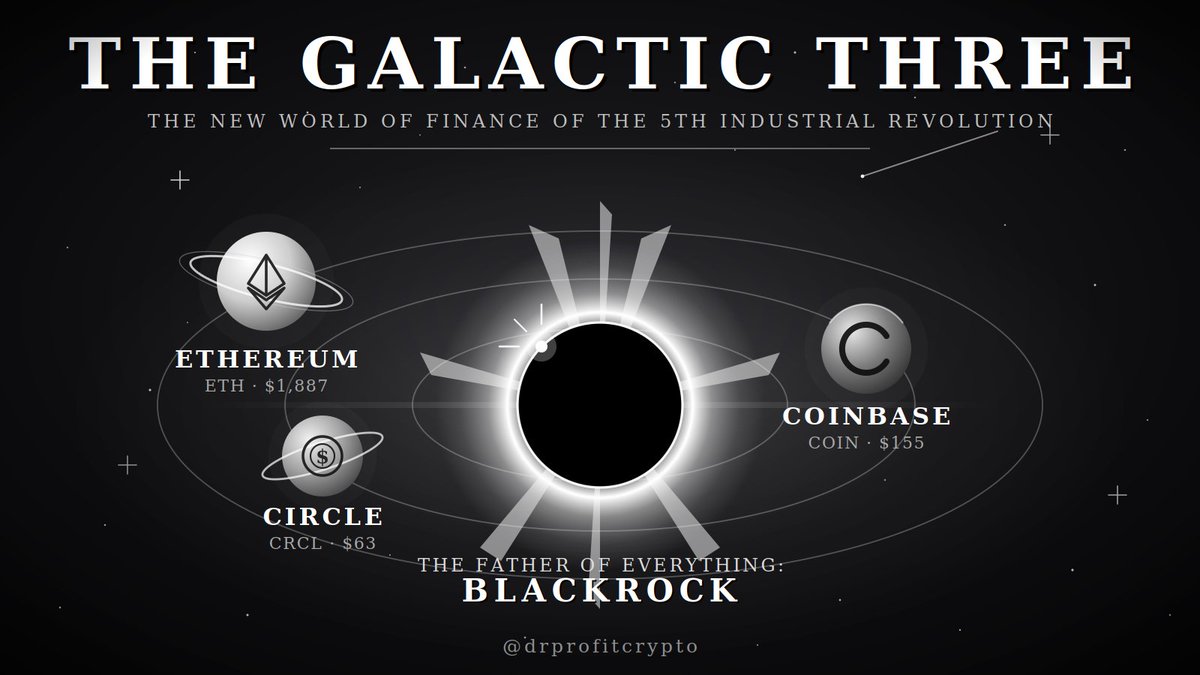
I am very bullish on the three giants: Circle, Coinbase, and Ethereum (ETH). Circle is the world's largest regulated stablecoin issuer. Coinbase is the world's largest cryptocurrency custodian and the largest cryptocurrency exchange in the United States. Ethereum is the world's largest smart contract and tokenization network. The foundation for the next generation of cryptocurrency and finance is already there, right before our eyes, and I am full of confidence in it. The reason is simple: once you truly understand this structure, you will understand. This argument is almost impossible to ignore. BlackRock proclaims itself the father of everything: every asset, every market, every major pool of funds in the world. Since the launch of cryptocurrency ETFs, this "father of everything" has also become the new "father" of cryptocurrency. Not only the father of Bitcoin, but the father of the entire cryptocurrency system. The three companies and assets most closely associated with this "father" are precisely the "galactic giants": Circle, Coinbase, and Ethereum. All my personal buy and sell orders, portfolio planning, and trading strategies are exclusively available to premium members. I will share in real time whenever I invest; I will also share in real time whenever I sell. This is exclusive to premium members. Learn more:
3. The Problem with Bitcoin:
The problem with Bitcoin is this: Don't get me wrong, I'm not bearish on Bitcoin; I'm still very bullish on it. But in this cycle, I've decided to hold 60% Ethereum and 40% Bitcoin. All the reasons are in this report. Currently, BlackRock can do almost nothing about Bitcoin except sell its exposure by packaging it into an ETF. There's no traditional business model behind Bitcoin, and no CEO. They can't just call Bitcoin and demand change. For people like Larry Fink and Wall Street, this makes Bitcoin a relatively boring asset. Yet, BlackRock is still heavily betting on Bitcoin, and IBIT has become the most successful ETF launch ever. Remember this carefully, because now you'll understand how this "problem" is solved, why Bitcoin is so important to BlackRock, and why the final outcome may not be what most people want. On July 23, BlackRock, Coinbase, Fidelity Investments, Strategy, and five other giants formed the Bitcoin Security Consortium, pledging $15 million over three years to provide Bitcoin with quantum-resistant protection. Meanwhile, Coinbase's own research estimates that 20% to 50% of all Bitcoin held in older wallet formats may be at risk of future quantum attacks. BlackRock has already listed quantum computing as an official risk factor in its ETF filings. Now, let's think further. Upgrading to quantum attack protection will be one of the most complex changes Bitcoin could face. Proposals such as BIP-360 already exist, and if the upgrade process is controversial, it could ultimately lead to a hard fork: creating two different Bitcoins. This has happened with Bitcoin Cash. So, if Bitcoin splits, which chain will the ETF track? BlackRock decides. The chain tracked by IBIT will immediately become institutional Bitcoin. The other chain will have no BlackRock backing, no ETF inflows, no reliable institutional support, and will be vulnerable to quantum attacks at any time. So, who will hold the unprotected, unsupported "original" Bitcoin? Nobody. The consortium officially claims it will not participate in Bitcoin governance. Of course, they will say that. The reality is that the Bitcoin community is slow and inefficient, Bitcoin Core development has been slow, and now, a foundation-like structure backed by the world's largest asset management company is developing a quantum-resistant Bitcoin. Meanwhile, miners are scattered across different continents, lacking communication, each operating their own decentralized business without any real cooperation or coordination. Then, Larry Fink, the father of the US dollar, stepped in and took over. He protects Bitcoin from quantum computer attacks, and in return, you use his Bitcoin. His Bitcoin operates under his institutional rules. This is why an asset that BlackRock could never directly control eventually found a "father." Connected to this entire structure are: Coinbase, holding ETF tokens; Circle, operating on reserves managed by BlackRock; and Ethereum, carrying the tokenization infrastructure. These three giants are so large that almost no one can fully understand what's happening around them. Today's update: We witnessed another hardware wallet security vulnerability today, and this will likely become the norm in the future.New technologies will eventually replace old ones, which is why the Bitcoin algorithm will need to be updated in the future.
4. Coinbase: Custodian of BlackRock's Bitcoin
Coinbase Custody is the primary custodian of BlackRock's IBIT. Read it again: the world's largest Bitcoin ETF has its underlying tokens actually custodied by Coinbase. BlackRock chose Coinbase from the beginning, not only for custody but also for access to spot market price data. When Wall Street buys Bitcoin, Coinbase holds those Bitcoins. Moreover, this partnership extends far beyond BlackRock. The vast majority of US spot Bitcoin and Ethereum ETF issuers choose Coinbase as their custodian, meaning that almost the entire ETF industry is stored in Coinbase's vault. Now let's talk about its connection to Circle, because this is where the whole structure becomes incredibly intricate. Coinbase holds equity in Circle and receives a share of the interest income generated from USDC reserves. Furthermore, Coinbase receives all the interest generated by USDC directly held on its platform. Every time USDC grows, Coinbase profits. Every time Circle profits, Coinbase also profits. Don't think of them as competitors; they run on the same machine. Coinbase has also built its own blockchain, Base, which has become one of the world's largest Layer 2 networks. And where does Base ultimately end up? Ethereum. Therefore, Coinbase is also directly funding the third member of the "Galactic Trio"—Ethereum. One company connecting every aspect of the system. Do you understand this connection? Do you understand how the sun and moon work? Everything fits perfectly; that's the Galactic Trio! Today, Coinbase is trading at around $155. The stock price is currently down about 60% from its previous high of $402, and at the same time, the company is building what I call a "universal exchange": offering tokenized stocks and options trading through the acquisition of Deribit, the world's largest crypto options platform, and launching an AI advisor registered with the U.S. Securities and Exchange Commission (SEC), USDC credit cards, and a MiCA license authorized to serve the entire European Union. But the tokenized stock business is the most important, because it's here that the connection between BlackRock, Ethereum, Circle, and Coinbase becomes undeniable.
5. Ethereum: A New World of Finance
When BlackRock launched its tokenized treasury fund, BUIDL, it chose to list it on Ethereum first. BUIDL's assets under management have exceeded $2.5 billion, and it has distributed over $100 million in dividends since its inception. Larry Fink has repeatedly stated publicly that the ultimate goal is the tokenization of all assets, including stocks, bonds, funds, and real estate. Data also confirms this vision: Ethereum's RWA (Risk-Weighted Asset) is worth approximately $16.6 billion, accounting for more than half of the entire tokenized asset market, with a year-on-year growth of 315%. BNB Chain's RWA is $3.6 billion, and Solana's is $2.5 billion. Ethereum's RWA is four and a half times that of its closest competitor, and the answer you need to know is: BlackRock CEO Larry Fink chose Ethereum.
I will discuss DTCC in more detail later in this report, but here's a brief overview: DTCC is the settlement pillar of the US capital markets, holding over $114 trillion in US securities. In 2026, DTCC received approval from the U.S. Securities and Exchange Commission (SEC) to tokenize Russell 1000 index constituents, including the entire S&P 500 and all major Nasdaq constituents, as well as major index ETFs and U.S. Treasuries. Companies like BlackRock, Goldman Sachs, and JPMorgan Chase participated. The core platform runs on the Ethereum client Besu, meaning Wall Street's underlying architecture is being rebuilt on Ethereum technology and standards. The process is simple. Currently, when you buy stocks, your broker sends an order, DTCC updates its database, and settlement takes a day. In the tokenized version, the process will change. Stocks will become tokens, transfers will occur on-chain, and settlement will be instantaneous. This infrastructure uses the language of Ethereum, so regardless of whether banks and custodians plan to integrate, they are building Ethereum-compatible infrastructure. Since EIP-1559 in 2021, a portion of every transaction fee on Ethereum has been burned and permanently lost. This upgrade predates ETFs, BUIDL, and DTCC by three years. The mechanism was already in place, but its true significance is only just beginning to emerge. Tokenized stock market changes hands: it's like Visa burning a portion of its own stock with every transaction. No other stock on Earth has this structure, and this only leads to a continuous price increase.
Ethereum underperformed in the last cycle due to a lack of regulatory clarity regarding its future. This is precisely why I avoided investing heavily in Ethereum in the last cycle, focusing primarily on Bitcoin. Remember the example of Ripple. Due to the shadow of litigation from the U.S. Securities and Exchange Commission (SEC), XRP barely performed in the 2021 bull market. Once the legal storm began to dissipate, I heavily invested in XRP, making it my second-largest investment after Bitcoin in the last cycle. I've spoken publicly about this and written several reports explaining why I bought XRP at $0.30 at the time. In the 2024 and 2025 cycles, XRP became one of the strongest performing assets. My expectations for Ethereum won't fundamentally change. Ethereum is currently priced at around $1880.Approximately 57% of the entire tokenized real-world asset market is built upon it. As the situation becomes clearer, prices will readjust, and fair value will eventually return.
6. Circle: The Deepest Connection Among the Three Stablecoins
Circle may have the deepest connection among the three stablecoins, but it's rarely mentioned, perhaps because it's still considered "a stablecoin company." But who manages the reserves behind USDC? BlackRock's Circle Reserve Fund is a government money market fund registered with the U.S. Securities and Exchange Commission (SEC), managed by BlackRock and custodied by BNY Mellon. Over 80% of the dollar funds behind USDC are held in funds managed by BlackRock. Long before mainstream media began discussing stablecoin stocks, BlackRock was already an investor in Circle in 2022. This excellent stock company is the company behind USDC, the progenitor of all future regulated stablecoins and the only large-scale dollar stablecoin in Europe regulated by MiCA. In the US, the GENIUS Act is forcing all issuers to come under regulatory oversight, and Tether (USDT) is already feeling the pressure. For the first time since 2022, USDT's circulating supply declined, decreasing by $3 billion in the first quarter of 2026. While the decline stopped in the second quarter, the real story is more complex. In the second quarter, USDC accounted for a record 12.5% of all cryptocurrency trading volume. In the first half of 2026, approximately 70% of stablecoin trading volume was completed through USDC, compared to only about 25% through USDT. In June alone, $1.21 trillion flowed through USDC, while only $576 billion flowed through USDT. The future of finance belongs to the liquid dollar. Every dollar flowing out of unregulated stablecoins ultimately ends up in the same place: USDC. And who profits? Circle.
But USDC isn't the whole story, because Circle also operates USYC: a tokenized treasury bill designed specifically for institutions. Instead of letting dollars sit idle on-chain or in bank accounts, institutions can transfer funds to USYC, which invests these funds in short-term US Treasury bonds while maintaining their on-chain availability. I've been watching the USYC supply for months. The fund has grown from approximately $350 million in October 2025 to $400 million, and now it's around $3 billion. It even surpasses BlackRock's BUIDL fund to become the world's largest tokenized treasury product. Binance now accepts it as institutional collateral. Ironically, the GENIUS Act prohibits stablecoin issuers from directly paying yields with the stablecoin itself. So where does the yield business go? The answer is USYC. Circle owns both ends of the transaction. USDC becomes a regulated digital dollar for payments and settlements; while USYC becomes a tokenized treasury bill product for yields and institutional collateral. I've been very patient, extremely patient. I'd been wanting to hold this stock and finally bought it at around $62, well below its opening price of $83 on its first day of trading and nearly 70% lower than its all-time high of $197.90. This was an excellent entry point. From today's $62, I expect it to rise to at least $500 by 2030. This is just my personal opinion and not investment advice.
7. Tokenization of Everything and the DTCC Revolution
The entire world is moving towards tokenization. Coinbase announced the launch of a tokenized US stock product pegged 1:1 to real shares, with dividends automatically distributed on-chain. Meanwhile, Kraken and Robinhood are racing to enter the same market. The Japanese stock market is trading via SBI using the Ethereum-based Ondo track. Nasdaq is also preparing its own tokenized securities framework. These companies and developments are not isolated but interconnected. Larry Fink himself has said: the dream is to tokenize everything, and it starts with stocks. Remember my words: Platforms like Hyperliquid and pure DEX infrastructure will eventually be banned if they don't implement robust KYC processes. Decentralization has no end. Stop having illusions. The elites will never allow you to control a completely independent and anonymous decentralized financial system. If you truly believe in decentralization, hold gold. Gold is the oldest existing decentralized asset. This is not investment advice. It's simply the most logical answer I can give to DeFi believers. There will be no fully decentralized financial system. You will see DeFi gradually evolve into KYC-based financial infrastructure.
If you still need definitive evidence that this transformation has already occurred, look at DTCC, the Depository Trust & Clearing Corporation. DTCC is the heart of the US financial system. It holds almost every US stock you've ever heard of and handles trillions of dollars in transactions. In 2026, it launched a tokenization service, transferring stocks onto the blockchain. When DTCC converts stocks into tokens, the actual transfer and settlement no longer occur within DTCC's own system. These things happen externally, on the blockchain, and in this case, on Besu, which is powered by Ethereum. Friends, do you see the connection? Do you understand what happens when trillions of dollars in tokenized stocks and bonds start flowing on-chain, 24/7, with instant settlement? Someone has to provide the tracks, the bridges, and the funding… Ethereum provides the tracks. This is precisely the settlement layer upon which this entirely new infrastructure operates. Coinbase provides the bridges, acting as a regulated custodian, connecting traditional capital with this entirely new digital system.Circle provides the funding. To settle large-scale tokenized transactions globally, you need a highly liquid, fully compliant digital dollar. That's USDC. Friends, a whole new financial world is before us, seize the opportunity! I'm actively investing in this revolution; I believe in this future, not a future of free-willed money. I don't believe in privacy coins or decentralized finance. I believe in compliant, regulated, and institutionally driven markets. My bet is on the other side, and many in the cryptocurrency space may not like my statement right now.
8. Clarity Act:
The Clarity Act will be extremely beneficial to the cryptocurrency industry, but I believe it will benefit Ethereum and Circle even more. Coinbase is getting more attention than Bitcoin. Bitcoin is widely considered a commodity. The Act answers the most critical questions about the other three types of tokens: which tokens are securities and which are commodities; whether exchanges are regulated by the SEC or the CFTC; which disclosure rules apply to issuers; how stablecoins and yield products will be regulated; how DeFi protocols will be regulated; and how safe harbor mechanisms for digital commodity trading will operate. The situation is clear: the bill passed the House in July 2025 with an overwhelming bipartisan vote of 294 to 134; it was approved by the Senate Banking Committee in May with a vote of 15 to 9; and now it needs a full vote before the Senate recess on August 10. Otherwise, we will have to wait until September. But in any case, the bill is about to take effect. All my personal buy and sell orders, portfolio planning, and trading strategies are exclusively shared with VIP members. I share my investment decisions in real time whenever I invest; I also share my sell decisions in real time. VIP members only. Learn more:
9. I am directly investing in change
These undervalued assets, or more accurately, the entire undervalued sector, are what I call the new finance of our new world. All the money invested in the overvalued AI market will eventually realize that we are facing a major transformation in the financial markets, and investment will flow into the financial sector. The entire sector remains undervalued because the public and many large investors still do not realize the scale of its future impact. They don't understand the impact of Coinbase, the impact of Circle, or the impact of Ethereum. They certainly don't realize the scale of the new tokenized financial system being built before their eyes. This transformation will be recorded in history. Again, our financial system is changing. I am directly investing in this transformation. I invest in leading companies and assets that drive change, operate the infrastructure, and are expected to profit the most from it. If you ask me how much I've invested, I can say I've invested a huge amount. I could even say my investment is enormous. I'm making long-term investments, and I expect these returns to benefit future generations, providing financial security for at least the next 10 to 20 years. This represents my personal opinion only and is not financial advice. Nothing I share should be considered advice to buy, sell, or hold any asset. Always do your own research and consult a licensed financial advisor before making any investment decisions. I am sharing my personal thoughts and decisions.
 3340035
阿布说币
フォローAt age 11, Buffett bought his first stock for $114.75.
He sold it early with a small profit, but within weeks the stock price soared to $200.
The lost profit far exceeded his initial gain.
This premature profit-taking became his first lesson for life.
Over eighty years, his net worth reached $165 billion. The underlying habit behind his immense wealth is simple: buy quality assets, hold them patiently, and don't sell easily.
In 1999, during the dot-com bubble frenzy, everyone chased tech stocks, mocking Buffett for being out of touch. He remained unmoved, sticking to his circle of competence.
In 1988, he invested $1 billion in Coca-Cola, holding it long-term. This investment grew to $25 billion, providing a stable annual dividend of $700 million.
In 2016, at 85, Buffett broke with conventional wisdom and heavily invested in Apple, even after claiming he didn't understand tech stocks. This holding peaked at $160 billion.
Ordinary people often fantasize about getting rich quick in a few weeks or months.
True snowballing compound interest relies on long-term perseverance. It's not about buying into the fluctuations of stock charts, but rather into companies with sustainable competitive advantages and continuously growing value.
When the market is in a panic sell-off, remember this: Compound interest doesn't come from frequent trading, but from choosing the right assets and enduring the long wait.
3700047阿布说币
フォローAt age 11, Buffett bought his first stock for $114.75.
He sold it early with a small profit, but within weeks the stock price soared to $200.
The lost profit far exceeded his initial gain.
This premature profit-taking became his first lesson for life.
Over eighty years, his net worth reached $165 billion. The underlying habit behind his immense wealth is simple: buy quality assets, hold them patiently, and don't sell easily.
In 1999, during the dot-com bubble frenzy, everyone chased tech stocks, mocking Buffett for being out of touch. He remained unmoved, sticking to his circle of competence.
In 1988, he invested $1 billion in Coca-Cola, holding it long-term. This investment grew to $25 billion, providing a stable annual dividend of $700 million.
In 2016, at 85, Buffett broke with conventional wisdom and heavily invested in Apple, even after claiming he didn't understand tech stocks. This holding peaked at $160 billion.
Ordinary people often fantasize about getting rich quick in a few weeks or months.
True snowballing compound interest relies on long-term perseverance. It's not about buying into the fluctuations of stock charts, but rather into companies with sustainable competitive advantages and continuously growing value.
When the market is in a panic sell-off, remember this: Compound interest doesn't come from frequent trading, but from choosing the right assets and enduring the long wait.
3160049
Una繁星
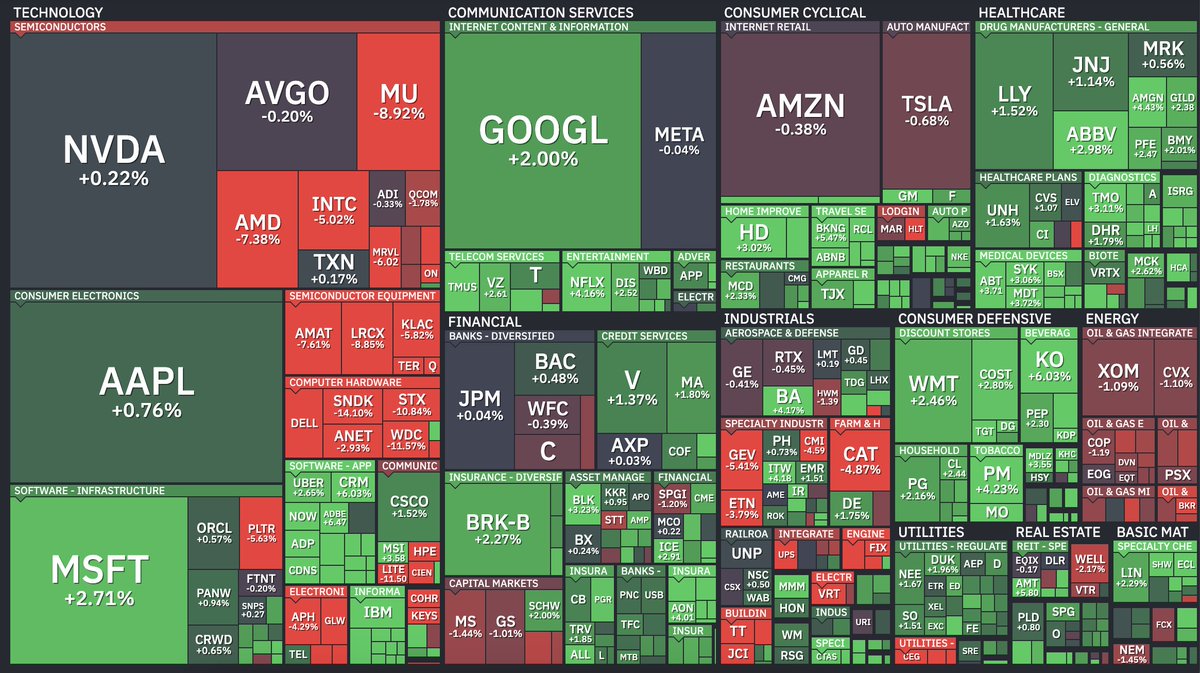
フォローSK Hynix fell 13%-14% today. The last time we saw such a large single-day drop was during the 2008 financial crisis.
Micron also opened lower tonight. Looking back at previous major pullbacks in chip stocks:
2000-2002 Dot-com Bubble: The SOX index fell 80%-85% from its peak.
2008 Financial Crisis: A drop of 60-70%.
2022 Bear Market: Frenzied interest rate hikes slashed valuations, and inventory cycles impacted earnings, resulting in a 35%-46% drop.
2020 Pandemic Impact: A rapid 35% drop, followed by a rapid rebound.
The semiconductor industry experiences an inventory adjustment cycle almost every 3-5 years. From the 1990s, 2001, 2008, 2018-2019, to 2022, history has shown almost no exceptions.
By 2026, four years will have passed since the last inventory cycle. While the demand structure has changed in the AI era, the inventory cycle logic still applies to consumer electronics and general-purpose memory.
History tells us that industries that survive can recover. But it doesn't tell us that after a nearly sevenfold increase, it can continue to rise indefinitely, another sevenfold; there will always be a limit.
As for when that limit will come, it ultimately depends on the major customers of storage stocks—the tech giants. If their investments don't yield long-term returns, and the returns are far below expectations, then the current valuations of storage stocks are unjustified.
 4040045
海登
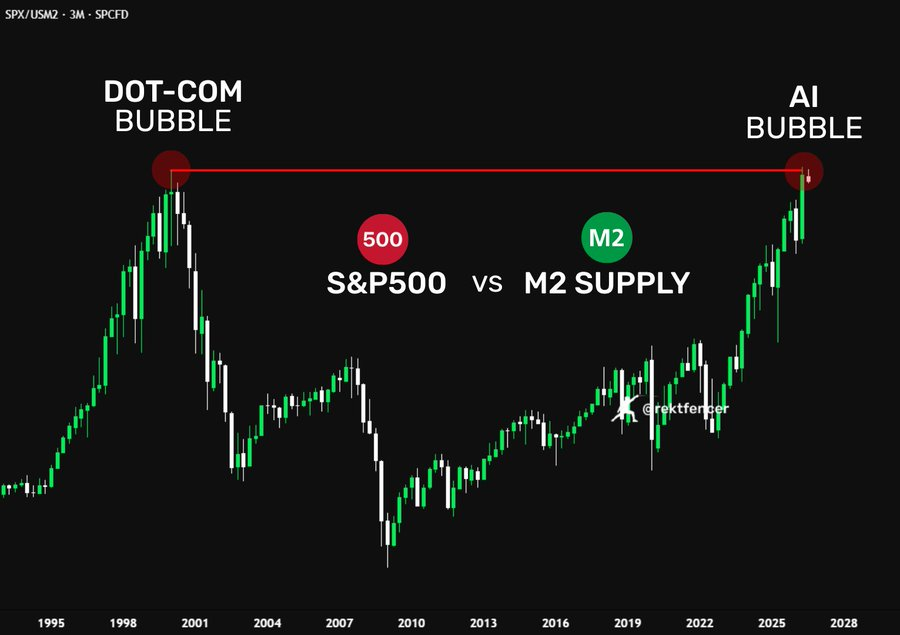
フォロー2000: S&P 500/M2 peaked → Dot-com bubble burst.
2021: S&P 500/M2 neared previous high → Bear market in 2022.
2026: S&P 500/M2 touched previous high again → ?
Historically, this signal has never been "harmless".
 3230028
阿布说币
フォローAt age 11, Buffett bought his first stock for $114.75.
He sold it early with a small profit, but within weeks the stock price soared to $200.
The lost profit far exceeded his initial gain.
This premature profit-taking became his first lesson for life.
Over eighty years, his net worth reached $165 billion. The underlying habit behind his immense wealth is simple: buy quality assets, hold them patiently, and don't sell easily.
In 1999, during the dot-com bubble frenzy, everyone chased tech stocks, mocking Buffett for being out of touch. He remained unmoved, sticking to his circle of competence.
In 1988, he invested $1 billion in Coca-Cola, holding it long-term. This investment grew to $25 billion, providing a stable annual dividend of $700 million.
In 2016, at 85, Buffett broke with conventional wisdom and heavily invested in Apple, even after claiming he didn't understand tech stocks. This holding peaked at $160 billion.
Ordinary people often fantasize about getting rich quick in a few weeks or months.
True snowballing compound interest relies on long-term perseverance. It's not about buying into the fluctuations of stock charts, but rather into companies with sustainable competitive advantages and continuously growing value.
When the market is in a panic sell-off, remember this: Compound interest doesn't come from frequent trading, but from choosing the right assets and enduring the long wait.
3520040阿布说币
フォローAt age 11, Buffett bought his first stock for $114.75.
He sold it early with a small profit, but within weeks the stock price soared to $200.
The lost profit far exceeded his initial gain.
This premature profit-taking became his first lesson for life.
Over eighty years, his net worth reached $165 billion. The underlying habit behind his immense wealth is simple: buy quality assets, hold them patiently, and don't sell easily.
In 1999, during the dot-com bubble frenzy, everyone chased tech stocks, mocking Buffett for being out of touch. He remained unmoved, sticking to his circle of competence.
In 1988, he invested $1 billion in Coca-Cola, holding it long-term. This investment grew to $25 billion, providing a stable annual dividend of $700 million.
In 2016, at 85, Buffett broke with conventional wisdom and heavily invested in Apple, even after claiming he didn't understand tech stocks. This holding peaked at $160 billion.
Ordinary people often fantasize about getting rich quick in a few weeks or months.
True snowballing compound interest relies on long-term perseverance. It's not about buying into the fluctuations of stock charts, but rather into companies with sustainable competitive advantages and continuously growing value.
When the market is in a panic sell-off, remember this: Compound interest doesn't come from frequent trading, but from choosing the right assets and enduring the long wait.
4210021
QFi 元宇宙阿Q 🔰
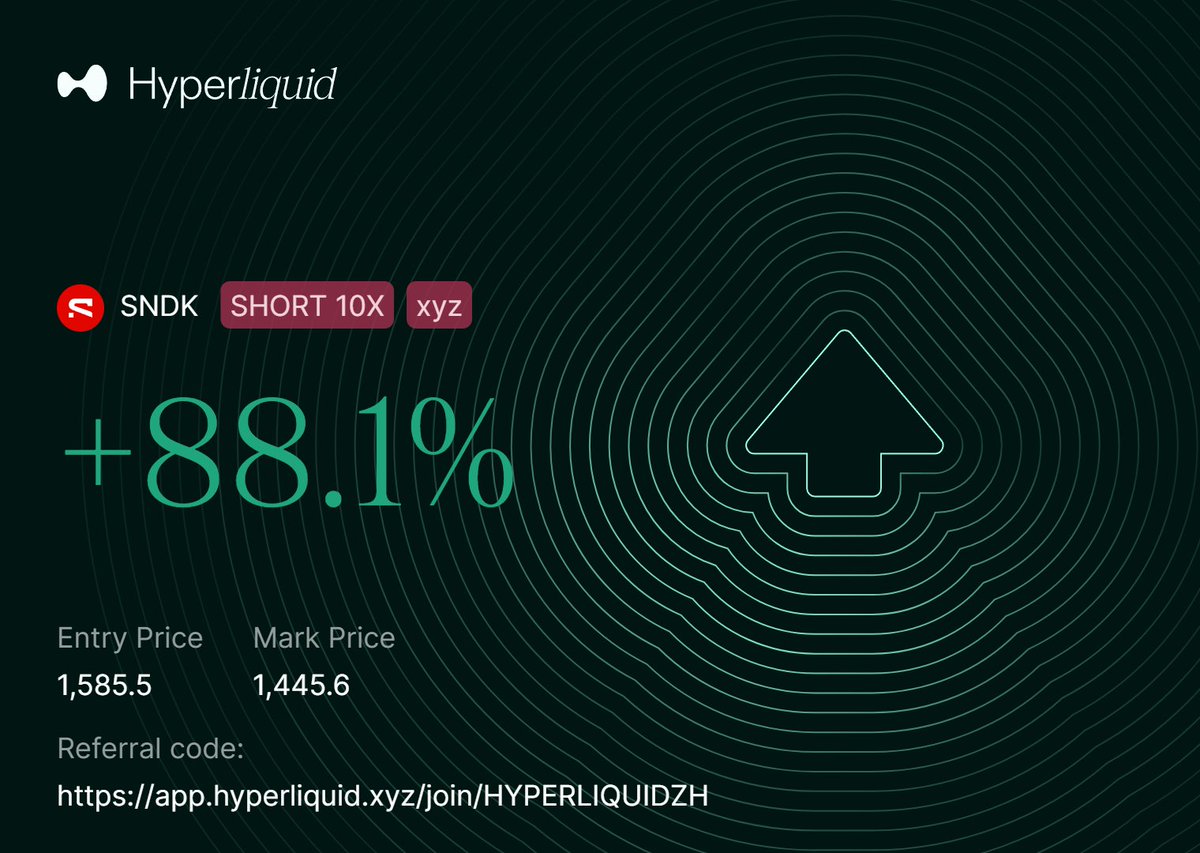
フォローIsn't Micron a leader in AI memory? Didn't its financial report look good? Why short it?
Let me explain my logic—three signals have appeared simultaneously.
First, from a macro perspective, the US government just announced new tariffs of 10% to 12.5% on 60 trading partners, directly impacting the semiconductor supply chain. Import costs for specialty chemicals, silicon wafers, and manufacturing equipment have all increased, putting real pressure on chip companies' profit margins. The market will begin to reprice the long-term cost structure of the semiconductor industry.
Second, Michael Burry has also been shorting Micron, with an entry price of approximately $1051.87. And just a few hours ago, he added to his short position near the $930 level. Many people don't recognize him, but you know the TV show "The Big Short"—he's the inspiration for it. His assessment is that the Philadelphia Semiconductor Index is about 65% above its 200-day moving average, a deviation only seen during the dot-com bubble of 2000.
Third, the 52-week high of 1255 has been followed by a rebound to 800, and now it's at 920. The daily uptrend has broken down, and any further upward movement will face significant selling pressure.
So, what's next? I have two scenarios in mind:
1- Following the red arrow in my chart, it will reach around 800, rebound, and then continue to fall, finding support around 6XX.
2- This decline will end around 800, followed by a period of consolidation. A direction will emerge after this consolidation.
In the short term, I think the selling pressure in the storage sector hasn't ended yet. The Nasdaq has also seen two consecutive weekly declines, indicating weak market sentiment.
Continue to hold short positions and monitor the support level around 800. $MU $SNDK
 4140036