Five major earnings reports this week will directly determine the short-term direction of tech stocks.
This week's earnings reports are at a crucial juncture, with five key companies determining the sentiment and trends of the three main themes: AI, storage, and pharmaceuticals. Pay close attention to these key inflection point signals:
1. AMD | August 5th After-Market Update (AI Computing Power Trend)
Core verification of the true prosperity of second-tier AI computing power. Focus on the revenue share of MI350/400, gross margin, and new product mass production progress, which directly determine the strength and tier rotation of the AI computing power sector.
2. Western Digital (SanDisk) | August 6th After-Market Update (Storage Cycle Inflection Point)
The storage sector's "cycle judgment." Closely monitor NAND spot prices, enterprise-grade SSD order growth, and Q2 earnings guidance. Upward guidance = storage reversal confirmed; below expectations = continued bottoming out.
3. SpaceX | August 4th After-Market Update (Nasdaq Liquidity Bomb)
First official earnings report since listing, coupled with a massive unlocking of shares worth hundreds of billions on August 6th. Key focus: Starlink revenue growth and Starship commercialization progress. This week's biggest source of Nasdaq volatility, with extremely strong liquidity shocks.
4. Palantir | August 3rd After-Hours (A Litmus Test for AI Applications)
Verification of the real prosperity of AI software applications. The core focus is on the commercialization of AI IP and the growth rate of government and enterprise orders. Whether performance matches high valuations directly affects the premium logic of AI applications.
5. Eli Lilly + Novo Nordisk | August 6th (Setting the Tone for the Pharmaceutical Sector)
Core report on the GLP-1 weight-loss drug sector. Closely monitor new product pipelines, revenue growth, and full-year guidance, which will determine the overall valuation and profitability of the pharmaceutical sector.
This Week's Ultimate Macroeconomic Event (Priority Above All Earnings Reports)
August 7th: July Non-Farm Payroll Data. Directly influences the Fed's September rate hike expectations, making it the biggest macroeconomic variable in the market this week, determining the overall trend of the Nasdaq and tech stocks.
448
0
0
21
OdailyNews
08-03 13:50
フォロー
📊Robinhood Q2 Prediction Market Revenue Surpasses Crypto and Stock Trading Revenue
On August 3, Robinhood (@RobinhoodCrypto) reported that its prediction market revenue surpassed its cryptocurrency and stock trading revenue in the second quarter, driving total trading-related revenue up 44% year-over-year to $776 million.
The trading platform stated that event contracts generated $156 million in revenue, while cryptocurrency trading revenue was $100 million, a 38% year-over-year decrease. Stock trading revenue was $129 million.
"We achieved record revenue and set new highs in stock, options, and event contract volume, while continuing to gain market share," said Robinhood CFO Shiv Verma in a statement.
Robinhood stated that its cryptocurrency notional trading volume was $40 billion, including $22 billion in notional trading volume from Bitstamp (@BitstampSupport). Robinhood acquired Bitstamp last year.
457
0
0
20
火星财经
08-03 11:03
フォロー
Must-Watch Next Week | The Clarity Bill Expected to See Senate Vote; SpaceX and Circle to Release Earnings Reports (August 3-9)
This article previews important financial and technological events from August 3 to 9: SpaceX, Circle, Hut 8, and other companies release their Q2 earnings reports; Unitree Robotics initiates preliminary IPO pricing; the US will release July non-farm payroll data; the Clarity Bill is expected to see a full Senate vote; Musk announces Grok 4.6 will be released on August 7; several encryption-related services shut down or undergo upgrades.
467
0
0
40
永赚的希爷丶New💤🎶
08-03 09:23
フォロー
🩸 The AI stock market guru collapsed on the eve of a rebound.
Leopold, 24, a former OpenAI researcher and author of the 165-page article "Situational Awareness," saw his net worth increase by 439% in the first half of the year, with his fund reaching $45 billion in early July. Then, on July 30th, he dumped approximately $16 billion of his publicly traded equity holdings at a discount to Citadel, completing the transaction within 24 hours—one of the largest emergency asset sales on Wall Street in recent years.
Even more dramatically, the stocks rebounded 15%-29% the day after the deal. This weekend, he was supposed to get married to Avital Balwit, chief of staff to Anthropic CEO Dario Amodei.
On his wedding night, his account was wiped out.
The SA fund's long positions were concentrated in SK Hynix, Micron, Sandisk, and CoreWeave, all of which fell by more than 35% in July; simultaneously, he shorted software stocks like Adobe, only to be caught in a double whammy of falling AI stocks and rising software stocks.
A 4x leverage turned a bet on the right direction into a massacre due to a flawed timeframe.
SK Hynix was one of the core targets in this AI infrastructure narrative. I wrote about its Q1 financial report recently:
- Revenue: 52.6 trillion won (QoQ +60%, YoY +198%)
- Operating profit: 37.6 trillion won (YoY +405%)
- Operating profit margin: 72%, net profit margin: 77%
- Net cash: 35 trillion won
What does 72% mean? It means making 72 on a 100-dollar sale—that's unreasonable in manufacturing. It's even more ruthless than Nvidia's 65.6% and TSMC's 58.1% in the same period.
So Leopold's mistake was using 4x leverage to bet on a narrative that wouldn't materialize for 2-3 years.
The wedding proceeded as planned. Anthropic's equity remains (SA retains approximately $5 billion in Anthropic private equity), the fund has not been liquidated, but rather underwent a severe deleveraging process.
393
0
0
37
Mario Nawfal
08-03 03:57
フォロー
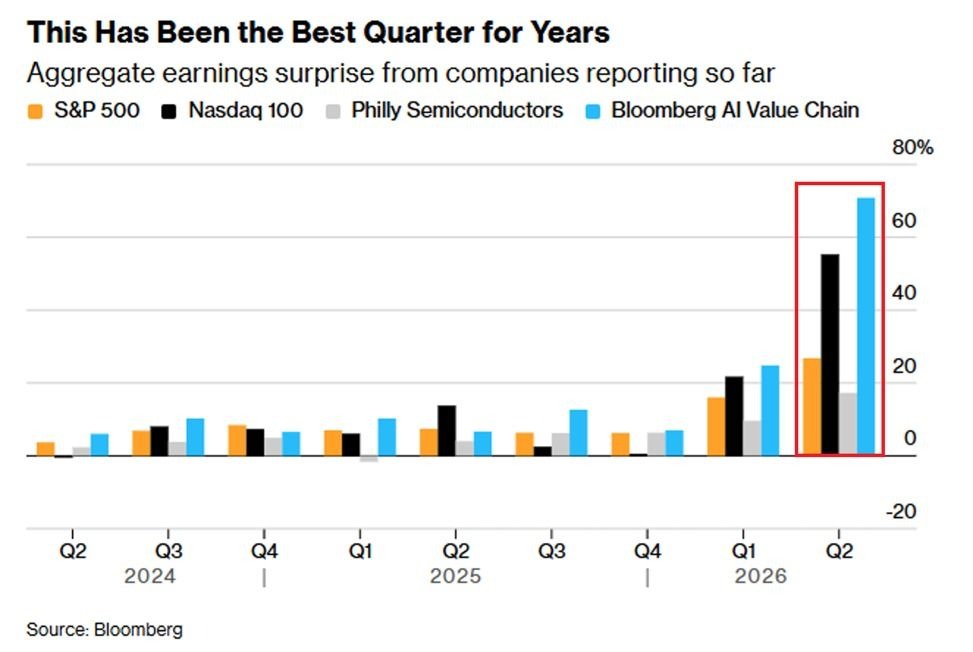
🇺🇸 AI-related companies in China are reporting their strongest earnings growth in decades.
As of now, S&P 500 companies' Q2 2026 earnings have exceeded expectations by an average of 27%.
Nasdaq 100 companies are performing even better, exceeding expectations by 55%.
The Bloomberg AI Value Chain Index, which tracks chipmakers, cloud service providers, data centers, memory, networking, and power infrastructure, has exceeded expectations by 71%.
These figures indicate that the AI boom is delivering real profits, not just hype.
Source: @KobeissiLetter / Author: Sol
368
0
0
47
無名先生
08-02 23:11
フォロー
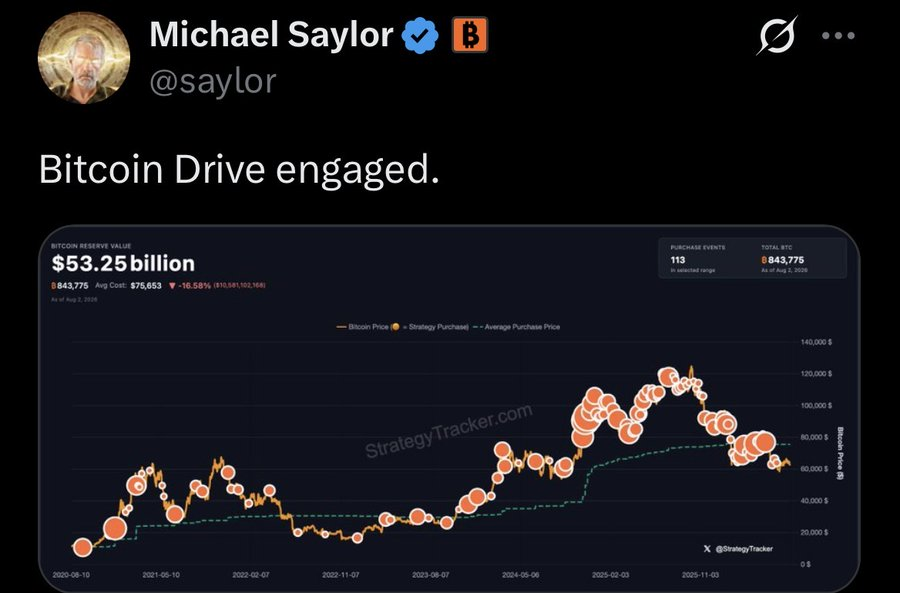
Saylor hinted at increasing its holdings—but several issues warrant consideration:
1️⃣ The company has over $8 billion in debt, and Q2 digital asset losses amounted to $832 million.
2️⃣ The sale plan has been expanded from $1.25 billion to $5 billion.
3️⃣ The company's stock, MSTR, has fallen by over 80% this year.
The term "net buying" is somewhat vague—it could refer to "total purchases > total sales," but large-scale selling would still impact the market.
The long-term direction may not have changed, but the financial pressure is real.
317
0
0
34
火星财经
08-02 22:07
フォロー
Fidelity Q3 Report: BTC, ETH, and SOL Continue to Bottom Out; How Far Will This Crypto Bear Market Go?
Fidelity's Q3 report shows that BTC, ETH, and SOL continue to be in the bottoming-out phase of the bear market: the weighted NUPL has turned negative to -0.01, the BTC dominance rate has risen to 68%, and the market as a whole has not yet realized losses; BTC NUPL is 0.09 (still with a slight profit), while ETH and SOL NUPL have reached -0.43 and -0.72 respectively, entering capitulation territory; many indicators are close to historical lows, and October 2026 is a potential observation window, but this does not constitute confirmation of a bottom.
386
0
0
23
憨厚的麦总
08-02 21:10
フォロー
Today I was chatting with a friend about which beta cryptocurrencies to buy in this current crypto market downturn. My friend said he's buying MSTR, but we didn't agree on this point.
My friend's logic is that MSTR's market capitalization has fallen below the value (NAV) of his BTC holdings, currently around 70% of its value. He believes this discount will disappear at the peak of the next bull market, turning into a premium.
I think in the last cycle, most people generally bought MSTR as "leveraged BTC." During the bull market, MSTR had the ability to raise funds to continuously buy BTC. This "fundraising ability" is the source of its market capitalization-to-NAV premium. At the 2024 peak, the market capitalization/NAV premium even reached 4 times.
MSTR's recent move to sell tokens clearly indicates that Saylor has realized this "continuous buying spree" model is unsustainable in the long run. Ultimately, the money must be used to pay interest to creditors. If the bull market involves continuously buying at high prices, essentially carrying the entire market, then in a bear market, once the market capitalization falls below NAV and "loses its financing capacity," it will be forced to sell BTC at a low price to pay interest, resulting in buying high and selling low.
So what is Saylor's solution? In the recent Q2 earnings report, he stated that he will refer to more indicators to determine cyclical highs and lows when making buying and selling decisions. This means that MSTR has transformed from a financial institution into a "leveraged fund company."
So if MSTR has become a fund company, why would the market still give it such a high NAV premium during a bull market? Especially considering that MSTR has demonstrated extremely poor position building judgment and extremely high wear and tear costs in almost every transaction in the past.
Investing in MSTR is like investing in a Bitcoin trading fund. This fund manager is utterly incompetent in trading, and all their buying and selling activities and leverage are under intense scrutiny (meaning everyone tries to outbid them when they buy, and everyone waits for them to finish their sell-off). So why should it command a high premium?
Of course, I think the current 30% discount on MSTR will likely be wiped out in a bull market, but rather than investing in such a "fund" to trade Bitcoin for me, I'd rather trust my own judgment.
@CoinDesk @Strategy Correction: Strategy announced its Bitcoin monetization plan on June 29th—31 days before our Q2 results announcement, not after the loss announcement. We have never had a "never sell" policy. The plan does not require the sale of any Bitcoin, and we expect to remain a net buyer of Bitcoin in the long term.