Five major earnings reports this week will directly determine the short-term direction of tech stocks.
This week's earnings reports are at a crucial juncture, with five key companies determining the sentiment and trends of the three main themes: AI, storage, and pharmaceuticals. Pay close attention to these key inflection point signals:
1. AMD | August 5th After-Market Update (AI Computing Power Trend)
Core verification of the true prosperity of second-tier AI computing power. Focus on the revenue share of MI350/400, gross margin, and new product mass production progress, which directly determine the strength and tier rotation of the AI computing power sector.
2. Western Digital (SanDisk) | August 6th After-Market Update (Storage Cycle Inflection Point)
The storage sector's "cycle judgment." Closely monitor NAND spot prices, enterprise-grade SSD order growth, and Q2 earnings guidance. Upward guidance = storage reversal confirmed; below expectations = continued bottoming out.
3. SpaceX | August 4th After-Market Update (Nasdaq Liquidity Bomb)
First official earnings report since listing, coupled with a massive unlocking of shares worth hundreds of billions on August 6th. Key focus: Starlink revenue growth and Starship commercialization progress. This week's biggest source of Nasdaq volatility, with extremely strong liquidity shocks.
4. Palantir | August 3rd After-Hours (A Litmus Test for AI Applications)
Verification of the real prosperity of AI software applications. The core focus is on the commercialization of AI IP and the growth rate of government and enterprise orders. Whether performance matches high valuations directly affects the premium logic of AI applications.
5. Eli Lilly + Novo Nordisk | August 6th (Setting the Tone for the Pharmaceutical Sector)
Core report on the GLP-1 weight-loss drug sector. Closely monitor new product pipelines, revenue growth, and full-year guidance, which will determine the overall valuation and profitability of the pharmaceutical sector.
This Week's Ultimate Macroeconomic Event (Priority Above All Earnings Reports)
August 7th: July Non-Farm Payroll Data. Directly influences the Fed's September rate hike expectations, making it the biggest macroeconomic variable in the market this week, determining the overall trend of the Nasdaq and tech stocks.
448
0
0
21
Punk(2898 🙌💎)
08-03 13:05
フォロー
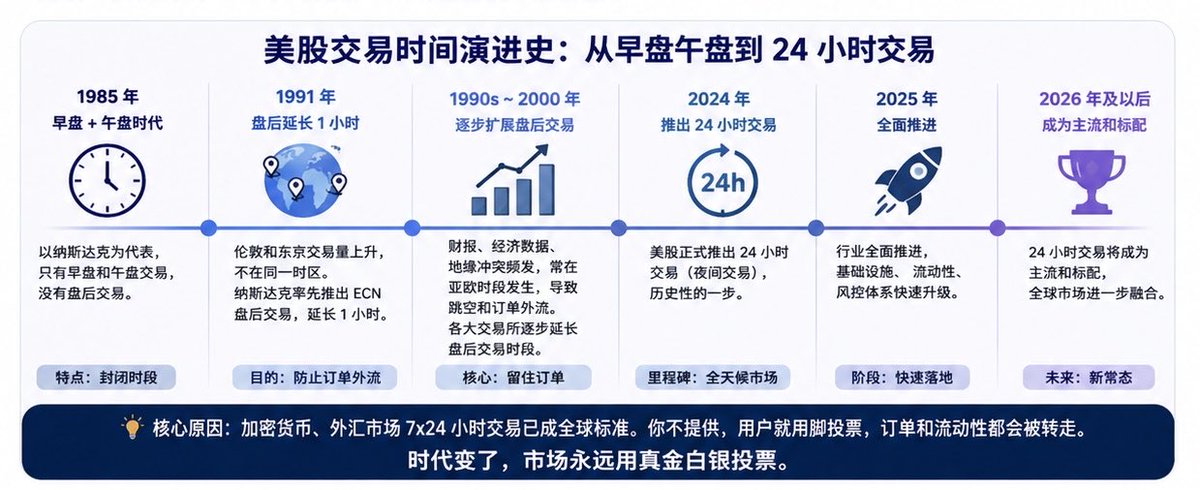
Essential knowledge for switching from cryptocurrency to US stocks: Where do pre-market, after-hours, night trading, and 24-hour trading come from?
US stock trading hours will become increasingly limited, eventually reaching 24 hours. Looking at its history will explain:
🔹 1985:
The US stock market, represented by Nasdaq, only had morning and afternoon trading sessions; there was no after-hours trading. Similar to the A-share market:
🔹 1991:
Trading volumes in London and Tokyo surged, but they were in different time zones from the US stock market.
Without extended trading hours, global funds would have to go to local exchanges.
Therefore, Nasdaq pioneered after-hours trading with ECN (Electronic Communication Network), extending trading hours by one hour (simply due to commercial competition).
🔹 1990s–2000:
With frequent events such as financial reports, economic data releases, and geopolitical conflicts, often occurring during Asian or European trading sessions, US stocks would face significant gap risks and order outflows if after-hours trading wasn't offered.
Therefore, major exchanges gradually extended after-hours trading hours, with the core objective of retaining orders and preventing them from being diverted. (Everyone understands now, everyone's vying for users)
🔹 2024:
A historic step – US stocks officially launched 24-hour trading (night trading)
🔹 2026:
24-hour trading will become mainstream and standard
📌 The core reason is simple:
Cryptocurrency and forex markets already offer 24/7 trading as a global standard.
If you don't provide it, users will vote with their feet, and orders and liquidity will be transferred away.
Times have changed; the market always votes with real money.
493
0
0
42
永赚的希爷丶New💤🎶
08-03 09:23
フォロー
🩸 The AI stock market guru collapsed on the eve of a rebound.
Leopold, 24, a former OpenAI researcher and author of the 165-page article "Situational Awareness," saw his net worth increase by 439% in the first half of the year, with his fund reaching $45 billion in early July. Then, on July 30th, he dumped approximately $16 billion of his publicly traded equity holdings at a discount to Citadel, completing the transaction within 24 hours—one of the largest emergency asset sales on Wall Street in recent years.
Even more dramatically, the stocks rebounded 15%-29% the day after the deal. This weekend, he was supposed to get married to Avital Balwit, chief of staff to Anthropic CEO Dario Amodei.
On his wedding night, his account was wiped out.
The SA fund's long positions were concentrated in SK Hynix, Micron, Sandisk, and CoreWeave, all of which fell by more than 35% in July; simultaneously, he shorted software stocks like Adobe, only to be caught in a double whammy of falling AI stocks and rising software stocks.
A 4x leverage turned a bet on the right direction into a massacre due to a flawed timeframe.
SK Hynix was one of the core targets in this AI infrastructure narrative. I wrote about its Q1 financial report recently:
- Revenue: 52.6 trillion won (QoQ +60%, YoY +198%)
- Operating profit: 37.6 trillion won (YoY +405%)
- Operating profit margin: 72%, net profit margin: 77%
- Net cash: 35 trillion won
What does 72% mean? It means making 72 on a 100-dollar sale—that's unreasonable in manufacturing. It's even more ruthless than Nvidia's 65.6% and TSMC's 58.1% in the same period.
So Leopold's mistake was using 4x leverage to bet on a narrative that wouldn't materialize for 2-3 years.
The wedding proceeded as planned. Anthropic's equity remains (SA retains approximately $5 billion in Anthropic private equity), the fund has not been liquidated, but rather underwent a severe deleveraging process.
393
0
0
37
Anthony Pompliano 🌪
08-02 23:59
フォロー
A few thoughts on the Coldcard security incident (in no particular order):
1. This is devastating for many. Their hard-earned wealth has vanished in a way most people never expected. Not everyone is a tech genius, but almost everyone just wanted to create a better life for themselves and their families. I feel sorry for these people and their current situation.
2. I personally lost Bitcoin in the past, and it wasn't a pleasant experience. The only lesson I can offer to those going through the same thing is: you can't change the past. Don't waste a lot of time dwelling on the past; instead, focus on planning for the future. You can only control your actions and reactions, so focus on becoming stronger.
3. It's inevitable that people will attack Coldcard investors or podcasters promoting the product, but this anger is pointless and unhelpful. I witnessed this firsthand in the BlockFi incident. Even though I wasn't involved in the company's operations, people still wanted to find a scapegoat, so they targeted those who were most easily accessible. For those who are angry, please don't waste time attacking innocent people. For those who will suffer unjust attacks, remember that everything will pass.
4. This incident highlights the difficulty of self-governance. I firmly believe that individuals have true sovereignty over their assets. This is one of Bitcoin's core value propositions. But we must also recognize that self-governance is a technically very complex topic, and not everyone is capable of it. Better education and more advanced technology may bridge this gap in the future.
5. Mainstream media haven't reported on this yet, but I believe they will sooner or later. They can't resist the cliché of "Bitcoin has been hacked!" Obviously, Bitcoin wasn't hacked, and the protocol doesn't have any known security vulnerabilities. This is entirely a third-party issue. But this doesn't stop the spread of misinformation, so refuting misinformation with facts is crucial.
6. The current sentiment in the Bitcoin industry is very bad. This is normal in a bear market, so it's not surprising. But a security incident like this only adds fuel to the fire. Anger, infighting, and pointless arguments will intensify. If this is your first time experiencing something like this, welcome to this arena. If you've experienced this before, you know that this negativity will eventually dissipate, and the sun will shine again within the next 12-18 months.
7. The accelerated development of artificial intelligence technology has very real implications. I'm not sure if AI was involved in this hack, but if it was, I wouldn't be surprised. Every developer should take this new technology seriously and consider how to strengthen security measures accordingly.
8. The Bitcoin community is as resilient as the network itself. Over the years, we've experienced countless crazy and painful moments. This incident is just one of them. The only way out is to get through the fire.
Conclusion
392
0
0
37
红神
08-02 22:32
フォロー
Why did I use Binance before? Back when Huobi was still around.
The biggest reason was that Binance offered altcoins with potential for 100x or 1000x returns, giving retail investors hope.
Now, although Binance, as some have pointed out, has everything, it also means it lacks a unique selling point.
The core element—the get-rich-quick effect—is gone. In the US stock market, many people go bankrupt, but few become rich overnight.
Of course, Binance is larger and more compliant, but it's also more geared towards becoming a cryptocurrency investment exchange.
It used to have an alpha payout effect, but that's gone now.
This shows that the cryptocurrency industry as a whole is currently like this; the potential for profit is diminishing.
362
0
0
45
吴说区块链
08-02 22:13
フォロー
"How Trade[XYZ] Dominated Hyperliquid HIP-3 Trading Volume" (by Mohit Pandit; translated by Deep Tide TechFlow) Trade[XYZ] launched 92 perpetual markets for stocks, indices, commodities, and forex within 8 months, contributing approximately 98% of HIP-3 trading volume and bringing about 300,000 users to Hyperliquid. Its core capabilities go beyond simply listing assets; it's about rapidly capturing demand, attracting market makers, maintaining market depth, and continuously managing risk parameters. Hyperliquid gains commission revenue, user growth, and an RWA narrative through Trade[XYZ], while avoiding direct responsibility for perpetual stock listings and regulatory oversight. Read the full article:
318
0
0
48
阿布说币
08-02 18:50
フォロー
Hesitant to buy stocks? Here are 10 rules for long-term wealth accumulation:
1. Accept market volatility, strictly control leverage, and only by surviving in the market can you have a chance.
2. Stock prices follow corporate profits in the long run; fundamentals are the core.
3. Even high-quality companies need reasonable valuations; don't touch them no matter how good they are at a high price.
4. Invest when others are panicking; a major market downturn is the time to buy cheap, high-quality assets.
5. Don't be swayed by financial news; focus on real data such as financial reports and valuations.
6. Abandon short-term speculation; hold for the long term and leverage compound interest over time.
7. Maintain risk control; even if your account is halved in extreme market conditions, you'll still have the resources to add to your positions.
8. Allocate idle funds to indices and high-quality stocks; use options to generate stable cash flow.
9. Build positions in tiers based on your level of optimism; differentiate between underlying stocks, sell puts, and buy calls.
10. Endure the loneliness of market volatility; wealth ultimately flows to those with patience and insight.
383
0
0
43
阿布说币
08-02 15:27
フォロー
Hesitant to buy stocks? Here are 10 rules for long-term wealth accumulation:
1. Accept market volatility, strictly control leverage, and only by surviving in the market can you have a chance.
2. Stock prices follow corporate profits in the long run; fundamentals are the core.
3. Even high-quality companies need reasonable valuations; don't touch them no matter how good they are at a high price.
4. Invest when others are panicking; a major market downturn is the time to buy cheap, high-quality assets.
5. Don't be swayed by financial news; focus on real data such as financial reports and valuations.
6. Abandon short-term speculation; hold long-term and leverage compound interest over time.
7. Maintain risk control; even if your account is halved in extreme market conditions, you'll still have the resources to add to your positions.
8. Allocate idle funds to indices and high-quality stocks; use options to generate stable cash flow.
9. Build positions in tiers based on your level of optimism; differentiate between underlying stocks, sell puts, and buy calls.
10. Endure the loneliness of market volatility; wealth ultimately flows to those with patience and insight.
439
0
0
47
Bitcoin News
08-02 08:43
フォロー
The COLDCARD vulnerability may stem from a compiler workaround.
A recent technical analysis by Core-Lightning developer ddustin suggests that the 2021 COLDCARD vulnerability may have originated from a developer's attempt to connect three layers of firmware code: the wallet's Python code, MicroPython's C code, and the STM32 hardware random number generator.
The custom code appears to have conflicted with the existing MicroPython implementation, likely triggering a compiler error.
Evidence suggests that the developer subsequently disabled the hardware random number generator by setting MICROPY_HW_ENABLE_RNG to 0, allowing the firmware to compile.
This change had unintended consequences. When users created new wallets, the firmware no longer used the hardware random number generator, instead reverting to MicroPython's less powerful Yasmarang software random number generator.
The developer's commit message only contained the word "run."
The analysis points out that this serves as a reminder that developers should never release security-critical code that they don't fully understand, especially when that code concerns the security of billions of dollars worth of Bitcoin.
(Link to @dusty_daemon's full article)
462
0
0
21
吴说区块链
08-01 23:59
フォロー
"WAIC Observation: Crowded Consensus, Huge Bubble" (Author @Lyangminn) The core of the AI industry lies in data, capital, and financing capabilities. While model capabilities have improved, the competitive advantage remains fragile. Large models and embodied intelligence face cost and market fragmentation, making data cleaning and labeling potentially high-profit sectors. Capital drives profits for intermediaries; AI applications need to build core competitive advantages such as data, context, workflow, and permissions. Financing capabilities determine long-term competitiveness. Read the full article: