

The contraction in the Bitcoin mining industry continues. Multiple data agencies show that network difficulty has fallen by about 20% from its historical high, and hashrate has also significantly decreased from its peak at the end of 2025. Following the decline in Bitcoin prices and the halving of block subsidies, miners' revenues are under further pressure.
Difficulty and computing power both declined.
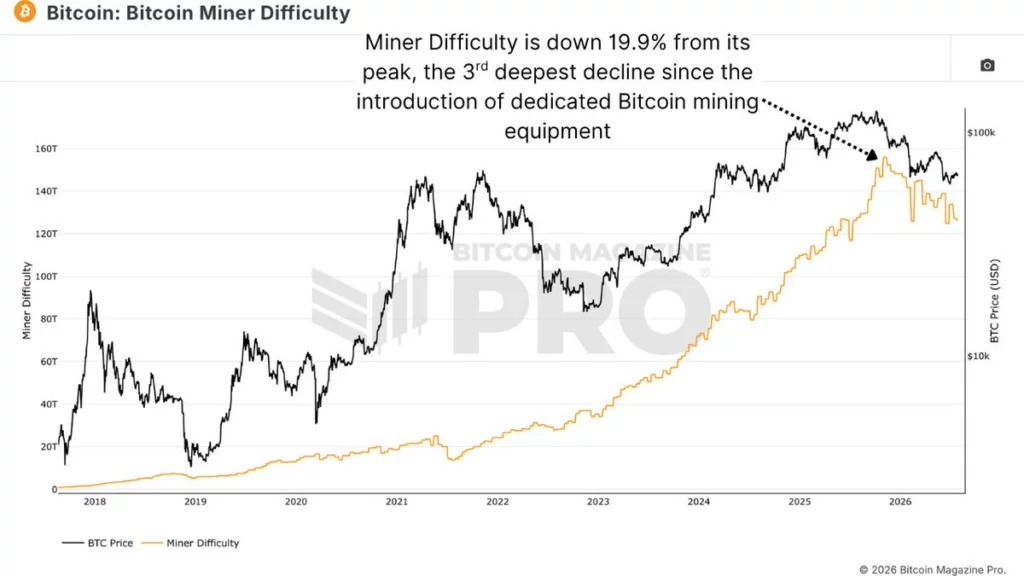
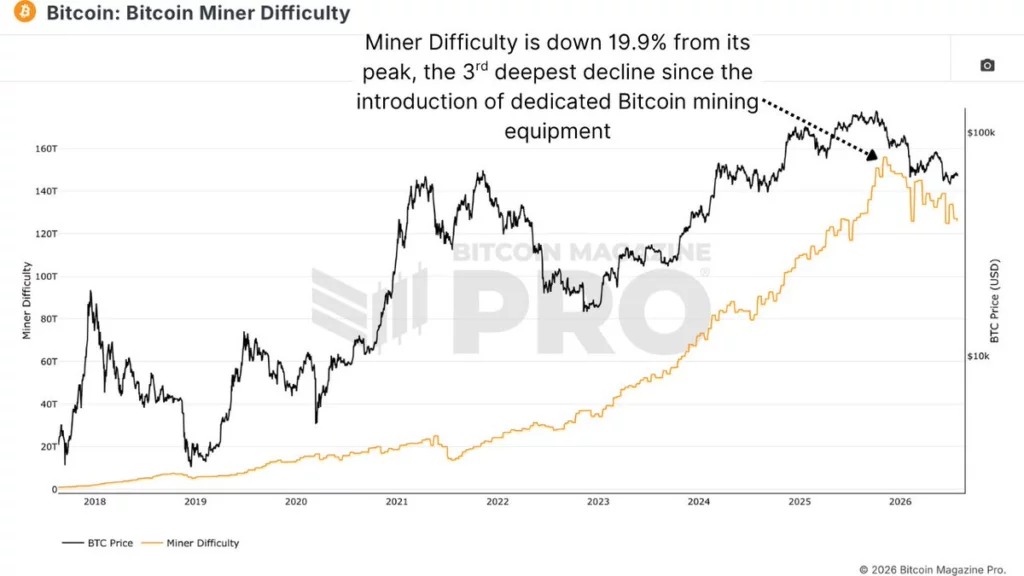
According to Bitcoin Magazine Pro, Bitcoin mining difficulty has dropped 19.9% from its peak, marking the third deepest drawdown since the ASIC era. Public on-chain data also shows that after the difficulty adjustment on July 25th, the current level is approximately 19% lower than the record set in November 2025.
In terms of hashrate, the 7-day average dropped to approximately 868 EH/s at the end of July, lower than the high of over 1 ZH/s at the end of 2025. The 30-day average given by Hashrate Index is approximately 940 EH/s, also about 12% lower than the record in December last year. Different platforms use different statistical windows, but the direction is consistent, indicating that the exit of mining rigs is still occurring.
Luxor's Hashrate Index also noted that Bitcoin's difficulty has turned negative on an annualized basis, marking only the second time this has happened in history. The last time was after China cracked down on mining in 2021, and this time it was not triggered by a single policy.
Declining incomes drive miners to exit the market.
The current pressures mainly stem from several factors: the price of Bitcoin has fallen by approximately 47% compared to 12 months ago, block subsidies remain at only 3.125 BTC per block, and transaction fee revenue continues to be low. Hashprice, a metric that measures daily revenue per unit of computing power, was approximately $32 per PH/s per day at the end of July.
This level is not friendly to older mining rigs. If electricity prices are higher than about 5 cents per kilowatt-hour, some models will find it difficult to maintain positive cash flow. Previous reports have shown that listed mining companies sold more than 32,000 BTC in the first quarter of 2026, exceeding the total for the entire year of 2025, mainly for debt repayment, operating costs, and data center construction.
Transaction fees have also failed to provide a sufficient buffer. Statistics show that in the week ending July 13, miners received approximately 20 BTC in transaction fees, averaging only 2.86 BTC per day, even lower than the subsidy of 3.125 BTC per block. This means that transaction fees are currently far from sufficient to replace the revenue generated by new block issuance.
AI contracts are changing the valuation logic of mining companies.
Mining stocks have historically been viewed as a highly elastic mirror of Bitcoin prices, but this relationship is weakening. This is because some mining companies are being repriced by the market as power, data center, and AI infrastructure companies, rather than simply Bitcoin producers.
Hut 8 is a prime example. On July 20, the company signed a second 15-year lease for its Beacon Point, Texas campus, covering 352 megawatts of capacity, bringing the campus's base contract value to $19.6 billion and the company's total contracted AI portfolio to $26.6 billion. The second phase is expected to be delivered in the second quarter of 2028.
Core Scientific also disclosed an expanded collaboration with AMD on July 28. The company stated that the 15-year agreement covers approximately 530 megawatts, corresponding to potential base contract revenue exceeding $14 billion; its leased customer capacity reaches approximately 1.1 gigawatts, corresponding to potential contract revenue exceeding $24 billion. TeraWulf reported that its first-quarter AI and high-performance computing leasing revenue reached $21 million, exceeding its Bitcoin mining revenue for the first time.
This explains why a decline in computing power can coexist with a rise in mining stocks. For some operators, after shutting down inefficient mining rigs, power access, land, and data center resources can still be redirected to higher-value AI workloads.
Structural changes are taking shape
However, the announced contract amounts do not equate to confirmed revenue. Many projects still require years of construction, external financing, and customer deployment; delays, rising costs, or a slowdown in AI demand could impact valuations.
More importantly, this contraction differs from previous cycles. Some power contracts and data center resources are entering 15- or even 20-year AI leases, meaning their likelihood of returning to Bitcoin mining in the future is decreasing. Luxor calls this trend a structural shift, not just a cyclical downturn.
In the short term, the Bitcoin network is still supported by hundreds of EH/s of computing power, and there is no immediate security crisis. The difficulty adjustment mechanism will also improve the profitability of miners remaining in the network after mining machines are phased out. However, in the longer term, as future halvings continue to reduce subsidies, the mining industry will become more reliant on rising coin prices, increased transaction fees, and improved equipment efficiency, or may accept a lower but sustainable level of network computing power.