

Bitcoin has recently entered one of its calmest trading phases this year, with prices hovering roughly between $62,000 and $65,000. As intraday volatility continues to narrow, short-term trading opportunities are decreasing, and market activity has noticeably slowed.
Volatility returns to January lows
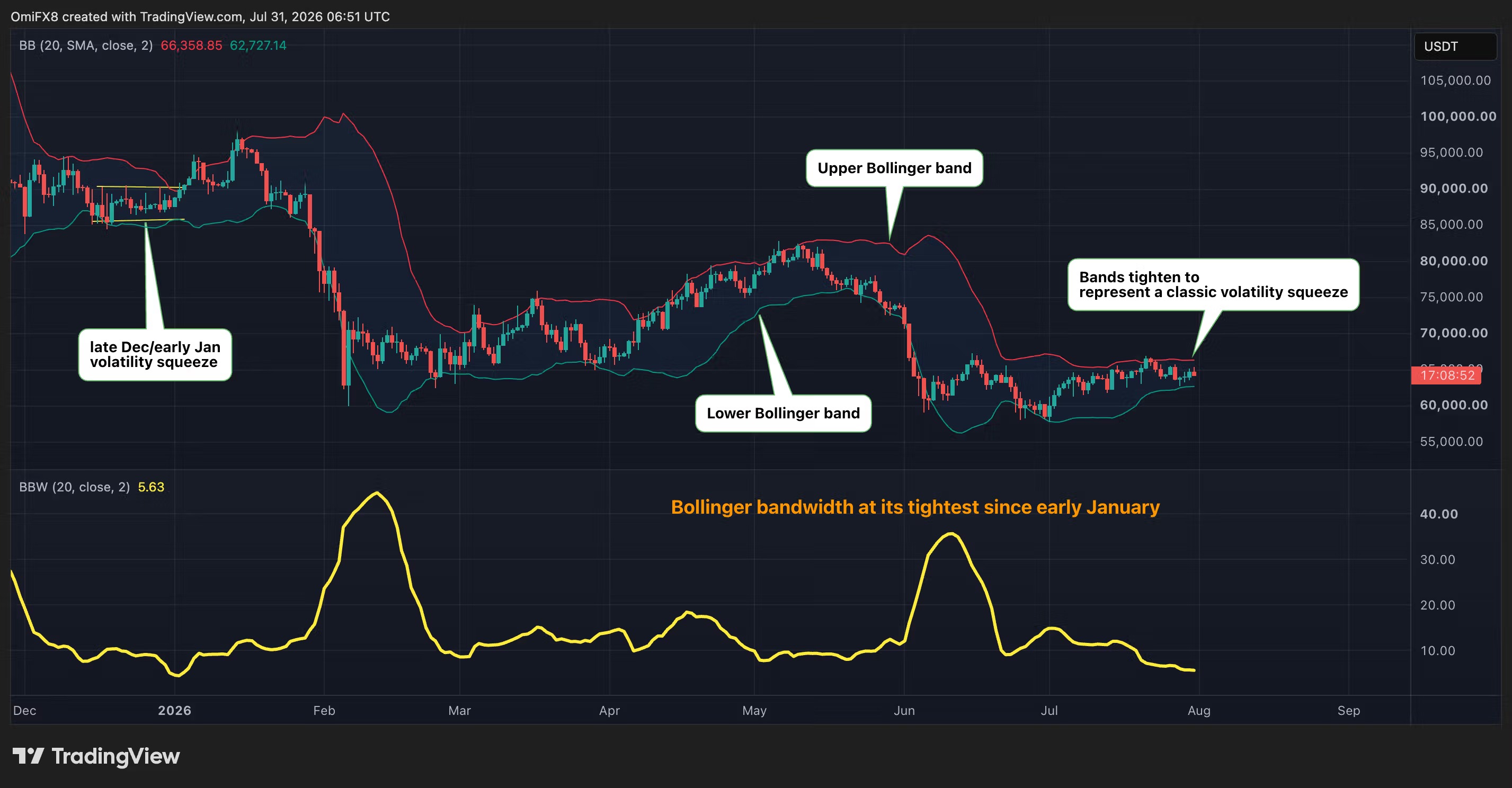
CoinDesk, citing chart data, reports that Bitcoin's daily Bollinger Band width has narrowed to its lowest level since the beginning of the year, reflecting a significant compression of price fluctuations. For traders who rely on trend-following strategies, this means that the trading space is shrinking.
The article mentions that the current Bollinger Band width indicator has dropped to 5.66. Typically, in this situation, momentum trading weakens, and range trading can only capture smaller price fluctuations.
Trading volume declined in tandem
Data from research firm K33 shows that Bitcoin's average daily trading volume this month is approximately $2.2 billion, lower than the $5.1 billion in January of this year, and may also be the lowest level since November 2023. The simultaneous occurrence of sideways price action and low trading volume indicates a growing wait-and-see attitude in the market.
In January of this year, Bitcoin also remained within a narrow range for an extended period. In the following weeks, market volatility increased again, with the price rising to nearly $98,000 before falling back to around $60,000 in early February, accompanied by a rebound in trading volume.
Historically, it has often been a case of stillness preceding movement.
The article argues that Bitcoin has exhibited a similar pattern multiple times since 2018: a period of low volatility followed by a more pronounced directional trend. The current market entry into a compression phase suggests that this period of calm may not last long.

However, low volatility usually only indicates that a major market move may be approaching, not that a direction is certain. If the consolidation period continues to lengthen, the subsequent breakout could be larger, but whether it will rise or fall still needs to be confirmed by the market itself.